 Birch Bay Siding
 Birch Bay Village Sits in One of Whatcom County's Toughest Exposure Zones
Homes in Birch Bay Village face a combination of weather stresses that most inland Whatcom County neighborhoods simply don't deal with. The water brings salt-laden air that settles on every exterior surface, wind-driven rain that gets pushed sideways into wall assemblies rather than just falling straight down, and a moss season that runs long and wet for much of the year. Any one of these on its own is manageable. Together, they shorten the useful life of siding that isn't matched to the environment, and they punish installation shortcuts that would go unnoticed somewhere drier.
This page is about one thing: getting siding installation right on a Birch Bay Village home. Not a general overview of siding — the specific job of installing it correctly on a house that sits close to open water, in a Pacific Northwest coastal microclimate that is wetter and saltier than the regional average.
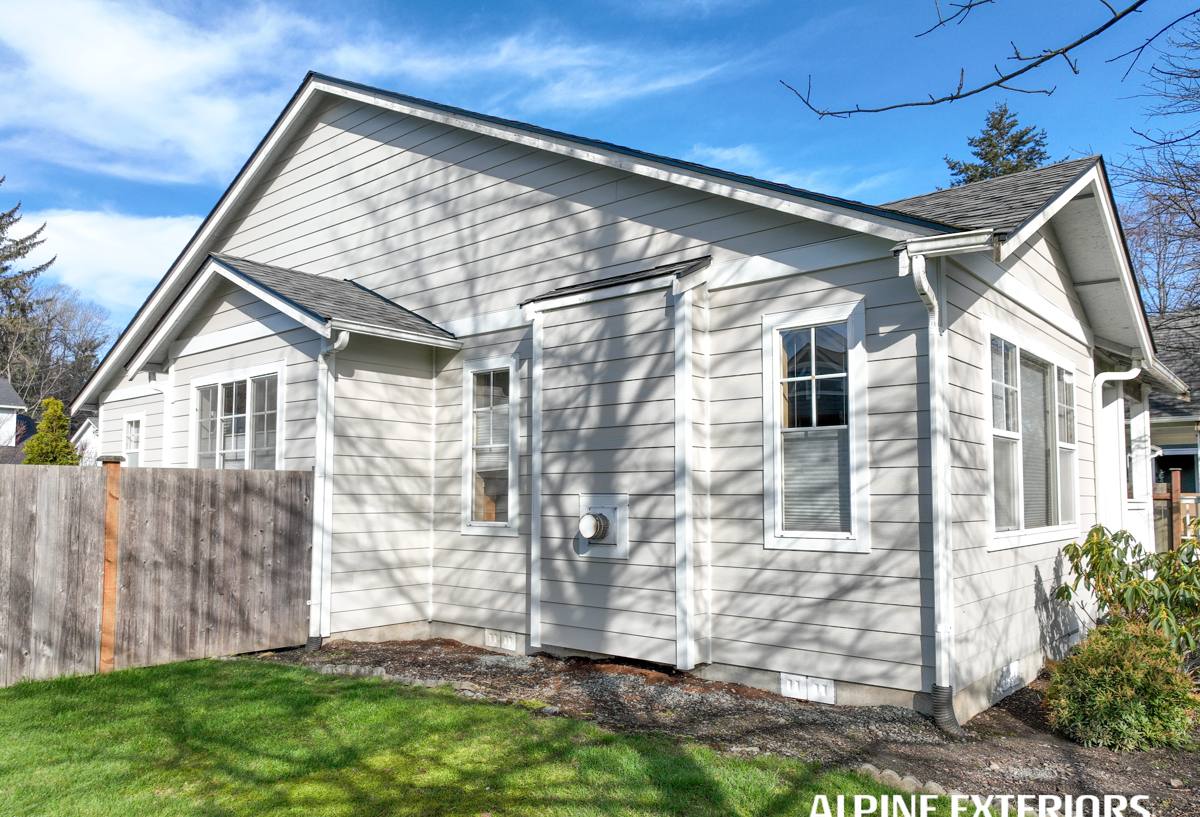
What Salt Air, Driving Rain, and Moss Actually Do to Siding
Salt air
Airborne salt is corrosive to metal fasteners, flashing, and trim connectors. When the wrong fastener type is used, or when fasteners are left exposed instead of properly capped and sealed, corrosion starts early and shows up as rust streaking, loosened boards, and eventually failure points where water gets behind the siding.
Driving rain
Wind off the water doesn't just wet the surface of a wall — it drives moisture up and under laps, into joints, and behind trim that isn't flashed correctly. A siding system that relies on caulk alone, without a proper drainage plane and flashing sequence behind it, will eventually let water in no matter how good the surface material is.
Moss and prolonged dampness
Whatcom County's wet season gives moss and algae months of standing moisture to work with. Moss holds water against the siding surface long after a storm has passed, which is hard on any material that can absorb moisture or swell, and it's especially hard on painted finishes that weren't built to resist mildew and staining in the first place.
Why We Don't Install Vinyl, LP SmartSide, Cedar, or Primed Spruce Here
We get asked this often enough that it's worth explaining plainly. These are honest trade-offs, not attacks on any manufacturer.
- Vinyl siding is affordable and low-maintenance in mild conditions, but it's a thin plastic product that expands and contracts with temperature swings, and its seams and J-channels are a common entry point for wind-driven rain once caulking ages. In a driving-rain exposure like Birch Bay Village, that's a real liability over the life of the siding.
- LP SmartSide and primed spruce are engineered and solid wood products. They perform fine in drier climates, but they are wood-based, meaning they can swell, delaminate at cut edges, or take on moisture damage if the factory coating or field-applied paint isn't maintained on a strict schedule — a hard ask in a long, wet moss season.
- Cedar siding has real appeal and a long track record, but it requires ongoing sealing or staining to resist moisture and to resist the moss and mildew that thrive in constant dampness. Skipped maintenance shows up fast on a waterfront-adjacent home.
None of these products are "bad." They're just not what we're willing to put our name behind in a salt-air, high-moisture coastal exposure. We install James Hardie fiber cement siding exclusively, because it's non-combustible, doesn't rot or delaminate, and comes factory-finished rather than relying on field-applied coatings that degrade under this kind of exposure.
What James Hardie Brings to a Birch Bay Village Home
James Hardie fiber cement is cement, sand, and cellulose fiber — there's no wood fiber to swell, rot, or feed moss the way organic materials can. The ColorPlus factory finish is baked on under controlled conditions, which gives it more consistent fade and moisture resistance than field-applied paint, and it comes backed by a substantial transferable warranty on both the material and the finish. James Hardie also engineers its ColorPlus lines in different formulations for different climate zones, including versions built for damp, moisture-heavy regions like coastal Whatcom County — which matters more here than in a drier inland market.
None of that replaces correct installation, though. Fiber cement siding installed without proper flashing, clearances, and fastening will still let water into a wall assembly. The product is only half the equation.
What a Correct Installation Actually Involves
This is where most siding failures we get called out to inspect actually start — not with the material, but with shortcuts taken during installation. On a Birch Bay Village home, we treat each of these as non-negotiable:
- A continuous weather-resistive barrier behind the siding, lapped correctly so water sheds outward and down, never inward
- Flashing at every window, door, and wall penetration — not just caulk standing in for flashing
- Corrosion-resistant fasteners suited to a salt-air environment, driven to manufacturer spec, not overdriven or underdriven
- Correct clearances from grade, roof lines, and decks so siding isn't sitting in standing water or splash-back
- Properly sealed joints and trim connections, using sealants rated for exterior exposure and movement
- Rain-screen or drainage gap detailing where the wall assembly calls for it, so incidental moisture can drain and dry instead of getting trapped
Skip any one of these and the siding may look fine for a few years before problems surface behind the wall, where they're expensive to find and fix.
Our Siding Installation Process for Birch Bay Village Homes
- On-site assessment — we look at existing siding condition, moisture damage, sheathing condition, and the home's specific exposure to wind and water
- Tear-off and sheathing inspection — old siding comes off and we inspect the sheathing underneath for rot or damage before anything new goes up
- Weather-resistive barrier installation — installed and lapped per manufacturer and code requirements
- Flashing at all openings and penetrations — windows, doors, vents, and anywhere else water can find a path in
- James Hardie fiber cement installation — installed to manufacturer specification for fastening pattern, clearances, and joint treatment
- Trim, caulking, and finish detailing — using materials rated for coastal, high-moisture exposure
- Final walkthrough — checking clearances, seams, and fastening before we consider the job done
How Siding Materials Compare Under Birch Bay Village Conditions
| Material | Salt-Air Corrosion Resistance | Rot/Moisture Resistance | Moss & Algae Resistance | Maintenance Burden |
|---|---|---|---|---|
| Vinyl | Good on the panel, weak at seams/fasteners over time | Doesn't rot, but seams can let water behind it | Surface growth possible; doesn't affect the material itself | Low, but seam failures aren't repairable — only replaceable |
| LP SmartSide / Primed Spruce | Fasteners need care; coating protects the wood substrate | Wood-based — vulnerable if coating fails | Can stain and hold moisture if coating wears thin | Regular repainting/recoating schedule required |
| Cedar | Fasteners need care; wood itself doesn't corrode | Requires sealing/staining to resist rot | Prone to moss and mildew without upkeep | Highest — ongoing sealing/staining needed |
| James Hardie Fiber Cement | Fasteners specified for exposure; panel itself doesn't corrode | Cement-based, doesn't rot or delaminate | Factory finish resists moisture and staining | Low — occasional washing, no recoating cycle |
What Drives Installation Cost on a Birch Bay Village Home
| Factor | Why It Matters |
|---|---|
| Condition of existing siding and sheathing | Moisture damage found during tear-off may require sheathing repair before new siding goes on |
| Home size and number of stories | More surface area and height affects labor, material quantity, and access equipment |
| Trim and architectural detail complexity | Multiple gables, dormers, and window trim take more time to flash and finish correctly |
| Site access | Tight lots or waterfront-adjacent access can affect staging and equipment options |
| Product line and color selection | James Hardie panel, plank, and shingle lines vary in material cost and installation time |
We walk every property before quoting so the number reflects the actual home, not a generic estimate.
Signs Your Current Siding Is Already Losing to the Exposure
- Soft or spongy spots when you press on the siding, especially near the bottom courses
- Persistent moss or dark staining that keeps coming back after cleaning
- Peeling, bubbling, or chalking paint on wood-based siding
- Rust streaks running down from fasteners or trim connectors
- Visible gaps opening at seams, corners, or trim joints
- Warping or buckling panels, particularly on sun- and wind-exposed walls
Any of these on a Birch Bay Village home is worth a professional look before the damage spreads to the sheathing and framing behind it.
Why a Crew That Already Works Birch Bay Village Matters
Siding installation isn't identical everywhere in Whatcom County. A crew that already works this specific coastline knows to spec fasteners and flashing for salt exposure without being told, knows how to sequence a tear-off around driving-rain weather windows, and isn't guessing at how a wall assembly here behaves over a wet winter. That familiarity shows up in fewer callbacks and a siding job that's still doing its job in twenty years, not just twenty months.
If you're weighing a siding replacement or new installation on a Birch Bay Village home, we're happy to take a look and put together a free, no-pressure estimate — just fill out the form below.