 Birch Bay Siding
 Two Different Materials, Two Different Bets on the Weather
If you're re-siding a home in Birch Bay, chances are you've come across both James Hardie fiber cement and LP SmartSide in your research. Both are marketed as upgrades over vinyl. Both are engineered products with real engineering behind them. But they are built from fundamentally different raw materials, and that difference matters more here than it does in a lot of the country.
Birch Bay sits right on the water, which means salt-laden air moving across every exterior surface, long stretches of driving rain off the Strait, and a moss and algae season that can run most of the year in shaded, north-facing exposures. Any siding material you choose is going to be tested by that combination, year after year. We install James Hardie exclusively, and this page walks through why, using LP SmartSide as the comparison point — fairly, and without the marketing spin either brand puts out.
What LP SmartSide Actually Is
LP SmartSide is an engineered wood product. It starts as strand wood — similar in concept to OSB — that's treated with LP's proprietary SmartGuard process, which includes zinc borate and a resin binder, then pressed and factory-primed. It comes in lap siding, panels, and trim, and it's a legitimate step up from raw untreated wood siding.
Its selling points are real: it's lighter than fiber cement, easier to cut and nail without specialized blades, holds a fastener well, and resists impact reasonably. Installed crews often move faster on it than on fiber cement, and the material cost is typically lower. For a lot of climates, it performs fine for its warranty term.
Where the wood origin shows up
The catch is what it's made of. Strand wood, even treated and resin-bound, is still an organic, cellulose-based material. Its entire long-term performance case rests on the factory treatment and the paint film staying intact and unbroken at every cut edge, fastener penetration, and joint. Where that seal is compromised — a missed caulk joint, a field cut left unsealed, a corner where water sits — moisture can reach the wood fiber underneath, and that's when swelling, delamination, and rot become a risk instead of a hypothetical.
What James Hardie Is
James Hardie fiber cement is a mix of Portland cement, sand, and cellulose fibers, cured under pressure and heat. There's no organic wood strand at the core — the cellulose fibers are a small reinforcing component in an otherwise mineral-based material. That's the core distinction between the two products, and it's the reason we standardized on it.
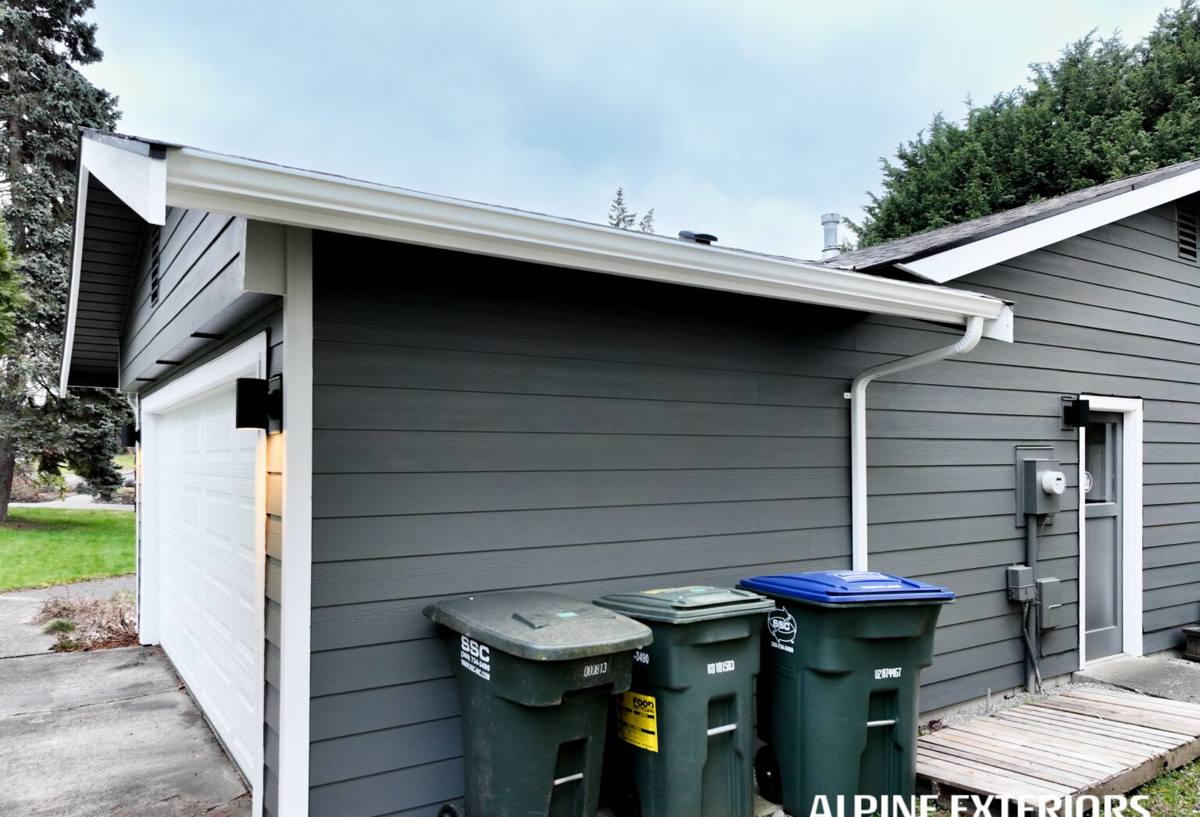
Hardie sells its lines by climate zone, and the Pacific Northwest falls under their HZ5 engineering — formulated specifically for high-moisture, high-humidity coastal conditions like ours. The lap siding, panel, and trim products used here are built around resisting the freeze-thaw, moisture-cycling, and moss-prone conditions Whatcom County actually produces, not a generic national spec.
ColorPlus factory finish
Most Hardie installs we do use ColorPlus Technology — a baked-on, multi-coat color finish applied at the factory under controlled conditions, rather than field-painted after installation. It carries its own 15-year finish warranty against fading and peeling, on top of the substrate warranty. A factory finish cures more evenly and consistently than anything applied on a job site with a brush or sprayer, which matters when the finish is your main defense layer against sun, salt, and rain.
Fire Performance
This is one of the clearest technical differences between the two products. James Hardie fiber cement is non-combustible — it doesn't contribute fuel to a fire. LP SmartSide is a treated engineered wood product; it carries a Class B fire rating in most configurations, which is a meaningful improvement over untreated wood siding, but it is still a wood-based material at its core, not a non-combustible one.
For most homeowners in Birch Bay this isn't a wildfire-zone concern the way it is east of the Cascades, but insurance underwriting and personal risk tolerance both factor material composition into the equation, and it's worth knowing the actual distinction rather than assuming both products behave the same way.
How the Two Hold Up Side by Side
| Factor | James Hardie Fiber Cement | LP SmartSide |
|---|---|---|
| Core material | Cement, sand, cellulose fiber | Engineered wood strand with resin binder |
| Combustibility | Non-combustible | Class B rated, wood-based |
| Moisture behavior | Does not swell or rot; stable when sealed correctly | Can swell, delaminate, or decay if the treated shell is breached |
| Finish | Factory-baked ColorPlus, or primed for field paint | Factory-primed, typically field-painted or pre-finished |
| Weight / install pace | Heavier, requires fiber-cement blades and technique | Lighter, faster to cut and hang |
| Typical warranty | 30-year limited, transferable (product); 15-year on ColorPlus finish | 5-year, 50-year limited (varies by product line and treatment against damage from fungal decay) |
| Material cost | Higher | Lower |
Warranty terms and coverage details shift periodically for both manufacturers, so treat the numbers above as a general reference point and confirm current terms directly against the manufacturer's published warranty before making a final decision.
Why Our Climate Changes the Calculation
A lot of siding comparisons read the same whether you're in Spokane or Birch Bay, because most of the country doesn't deal with the specific combination we get here.
Salt air
Proximity to the water means airborne salt settles on every exterior surface, accelerating wear on fasteners, finishes, and any exposed seam. A mineral-based material handles that exposure differently than an organic one — it's not being fed by the salt-laden moisture the way wood fiber can be.
Driving rain
Wind-driven rain off the Strait doesn't just wet a wall, it drives moisture up under laps and into any gap in caulking or flashing. That's exactly the scenario where a sealed-edge engineered wood product depends entirely on the installer having sealed every cut and joint correctly, with zero tolerance for a missed spot.
Moss and algae season
Shaded, north-facing walls in this area can stay damp for extended stretches, which is prime territory for moss and algae growth. Surface growth on any siding material is a cosmetic and maintenance issue, but on an organic substrate, prolonged surface moisture sitting against the material is a different risk profile than the same moisture sitting against cured cement.
Installation Sensitivity — True of Both, But the Stakes Differ
We want to be fair here: LP SmartSide installed correctly, by a crew that seals every cut edge, follows the nailing schedule, and flashes properly, can perform well through its warranty period. Poor installation is the root cause of most siding failures, regardless of brand. That's true of Hardie too — fiber cement installed with the wrong fasteners, insufficient clearance, or unsealed joints will underperform its own engineering.
The difference is what happens when installation isn't perfect, which in the real world it sometimes isn't. A sealing gap on fiber cement is a maintenance item. A sealing gap on an organic substrate, sitting under years of Birch Bay rain and salt air, has a materially different failure path. We'd rather build in that margin for our clients from the start.
What We Actually Install, and Why
We install James Hardie exclusively. Not because LP SmartSide is a bad product — it isn't, and plenty of homes around the region wear it without issue — but because we'd rather stand behind one material system we can install to spec every time, in a climate zone Hardie specifically engineers for, backed by a factory finish and a transferable warranty we trust to hold up over decades near saltwater. That's a standard we set for our own work, not a claim about anyone else's.
A Practical Checklist If You're Comparing Options
- Ask what climate zone the product is engineered for, and whether that matches Whatcom County's coastal conditions
- Get the actual warranty document, not just the marketing summary — read what voids it
- Ask whether the finish is factory-applied or field-applied, and what the finish-specific warranty covers
- Ask your contractor how they seal cut edges, corners, and butt joints — this is where failures start on any engineered material
- Check whether the product carries a non-combustible or fire-resistance rating if that matters to your insurer
- Get a written maintenance expectation — painting cycle, caulk inspection interval, moss treatment — for whichever product you choose
Talk to Us Before You Decide
You don't have to take our word for any of this — ask questions, compare warranty documents, and make the call that fits your home and your budget. If you'd like a straight assessment of your siding, current condition, and what a James Hardie install would look like on your specific house, we're happy to come out, take a look, and put together a free, no-pressure estimate.