 Birch Bay Siding
 Custer's Climate Is Harder on Siding Than Most Homeowners Realize
Custer sits inland from Birch Bay along the Whatcom County coastline, close enough to Georgia Strait and Semiahmoo Bay that salt-laden air reaches homes well beyond the immediate waterfront. Add in Whatcom County's long, wet winters, wind-driven rain off the water, and the shaded, moisture-holding tree cover common on rural and semi-rural Custer lots, and you get a climate that is genuinely tough on exterior building materials. It's not dramatic weather in the sense of hurricanes or hail — it's persistent, year-round moisture exposure that slowly finds every weak point in a home's exterior.
Homeowners who move to Custer from drier parts of the country are often surprised by how quickly siding, trim, and paint show wear here compared to where they came from. It's not that the materials were bad — it's that they weren't matched to this specific climate. That mismatch is the single biggest driver of premature siding failure we see on service calls in this area.
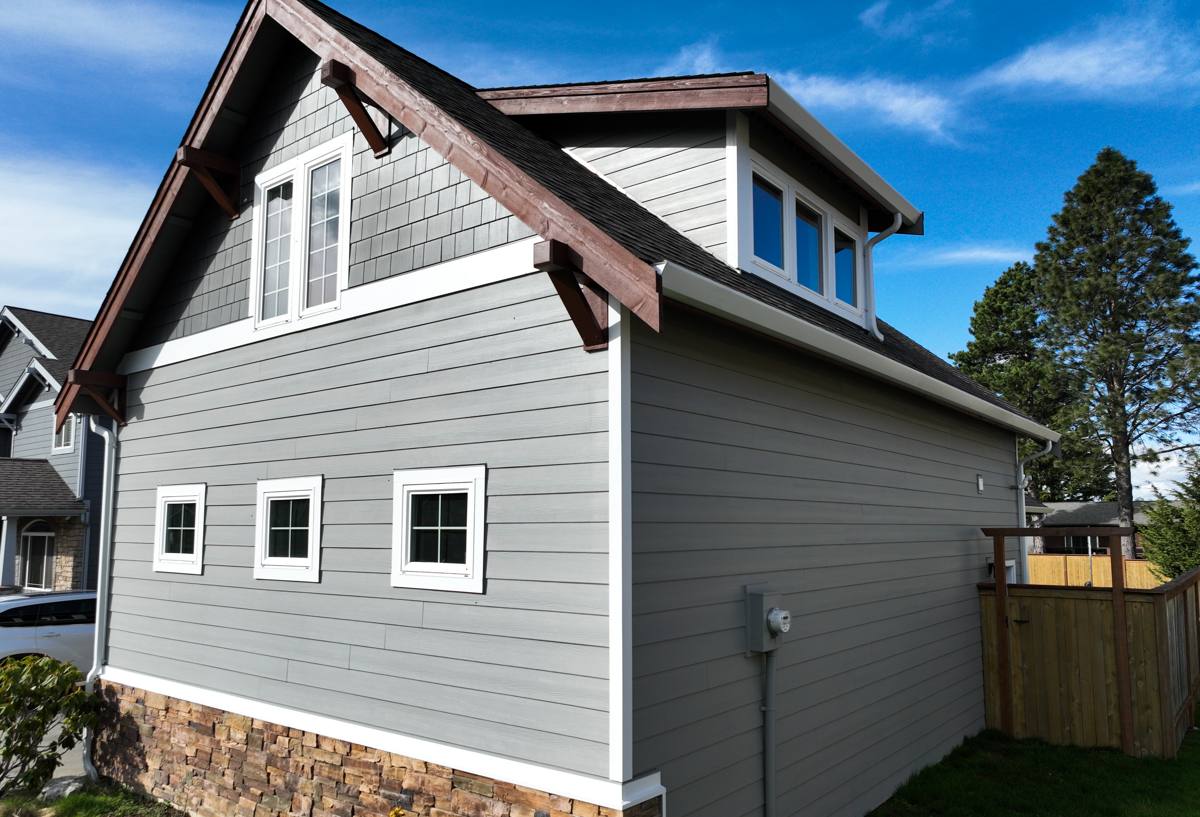
What Custer Homes Actually Face
Salt Air and Corrosion
Even a few miles inland from Birch Bay, prevailing winds carry fine salt particulate onto exterior surfaces. Over years, this accelerates the breakdown of certain paints and finishes, and it's harder on unprotected metal fasteners, trim, and flashing than most people expect. Materials and hardware chosen without coastal exposure in mind tend to show it first at seams, fastener heads, and lower courses near grade.
Driving Rain
Whatcom County doesn't just get a lot of rain — a meaningful share of it arrives sideways, pushed by wind off the water. That matters more than total rainfall totals suggest, because wind-driven rain gets forced into laps, seams, and butt joints that would stay dry in a calmer climate. Siding systems and installation details that work fine in a low-wind region can underperform here if they weren't built and installed with that in mind.
The Long Moss and Algae Season
Shaded exposures, damp air, and mild temperatures give moss and algae an unusually long growing season in this part of Whatcom County — often most of the year on north-facing walls or areas shaded by trees and fences. Moss doesn't just look bad; it holds moisture directly against the siding surface, which is exactly the condition that causes rot in wood-based products and accelerates deterioration in lower-quality composites.
Freeze-Thaw Cycling
Custer doesn't see extreme cold, but it does get enough freeze-thaw cycling in winter that any siding material already holding moisture is at risk of cracking, swelling, or delaminating when that trapped water expands. This is a secondary effect of the moisture problems above, not a standalone issue — but it compounds them.
Why We Only Install James Hardie Fiber Cement Siding
Birch Bay Siding Company made a deliberate decision to install exclusively James Hardie fiber cement siding — not vinyl, not LP SmartSide, not cedar or primed spruce, not other fiber cement brands. That's not a marketing position; it's a response to what we've seen hold up in this exact climate versus what struggles.
Fiber cement as a category resists the two things that do the most damage here: sustained moisture and organic growth. James Hardie's HZ5 product line is specifically engineered for climate zones like ours, with a formulation built to handle freeze-thaw cycling and moisture exposure better than the standard HZ10 line sold in milder regions. The factory-applied ColorPlus finish is baked on under controlled conditions and backed by a substantial finish warranty — a meaningful advantage over field-applied paint, which is the first thing to fail under UV, salt air, and repeated wetting.
We're not going to tell you every alternative product is worthless — vinyl, engineered wood, and other fiber cement brands all have legitimate uses and can perform reasonably well in the right setting. Our position is narrower: for the specific combination of salt air, driving rain, and moss exposure that Custer homes deal with, we've settled on Hardie as the product we're willing to put our name behind and warranty.
How the Common Alternatives Compare in This Climate
| Material | Moisture Behavior | Salt Air / Coastal Fit | Finish Durability |
|---|---|---|---|
| James Hardie fiber cement | Non-combustible, dimensionally stable, engineered HZ5 line for this climate zone | Strong — cement composition doesn't rot or corrode | Factory ColorPlus finish, long warranty on color and film integrity |
| Vinyl siding | Doesn't absorb water, but can warp or buckle with heat and doesn't stop moisture reaching the wall behind it | Holds up reasonably, but seams and fasteners are a weak point over time | Color molded through material but fades with UV; can't be repainted easily |
| LP SmartSide / engineered wood | Wood-based core is vulnerable if the factory seal is compromised at cuts or fastener points | Moderate — performance depends heavily on installation detail and maintenance | Factory-primed, needs field paint upkeep over time |
| Cedar / primed spruce | Natural wood — absorbs moisture, prone to rot and moss growth without diligent upkeep | Weakest of this group in sustained salt and moisture exposure | Requires regular repainting or staining, highest long-term maintenance |
What Correct Installation Looks Like Here
Fiber cement's real-world performance depends heavily on installation quality — this is true of any siding product, but it matters more in a climate that punishes shortcuts. On a Custer job, our crew pays particular attention to a few details that are easy to skip and expensive to get wrong:
- Proper rainscreen or drainage gap behind the siding so incidental moisture can escape instead of sitting against the wall assembly
- Correct flashing at every window, door, and roofline transition, sequenced so water sheds outward at every layer
- Manufacturer-specified fastener placement and type, chosen for coastal exposure rather than generic hardware
- Proper joint and butt seam treatment, including factory-primed cut edges, to prevent the moisture entry points that cause failures years down the road
- Correct clearance from grade, decks, and roof lines so splashback and standing water don't sit against the bottom courses
None of this is unique or secret — it's simply what the manufacturer's installation spec calls for. But in our experience, it's exactly the detail work that gets rushed on lower-bid jobs, and it's the reason two houses with the same siding brand can perform very differently ten years later.
Siding Is Rarely the Whole Story
Because we handle siding, roofing, windows, and decks, a Custer estimate often turns into a broader conversation about the whole exterior envelope rather than just the wall covering. Siding failure is frequently a symptom of a problem somewhere else — a roof edge shedding water onto a wall it shouldn't, window flashing that was never properly integrated with the siding, or a deck ledger trapping moisture against the house. Addressing siding in isolation without checking these connection points is a common reason repairs don't hold.
When we evaluate a home in this area, we're looking at how water moves across the whole exterior — roofline to wall to window to grade — not just whether the siding itself looks worn.
What Drives Cost on a Custer Siding Project
| Factor | Why It Matters |
|---|---|
| Home size and wall area | Larger or more complex facades require more material and labor hours |
| Story height and access | Two-story and steep-lot homes need more scaffolding and safety setup, which affects labor time |
| Existing siding removal | Tear-off of old wood, vinyl, or damaged material adds labor beyond a straightforward install |
| Moisture or rot repair | Any sheathing or framing damage found during tear-off needs to be repaired before new siding goes on |
| Trim and detail complexity | Homes with more windows, dormers, or architectural trim take more time to flash and finish correctly |
| Product line and profile | Hardie's plank, shingle, and panel profiles vary in material cost and installation time |
We won't quote a number without seeing the home, but these are the honest variables that move a project's price up or down, and we'll walk through each one with you during an estimate.
Maintaining Hardie Siding in a Custer Climate
Fiber cement is low-maintenance compared to wood or vinyl, but "low-maintenance" doesn't mean zero-maintenance, especially with this much moss and moisture exposure. A simple seasonal routine goes a long way:
- Rinse siding annually, focusing on shaded, north-facing, and tree-covered walls where moss and algae take hold first
- Keep gutters clear so overflow doesn't run directly down wall surfaces
- Trim back vegetation and tree limbs that keep siding damp and shaded longer than necessary
- Inspect caulking at trim, window, and door joints every year or two and re-caulk where it's cracked or pulled away
- Watch for any soft spots, staining, or discoloration near grade, decks, or roof transitions — early signs of a moisture path worth investigating
Homeowners who stay on top of this short list generally get the full service life out of their siding investment; the ones who don't are usually the ones calling us about problems that started small.
Why a Local Crew Matters in Custer
A crew that works this specific stretch of Whatcom County day in and day out understands things that don't show up in a manufacturer's install manual — which exposures in this area take the worst weathering, how local wind patterns drive rain against particular wall orientations, and where moss tends to establish itself fastest on homes near the water versus further inland. That local pattern recognition shapes real decisions on the job: where we pay extra attention to flashing, which walls need a closer look at the drainage plane, and what maintenance advice actually applies to your specific lot rather than generic guidance that doesn't account for Custer's conditions.
It also means accountability. A local company with a physical presence in the community has every reason to install correctly the first time and stand behind the work — we're not driving in from out of the area for one job and disappearing.
Get a Straightforward Estimate
If your Custer home's siding is showing moss, staining, cracking, or general wear from this coastal climate, we're happy to take a look and give you an honest read on what's going on — no pressure, no inflated scare tactics. Use the form below to request a free estimate, and we'll walk the exterior with you and explain exactly what we see and what your options are.