 Birch Bay Siding
 Exterior Work in a Coastal Whatcom County Community
Semiahmoo and Birch Bay sit right up against saltwater, which puts homes here in a different category than siding jobs ten or fifteen miles inland. Wind comes off the water with salt in it, driving rain arrives sideways more often than straight down, and the growing season for moss and algae on a north-facing wall runs most of the year in this part of Whatcom County. We do exterior work up and down this stretch of coastline, and the pattern is consistent: homes exposed to the bay wear out their siding faster than homes tucked back from the water, and the type of siding matters more here than almost anywhere else we work.
This page covers what we see on siding replacement projects in the Semiahmoo and Birch Bay area, why we've standardized on one product for this climate, and what to expect from a local crew that works this coastline regularly rather than occasionally.
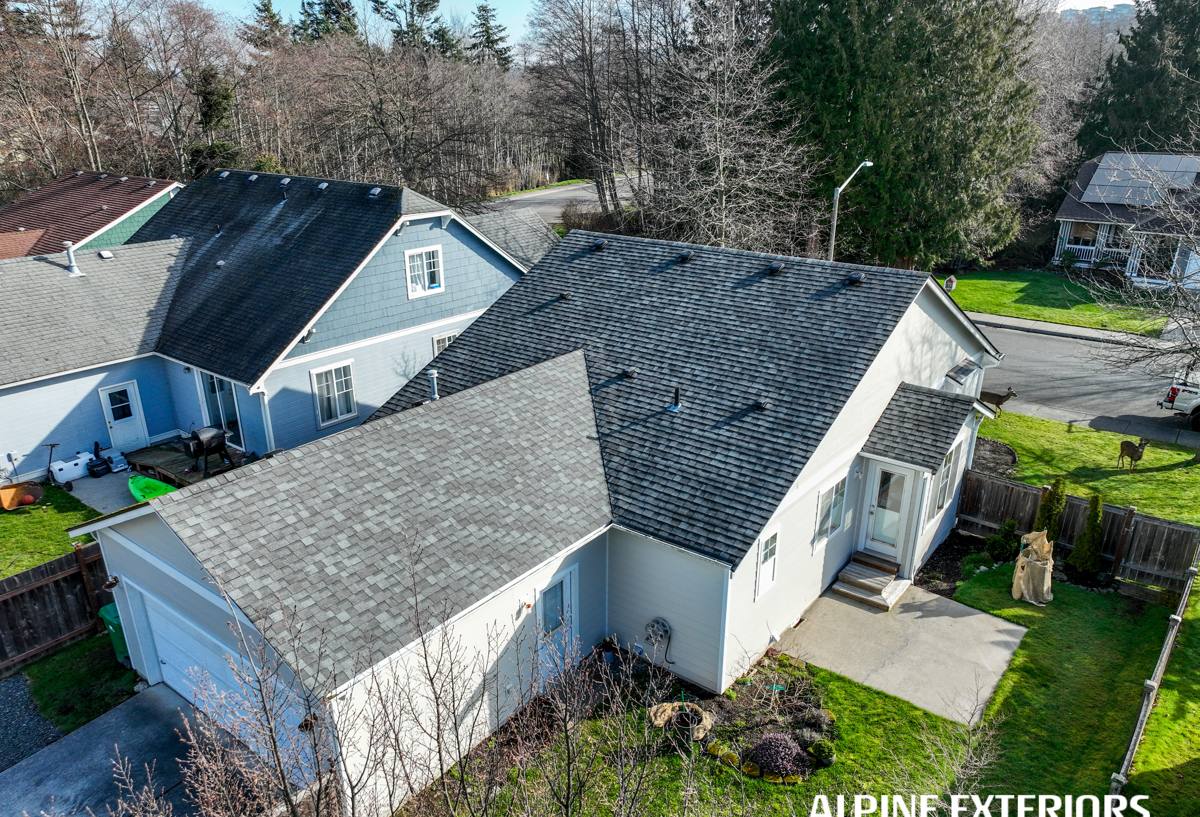
What Salt Air and Driving Rain Actually Do to a Wall
Salt air isn't just a smell — it's fine airborne salt that settles on every exterior surface and accelerates corrosion on fasteners, trim, and any metal components in a siding system. Combined with near-constant humidity and rain that gets pushed horizontally by wind off the water, siding on a Semiahmoo or Birch Bay home is under more sustained moisture and mineral load than siding a few miles inland.
The moss and algae factor
Whatcom County's long wet season means shaded and north-facing walls stay damp for extended stretches. That's exactly the environment moss, algae, and mildew need to establish themselves. On some siding materials, that growth is mostly cosmetic and comes off with a wash. On others, sustained moisture behind or under a green film leads to softening, swelling, or paint failure underneath.
Wind-driven rain and seams
Any siding system has seams, joints, and butt ends — the question is how that material behaves when those seams are wet more often than dry. Materials that swell, wick moisture, or take longer to dry out are working against themselves in a location like this. That's the core issue we weigh with every product we've considered installing here.
Why We Install Only James Hardie Fiber Cement
We get asked regularly why we don't offer vinyl, LP SmartSide, or the primed wood options some homeowners request. It's not that those products don't have a place somewhere — it's that after years of exterior work on this coastline, we don't think they hold up to Semiahmoo and Birch Bay conditions the way we're willing to put our name behind.
Vinyl siding is affordable and low-maintenance in mild, sheltered settings, but it's a petroleum-based product that becomes brittle in cold snaps and can warp or deform when exposed to sustained wind loads and temperature swings — both realities on an exposed waterfront lot. Engineered wood products like LP SmartSide perform well in many parts of the country, but they're wood-based, and wood-based siding depends heavily on an intact factory coating and correct field caulking to keep moisture out. On a property that stays damp for weeks at a stretch, any breach in that coating is an opening for the exact kind of swelling and edge failure that wood composites are known for.
James Hardie fiber cement is cement, sand, and cellulose fiber — it doesn't rot, it isn't food for mold or moss the way wood-based products can be, and it doesn't expand and contract with moisture the way engineered wood does. It's also non-combustible, which matters to insurers and to homeowners who've paid attention to wildfire risk trends in the Pacific Northwest. We install it because it's the product we've seen hold its line, its finish, and its warranty coverage in exactly the kind of marine exposure Semiahmoo and Birch Bay homes deal with.
The trade-offs, honestly
Fiber cement isn't the cheapest material up front, and it's heavier and less forgiving to install than vinyl — it requires a crew that knows proper fastening, clearances, and caulking details specific to Hardie's installation manual. Get those details wrong and even a good product underperforms. That's why installation quality matters as much as the product choice itself.
The Hardie Product Lines We Use Here
James Hardie engineers its siding in climate-specific formulations called HZ10 and HZ5. Coastal Washington falls into the HZ5 zone, engineered for wetter, more freeze-thaw-variable climates than the HZ10 formulation used in hot, dry regions. That distinction matters — it's part of why we don't treat "fiber cement" as a single generic product.
- HardiePlank lap siding — the most common choice for full replacements, available in several exposure widths and textures
- HardieShingle — for accent gables or a shingle-style look without the maintenance of actual cedar shingles
- HardiePanel — vertical panel siding, often used for board-and-batten style accents
- HardieTrim — matching trim boards so the whole exterior system is consistent, not mixed materials at the edges
All of it comes with ColorPlus Technology as an option — a factory-baked finish that's more consistent and more resistant to fading and chipping than field-applied paint, which also means fewer repaint cycles on a home that already deals with a lot of weather.
What a Siding Replacement Project Looks Like
Every project starts with a walkaround assessment of the existing siding and the wall assembly underneath it. On older Semiahmoo and Birch Bay homes, we're often finding out how much moisture has already gotten behind the old siding before we ever talk about the new material.
- On-site inspection of existing siding, trim, and any visible water damage or soft spots
- Removal of old siding and inspection of the sheathing and weather-resistive barrier underneath
- Repair or replacement of any compromised sheathing before new siding goes on
- Installation of a new weather barrier and proper flashing at windows, doors, and penetrations
- Hardie siding installation to manufacturer clearance and fastening specifications
- Trim, caulking, and final finish work
That second and third step — what's actually happening behind the old siding — is where a lot of the real story on a coastal property gets found. We don't skip it, and we don't guess at scope before we've seen what's underneath.
Comparing Common Siding Options for This Climate
| Material | Moisture behavior in coastal/marine exposure | Maintenance | Combustibility |
|---|---|---|---|
| James Hardie fiber cement | Does not rot, swell, or feed mold; stable in sustained damp conditions | Occasional wash; ColorPlus finish resists fading | Non-combustible |
| Vinyl | Doesn't absorb water but can warp/deform under wind and temperature swings | Low, but damage often means full panel replacement | Combustible, can melt/deform near heat sources |
| LP SmartSide / engineered wood | Wood-based; relies on intact coating and caulking to resist swelling and edge wear | Coating and caulk need regular inspection | Combustible |
| Cedar / primed wood | Natural material; prone to moisture absorption, rot, and moss growth without diligent upkeep | Highest — regular refinishing and moisture monitoring | Combustible |
Roofing, Windows, and Decks — the Same Coastal Logic
Siding is rarely the only thing wearing out on a waterfront home at the same rate. Roofing takes the same wind-driven rain and salt exposure, and moss on a roof is often a more urgent problem than moss on a wall because of what it does to shingle life and to gutters. Windows on an exposed elevation deal with wind-driven water intrusion at the frame and sill, and older single-pane or poorly flashed units are common failure points we find during siding tear-off. Decks facing the water take direct sun, salt, and rain with no wall to shield them, which shortens the life of untreated or poorly maintained wood decking.
We handle all four — siding, roofing, windows, and decks — because on a coastal property they're rarely independent problems. A window that's been leaking behind the trim for years is often part of why the sheathing under nearby siding is compromised, and a roof shedding granules onto a deck below tells you something about what's happening two stories up. Looking at the whole exterior at once, rather than one component in isolation, is how we catch that.
Choosing a Local Crew for a Semiahmoo or Birch Bay Property
A crew that mostly works inland, drier neighborhoods doesn't necessarily know how to detail flashing and clearances for a lot that takes wind-driven rain off open water most of the year. A few things worth asking any contractor bidding coastal exterior work:
- Do they have specific experience with waterfront or near-waterfront properties in Whatcom County, not just general siding experience
- Are they a certified James Hardie installer, and can they explain the HZ5 versus HZ10 distinction without prompting
- Do they inspect and address sheathing and moisture barrier condition before quoting a final price, rather than quoting off a driveway walkaround
- Do they carry proper licensing and insurance for exterior work in Washington
- Will they put manufacturer and workmanship warranty terms in writing before work starts
- Do they have a plan for flashing details at windows, doors, and roof-to-wall transitions specifically
What to Expect for Maintenance After Installation
Properly installed Hardie siding with a ColorPlus finish is genuinely low-maintenance, but "low" isn't "zero" on a property exposed to salt air and moss-friendly conditions most of the year. A rinse-down once or twice a year knocks back salt residue and early moss growth before it has a chance to establish. Keeping gutters clear and vegetation trimmed back from walls reduces the shaded, damp conditions moss prefers. Caulking at trim joints and penetrations is worth a visual check annually, since caulk is the one component in the system that does age faster than the siding itself.
If you're weighing a siding replacement on a Semiahmoo or Birch Bay property — or want a second opinion on what's really going on behind aging siding, trim, or roofing — we're glad to come take a look and give you a straightforward, no-pressure estimate using the form below.