 Birch Bay Siding
 Bellingham sits on the water in Whatcom County, close enough to Birch Bay and the Salish Sea that homes here deal with a version of coastal weather that's a little different from what you'd find further inland. Salt-laden air off Bellingham Bay, long stretches of driving rain through fall and winter, and shaded, moisture-holding lots that grow moss on anything that sits still too long — these aren't occasional problems, they're the baseline. We work throughout this area and build our approach around it.
What Bellingham's Climate Actually Does to a House
It's worth being specific about this, because "wet climate" undersells it. Three things stack up on Bellingham homes over time:
Salt Air and Moisture
Proximity to the bay means airborne salt settles on exterior surfaces, especially on homes with unobstructed exposure toward the water. Combined with near-constant humidity, that accelerates corrosion on fasteners, trim, and any siding product that isn't dimensionally stable when it takes on moisture.
Driving Rain
Whatcom County doesn't just get rain — it gets wind-driven rain that hits siding at an angle instead of falling straight down. That matters because it pushes water into laps, seams, and butt joints that would stay dry in a calmer climate. Flashing details and water-resistive barrier work behind the siding carry more of the load here than they would somewhere drier.
Moss and Shade
Bellingham's tree cover is part of what makes the area attractive, but shaded north walls and roof lines that don't get much direct sun stay damp longer after every rain event. That's exactly the condition moss and algae need to take hold, and once organic growth is established on a wall, it holds moisture against the surface underneath it — which is a bigger issue for some siding materials than others.
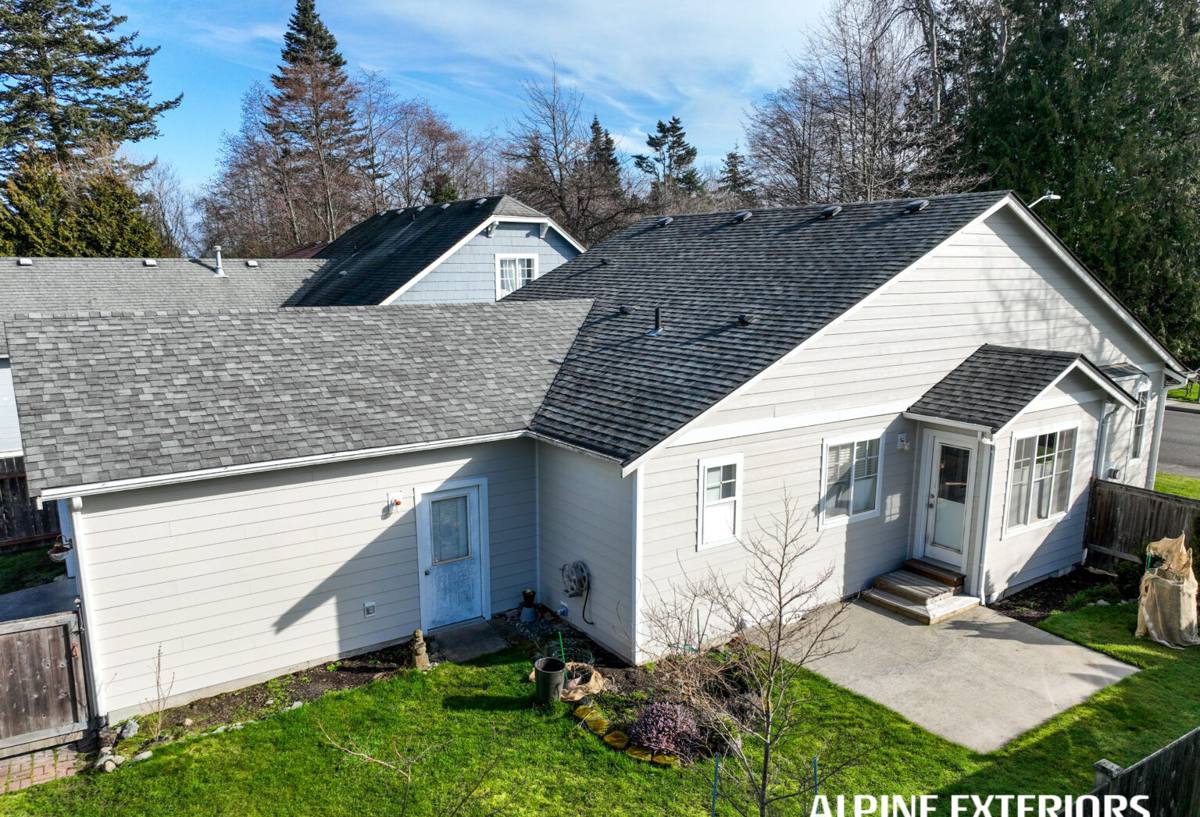
Siding, Roofing, Windows, and Decks — Handled by One Local Crew
We're a full exterior contractor, not a siding-only outfit that subcontracts everything else out. That matters in a climate like this because the systems interact: bad flashing at a roofline shows up as a siding problem two years later, a window that isn't flashed correctly telegraphs moisture into the wall assembly behind brand-new siding, and a deck built without attention to ledger flashing can rot a band joist regardless of how good the siding above it is.
- Siding — James Hardie fiber cement, installed to manufacturer spec for this climate zone.
- Roofing — replacement and repair, with attention to the flashing details that keep water out of wall assemblies.
- Windows — replacement with correct flashing and integration into the siding system, not just a swap-and-caulk job.
- Decks — built and maintained with the same moisture-management standard we hold siding to.
Having one crew responsible for how these systems tie together means fewer gaps where water finds a way in.
Why We Install Only James Hardie Fiber Cement Siding
We get asked why we don't offer vinyl, LP SmartSide, or other fiber cement brands. The honest answer is that we standardized on one product because we're the ones who have to stand behind the installation, and we'd rather do that with a product we trust in this specific climate.
Vinyl
Vinyl siding is inexpensive and low-maintenance in a general sense, but it's a thin plastic product that expands and contracts significantly with temperature swings, and it's not the material we'd choose for a marine climate with driving rain — water management at seams and penetrations depends heavily on installation quality, and the material itself offers little structural resistance to wind-driven moisture intrusion. It also isn't repairable in a meaningful sense; damaged panels get replaced, not patched, and older colors are frequently discontinued.
Engineered Wood (LP SmartSide) and Other Fiber Cement Brands
Engineered wood siding has improved over the years, but it's still a wood-based product, and wood-based products are the ones most sensitive to the kind of sustained moisture exposure that shaded, damp Bellingham lots produce. Other fiber cement brands on the market are reasonable products, but we've chosen not to split our installation standards, warranty relationships, and crew training across multiple systems — we install one, we install it correctly, and we know exactly how it performs here.
Why James Hardie
James Hardie fiber cement is non-combustible, dimensionally stable in wet-dry cycling, and available in HZ5 formulations engineered for the freeze-thaw and moisture demands of Pacific Northwest climates. The ColorPlus factory finish is baked on under controlled conditions rather than field-applied, which matters in a region where paint has to survive a lot of rain exposure early in its life. It also carries a strong transferable warranty when installed by a qualified crew — which is the other half of the equation.
What Correct Installation Actually Involves
Fiber cement siding's real-world performance depends heavily on installation details that are easy to skip and hard to spot after the fact:
- Proper starter strip and clearance from grade, decks, and roof lines so siding doesn't wick moisture from below.
- Correct fastener type, spacing, and penetration depth — under- or over-driven fasteners are a common failure point.
- A continuous, correctly lapped water-resistive barrier behind the siding, not just house wrap stapled up quickly.
- Properly flashed and caulked penetrations at windows, doors, and utility fixtures.
- Correct joint treatment at butt seams and corners, which is where wind-driven rain finds its way in if it's going to.
- Field-cut edges primed or sealed per manufacturer spec so cut ends don't become the weak point in an otherwise sound wall.
None of this is exotic — it's craftsmanship and following the manufacturer's installation manual instead of shortcutting it. It's also exactly the kind of thing that determines whether a warranty actually holds up if a problem shows up years later.
Comparing Siding Options for a Bellingham Home
| Factor | Vinyl | Engineered Wood | James Hardie Fiber Cement |
|---|---|---|---|
| Moisture resistance in driving rain | Depends on install quality | Moderate — wood-based core | High — cement-based, dimensionally stable |
| Performance in salt air | Doesn't corrode, but seams stress over time | Moderate | Strong, non-corrosive material |
| Moss/algae resistance on shaded walls | Can trap moisture at seams | Vulnerable if coating is compromised | Resistant; factory finish holds up to cleaning |
| Fire resistance | Melts/deforms under heat | Combustible | Non-combustible |
| Finish durability | Can fade, doesn't repaint easily | Field-applied or factory finish varies | Factory-baked ColorPlus finish |
| Typical warranty | Limited, prorated | Limited | Strong transferable warranty when installed to spec |
Roofing, Windows, and Decks in the Same Climate
Roofing
Roof flashing and underlayment take the brunt of Bellingham's rain volume before anything reaches the walls. A roof that's shedding water correctly at valleys, penetrations, and wall intersections is doing half the work of keeping siding dry underneath it.
Windows
Window flashing that integrates properly with the water-resistive barrier and siding is one of the most common places we find moisture problems on older homes in this area — not from the window unit itself, but from how it was tied into the wall assembly around it.
Decks
Ledger board flashing, proper spacing between deck boards and the house, and materials chosen for constant damp exposure all matter more here than in a drier climate. A deck built without those details tends to show rot at the house connection first.
Maintenance That Actually Matters Here
Fiber cement siding is low-maintenance compared to wood or vinyl, but "low-maintenance" doesn't mean "no maintenance" in a climate like this one:
- Rinse siding periodically, especially shaded north- and east-facing walls where moss and algae take hold first.
- Keep gutters clear so overflow doesn't run down and pool against siding at corners and end walls.
- Trim back vegetation and tree limbs that keep a wall section shaded and damp longer than the rest of the house.
- Re-caulk at trim joints and penetrations on the manufacturer's recommended schedule — caulk fails before the siding does.
- Have flashing at roof-to-wall intersections and window heads checked periodically, since that's where hidden moisture problems usually start.
Cost Factors for a Bellingham Siding Project
| Factor | Why It Affects Cost |
|---|---|
| Home size and wall complexity | More corners, dormers, and transitions mean more cutting, flashing, and labor time. |
| Existing siding removal and substrate condition | Rot or water damage found underneath old siding needs to be addressed before new siding goes on. |
| Siding profile and finish selection | Lap width, shingle-style panels, and trim details vary in material and labor cost. |
| Access and site conditions | Sloped lots, tight setbacks, and limited staging area affect scaffolding and logistics. |
| Scope bundling | Combining siding with roofing, window, or deck work in one project can reduce overlapping site costs. |
We give straightforward, itemized estimates — no invented numbers here, since every property is different, but we're glad to walk through the real range for your specific home.
Why a Local Crew Matters
A contractor based near Birch Bay and working regularly in Bellingham knows this climate firsthand — not from a manufacturer's regional guidelines, but from having repaired what happens when installation shortcuts meet Whatcom County weather. That's the kind of judgment that shows up in the small decisions on a job: where to add extra flashing, which wall orientations need closer attention to moss resistance, how to sequence work around the area's rain patterns.
What to Look for When Hiring
- Manufacturer certification or documented training on the specific siding system being installed.
- A written scope that details flashing, water-resistive barrier, and fastening specs — not just "install siding."
- Local references and a track record of work in the same climate conditions.
- A clear warranty explanation, including what's covered by the manufacturer versus the installer.
- Proper licensing and insurance, confirmed in writing before work starts.
If you're weighing a siding, roofing, window, or deck project on a Bellingham home, we're happy to take a look and walk through what your house actually needs — no pressure, no invented urgency. Reach out for a free estimate using the form below.