 Birch Bay Siding
 Exterior Work in the Nooksack Area: What the Climate Actually Does to a House
Homes in and around Nooksack sit inside Whatcom County's marine-influenced weather pattern, and that pattern is harder on exterior materials than most homeowners realize until they're dealing with the consequences. You get a long wet season, moisture-laden air moving in off the Salish Sea, and enough overcast, shaded days each year to give moss and algae every advantage they need. None of that is dramatic on any single day. It's the accumulation over years that separates a siding job that still looks tight after fifteen years from one that's cupping, staining, or rotting at the butt joints by year eight.
Three things do most of the damage locally: salt-tinged air that accelerates corrosion on fasteners and trim metal, driving rain that gets pushed sideways into wall assemblies during winter storms, and a moss season that can run from fall through spring on north-facing and shaded walls. Add typical Pacific Northwest temperature swings and freeze-thaw cycles in colder stretches, and you've got a climate that punishes any siding material with weak points at seams, fastener penetrations, or exposed end grain.
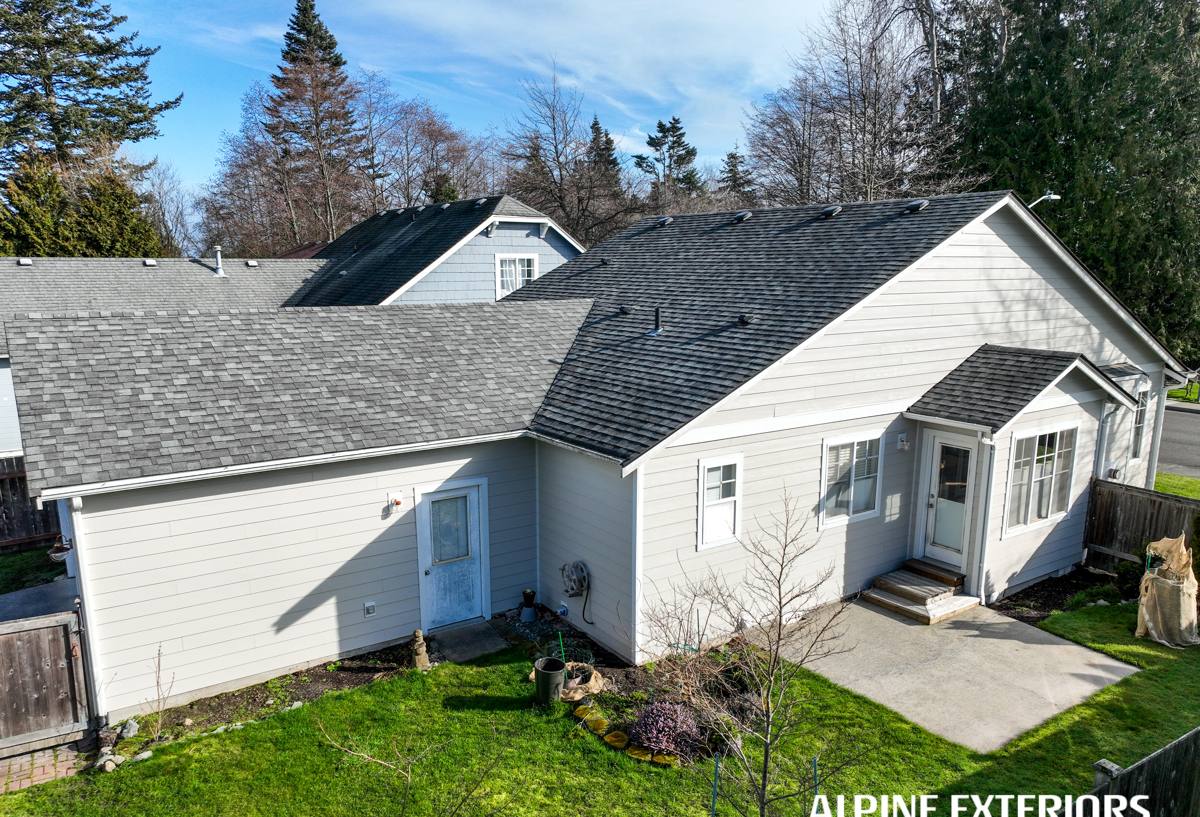
Why Material Choice Matters More Here Than in a Dry Climate
In a low-humidity climate, a mediocre siding installation can coast for years before problems show up. Here, mistakes and material weaknesses get exposed fast. Wood-based products swell and dry out repeatedly with every wet-dry cycle, which stresses paint film and joints. Engineered wood products are vulnerable at any spot where the factory-sealed edges get cut or compromised on site, and if moisture gets behind the cladding, it has few ways to leave before it starts affecting the substrate. Vinyl handles moisture fine on its own, but it moves a lot with temperature and doesn't offer much of a barrier against the driving rain events that hit exposed walls during winter fronts.
This is the core reason our company made a deliberate decision: we install James Hardie fiber cement siding, exclusively. We don't install LP SmartSide, vinyl, Cemplank, Allura, primed spruce, or cedar. That's not a marketing position — it's a standard we hold because we've seen what holds up in this climate over the long term and what tends to need attention sooner than homeowners expect.
What We're Not Installing, and Why
Wood and engineered-wood sidings can be attractive and perform reasonably well when maintained aggressively, but they ask a lot of a homeowner: regular repainting or resealing, prompt attention to any nick or gap in the factory coating, and vigilance about ground clearance and gutter performance. Vinyl is low-maintenance and inexpensive, but it's a thinner, more temperature-reactive material that doesn't offer the same rigidity or fire performance, and color options fade over time under UV exposure. None of these are "bad" products in every application — they're just not the trade-off we're willing to make on homes that have to survive decades of Whatcom County winters.
James Hardie: The System We Standardized On
James Hardie fiber cement is manufactured from cement, sand, and cellulose fiber, cured into a rigid, non-combustible board that doesn't swell, rot, or attract insects the way wood-based products can. Hardie also engineers its product lines by climate zone — homes here fall into what Hardie designates an HZ5 zone, meaning the boards are formulated with moisture and freeze-thaw performance suited to the Pacific Northwest rather than a generic national spec.
The factory-applied ColorPlus finish is baked on under controlled conditions, which gives it more consistent coverage and better fade resistance than field-applied paint, and it comes backed by its own finish warranty separate from the product warranty on the board itself. For a house exposed to salt air and long wet stretches, having a factory finish that isn't relying on job-site weather conditions to cure properly is a real advantage, not a marketing detail.
| Factor | James Hardie Fiber Cement | Wood / Engineered Wood | Vinyl |
|---|---|---|---|
| Moisture response | Dimensionally stable, doesn't swell | Absorbs moisture, can swell/warp | Unaffected by moisture itself |
| Fire rating | Non-combustible | Combustible | Combustible |
| Finish durability | Factory-baked, warrantied separately | Field-applied, needs recoating | Molded-in color, fades with UV |
| Typical maintenance | Periodic wash, caulk check | Repaint/reseal on a cycle | Low, but prone to cracking with impact |
| Insect/rot resistance | Not a food source, doesn't rot | Vulnerable if coating fails | Not applicable |
How a Nooksack-Area Siding Project Actually Runs
Assessment and Moisture Check
We start every project with a walk-around that looks past the surface: we're checking for soft spots, staining patterns that hint at water intrusion, gutter and downspout performance, and how the existing siding is handling grade and roof-to-wall transitions. In this region, a lot of siding failure traces back to water management details — kickout flashing, window head flashing, deck ledger connections — rather than the siding material itself. We flag those before pricing anything, because installing new siding over an unresolved moisture path just hides the problem for a while.
Weather Barrier and Prep
Correct installation starts underneath the boards. A continuous, properly lapped weather-resistive barrier, correctly flashed openings, and appropriate rainscreen or furring where the wall assembly calls for it all matter more here than in drier climates, because any water that does get past the cladding needs somewhere to drain and dry out. This is also where a lot of cut-rate installations fall short — skipping or shortcutting this layer doesn't show up as a problem on day one, but it shows up eventually.
Installation to Manufacturer Spec
James Hardie publishes specific fastening patterns, clearances, and gap requirements, and the product's own warranty depends on installation meeting those specs — not on the board being good material alone. That means correct nail spacing and setback, proper caulking at butt joints and penetrations, minimum clearance from grade, roofing, and decks, and factory-mitered or properly sealed field cuts to protect the exposed core of the board. We follow the published installation manual as a floor, not a suggestion.
Trim, Corners, and Finish Details
The small stuff is where houses in this climate either shed water cleanly or start collecting it. Corner boards, window and door trim, and butt joint caulking all get attention with the same climate in mind — driving rain finds gaps, and moss finds anywhere shaded and slow to dry. We also address ventilation at soffits and any spots where airflow behind the cladding will help the wall assembly dry between storms.
Beyond Siding: Roofing, Windows, and Decks
Siding doesn't work in isolation — it's one piece of a building envelope that also includes the roof, windows, and any attached structures like decks. We handle all four because they interact constantly in this climate. A roof with poor flashing at a wall intersection will feed water straight into a siding failure no matter how good the cladding is. Windows with failed seals or improperly flashed rough openings are one of the most common sources of hidden water damage behind otherwise sound siding. Decks attached to the house create ledger connections and grade-level details that, done wrong, funnel water directly at the wall.
Handling these trades together means we're not pointing fingers at "somebody else's work" when we find a problem — we can address the whole envelope with one crew that understands how the pieces fit.
Roofing in the Local Climate
Roofs here take a beating from moss growth on shaded slopes, sustained wet periods that stress underlayment and flashing, and wind-driven rain during winter storms. Regular inspection of flashing, valleys, and moss buildup goes a long way toward protecting both the roof and the siding below it.
Windows and Envelope Integration
Replacement windows are only as good as their flashing and integration with the surrounding siding. We treat window flashing detail as part of the siding scope whenever the two projects overlap, since a window installed without proper head flashing can undermine even a well-installed Hardie wall.
Decks
Deck ledger boards attach directly to the house structure, and that connection needs to be flashed and sealed correctly or it becomes a chronic water entry point. We build and repair decks with that ledger-to-wall detail as a priority, not an afterthought.
What Drives Cost on a Nooksack Siding Project
Every house is different, but a few factors consistently move the price on projects out here more than homeowners expect:
| Cost Factor | Why It Matters Locally |
|---|---|
| Existing moisture damage | Rot or water intrusion found during tear-off adds repair scope before new siding goes on |
| Wall complexity | Dormers, multiple stories, and cut-up elevations increase flashing and trim labor |
| Trim and accent choices | Board-and-batten accents, shake-style panels, or trim upgrades add material and labor cost |
| Access and site conditions | Tight lots, slopes, or landscaping near the foundation affect staging and scaffolding needs |
| Tear-off vs. re-side | Full removal of old siding versus installing over an approved substrate changes labor scope |
We give homeowners a real number after seeing the house, not a phone estimate based on square footage alone — too many of the variables above only show up in person.
Why a Local Crew Matters for This Work
A crew that works this specific stretch of Whatcom County regularly develops a feel for which details actually matter here: where moss tends to build fastest, which wall orientations take the worst of the winter rain, and how local permitting and inspection processes work. That's different from a crew that installs siding nationally and treats every region the same. It also means callbacks and warranty service aren't a multi-hour drive away — we're not disappearing after the final invoice.
What to Ask Before Hiring Anyone for Exterior Work Here
- Are they licensed and insured in Washington, and will they provide proof without being asked twice?
- Do they follow the manufacturer's published installation manual for whatever siding product they're using?
- Will they inspect and address the weather-resistive barrier and flashing, not just install over what's there?
- Can they explain the warranty structure — what's covered by the manufacturer versus their own workmanship warranty?
- Do they have experience specific to this climate, or are they applying a generic approach from a drier region?
- Will they give you a written scope that spells out tear-off, prep, and finish details, not just a total price?
Maintaining Hardie Siding Once It's Installed
One advantage of fiber cement in this climate is how little ongoing maintenance it actually needs compared to wood-based alternatives. A periodic rinse to knock off pollen, dust, and early moss growth, an annual look at caulking around joints and penetrations, and prompt attention if a gutter starts overflowing onto a wall section will keep a correctly installed Hardie exterior performing for decades. That's a much lighter maintenance burden than a repaint cycle every several years, which is one more reason it holds up as the better long-term choice for houses that see this much rain.
If you're weighing a siding, roofing, window, or deck project for a home in the Nooksack area, we're glad to take a look and walk you through what we're seeing and what it would take to do it right. The estimate is free, there's no pressure attached to it, and you can use the form below to get started.