 Birch Bay Siding
 Every siding problem eventually raises the same question: patch it, or replace it? The honest answer is that it depends on the age of the siding, the material it's made from, how much of the wall is affected, and what's happening underneath the surface. Homeowners in Birch Bay face a harder version of this question than most, because salt air off Semiahmoo Bay, driving winter rain, and a long moss season put steady stress on exterior walls year-round. Below is a straightforward way to think through the decision before you spend money on either option.
Start With What's Actually Failing
"My siding looks bad" and "my siding is failing" are not the same problem. Cosmetic issues — faded paint, chalky color, moss staining, a few loose boards — are often repairable. Structural issues — soft or crumbling material, siding that's pulling away from the wall, water stains on interior walls near exterior corners — usually point to problems repair can't fix for long, because the damage is happening behind the siding, not just on its face.
Before deciding anything, figure out which category you're in. A quick way to tell:
- Press on the siding in a few spots. If it flexes, feels soft, or crumbles slightly, moisture has likely gotten into the material itself.
- Check the bottom few feet of walls near downspouts, hose bibs, and grade level — these are the first places rot and moisture damage show up in our climate.
- Look at trim, corner boards, and window casings. If they're deteriorating faster than the field siding, water is probably getting behind the assembly there.
- Note how widespread the issue is. A single damaged board is a repair. Damage repeating across multiple walls is usually a sign the whole system is aging out.
Why Underlying Moisture Changes the Math
Whatcom County's wet season runs long, and Birch Bay's exposure to wind-driven rain off the water means siding here takes on more direct moisture than siding a few miles inland. If water has been getting behind the siding for any length of time, the housewrap, sheathing, or framing underneath may already be compromised. Replacing a rotten board on the surface without addressing what let water in behind it is a short-term fix — the same failure will show up again in a year or two, often worse.
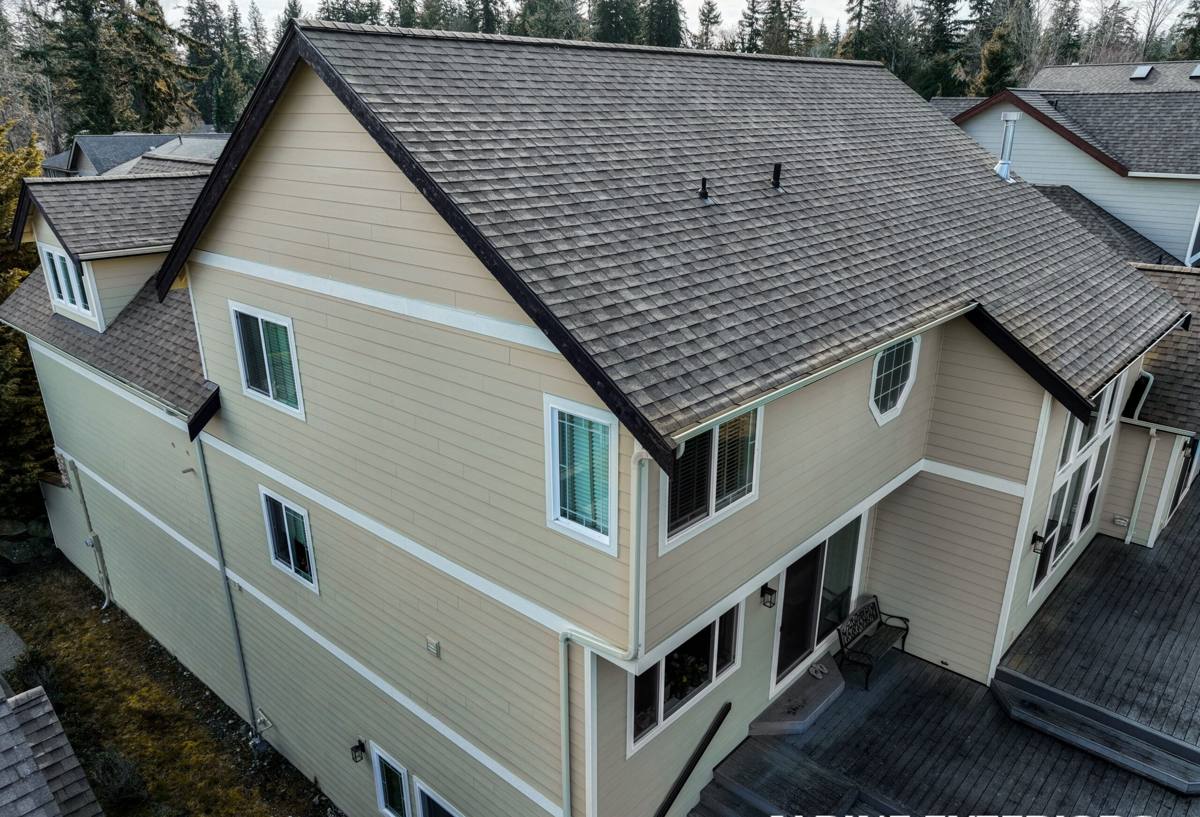
Material Matters More Than People Expect
How well a repair-vs-replace decision holds up depends heavily on what the siding is made of. Some materials age gracefully and take repairs well. Others degrade in ways that make partial repair a losing bet.
| Material | How It Typically Fails | Repair Outlook |
|---|---|---|
| Cedar / primed wood | Rot, cupping, paint failure from repeated wet-dry cycles | Repairable early; once rot sets in, it spreads faster than patching keeps up |
| Vinyl | Cracking, fading, warping from heat and impact | Panels can be swapped, but exact color matches fade out within a few years |
| LP SmartSide (engineered wood) | Edge swelling and delamination where moisture penetrates cut ends or seams | Localized swelling can sometimes be cut out and replaced if caught early |
| Older fiber cement (non-Hardie) | Cracking, edge chipping, finish wear depending on brand and install era | Case by case — condition and finish type drive whether patching is worth it |
| James Hardie fiber cement | Rare; mainly impact damage or installation-error moisture intrusion | Individual boards can usually be replaced cleanly without disturbing the rest |
Notice the pattern: materials that absorb moisture into their core (wood, engineered wood) tend to fail in ways that spread. Materials that resist moisture absorption fail more locally, which makes spot repair a realistic option rather than a stopgap.
The Age Threshold
Age is one of the more reliable predictors of whether repair is worth doing. As a rough guide for our climate:
- Under 10 years old: Isolated damage is almost always worth repairing, assuming the rest of the siding is sound.
- 10–20 years old: Repair is still reasonable for minor, isolated issues, but it's worth having the whole exterior inspected — if one section is failing, others close behind it in age may not be far off.
- 20+ years old: This is where repair costs start competing directly with replacement costs. Once you're paying a contractor to mobilize, match materials, and repaint or re-finish a patched area, the price gap between "fix it again" and "just replace it" narrows fast.
Coastal Exposure Shortens the Clock
Birch Bay properties, especially those closer to the waterfront, deal with more airborne salt and consistent moisture than homes further inland in the county. Salt air accelerates finish breakdown and corrodes exposed fasteners faster than a typical inland Whatcom County home experiences. Homes with heavy tree cover — common around Birch Bay's residential streets — also deal with prolonged moss and algae growth, which holds moisture against the siding surface for extended periods rather than letting it dry between rains. Both factors mean siding here often needs attention on a shorter timeline than manufacturer averages would suggest, and it's a big part of why we only install materials engineered specifically to handle wet coastal climates.
When Repair Is the Right Call
Repair makes sense when the damage is limited, recent, and isolated — a board cracked by a fallen branch, a section damaged during a storm, or a small area where a leak has already been fixed and the siding just needs to be made whole again. It also makes sense when the rest of the siding is in good condition and reasonably young. In these cases, a quality repair restores both function and appearance without the cost or disruption of a full replacement.
When Replacement Is the Smarter Investment
Replacement becomes the better call when damage is widespread, when the siding is old enough that more failures are likely on the way, or when repeated repairs haven't actually solved the underlying moisture problem. It's also worth considering replacement when a home's siding material is one that's known for maintenance burden over time — repainting cycles, caulking upkeep, or moisture sensitivity that never really goes away no matter how well it's maintained.
This is where material choice matters for the long run, not just the immediate repair. When we do full siding replacements in Birch Bay, we install James Hardie fiber cement exclusively. We don't offer vinyl, LP SmartSide, cedar, or primed spruce as options — not because those products can't be installed correctly, but because after years of servicing exteriors in this climate, we've standardized on the one material that consistently holds up to salt air, driving rain, and moss exposure with the least long-term maintenance. Hardie's fiber cement composition doesn't absorb moisture into its core the way wood-based products do, its ColorPlus factory finish is baked on rather than field-painted, and it carries a strong transferable warranty that reflects the manufacturer's confidence in the product over decades of coastal use.
A Simple Way to Frame the Decision
- Is the damage isolated to one area, and is the rest of the siding sound? → Repair is likely reasonable.
- Is the siding older than 20 years, or has this same wall been repaired before? → Replacement probably saves money over time.
- Is there evidence of moisture behind the siding, not just on the surface? → Address the underlying cause; a surface repair alone won't hold.
- Is the material one known for absorbing moisture or requiring ongoing upkeep? → Weigh replacement with a lower-maintenance material against repeated repair costs.
What a Proper Inspection Should Cover
Whichever direction you're leaning, a real inspection should go further than a quick look from the driveway. A thorough exterior evaluation checks:
- Condition of siding at all wall elevations, not just the most visible ones
- Trim, corner boards, and any wood-to-siding transitions where water tends to collect
- Flashing above windows, doors, and any roof-to-wall intersections
- Caulking and sealant condition at seams and penetrations
- Signs of moisture at the base of walls and near grade
- Overall age and remaining service life of the current material
That last point matters more than homeowners often realize. A contractor who only quotes the repair in front of them, without looking at the bigger picture, isn't giving you the full information you need to make a sound financial decision.
Cost Considerations Beyond the Sticker Price
A single repair almost always costs less upfront than a full replacement — that's not in dispute. But the fair comparison isn't repair cost versus replacement cost in isolation; it's repair cost repeated over the remaining life of aging siding versus a one-time replacement with a material that's engineered for the local climate. If a home is facing its second or third repair on the same section within a few years, that pattern is worth running the numbers on rather than continuing to treat it as a series of unrelated small jobs.
Getting an Honest Recommendation
The right answer isn't always the more expensive one — plenty of Birch Bay homes with sound, younger siding just need a competent repair and nothing more. But when the underlying material or its age is working against you, a straight answer about replacement, and about what to replace it with, is worth more than a quick patch that buys another year or two before the same conversation happens again.
If you're weighing repair against replacement on your Birch Bay home, we're happy to take a look, tell you honestly which side of that line your siding falls on, and walk you through what James Hardie replacement would involve if that's the direction that makes sense. There's no pressure and no cost for the estimate — just a straight assessment of what's going on with your walls.