 Birch Bay Siding
 Exterior Work Built for Cherry Point's Coastal Conditions
Cherry Point sits along the Strait of Georgia shoreline in Whatcom County, just up the coast from Birch Bay, in a stretch of the county where rural land, shoreline bluffs, and scattered residential properties share the same weather system. Homes out here don't face the same exposure as a sheltered inland lot. Wind comes straight off the water, rain arrives sideways more often than straight down, and the tree cover that gives many properties their privacy also keeps siding and roofing damp for days after a storm passes. That combination is exactly what wears down the wrong exterior products faster than homeowners expect.
We're a local siding, roofing, window, and deck contractor, and we've built our business around exteriors that hold up to this specific climate rather than a generic weather profile. That means understanding how salt-laden air interacts with different siding materials, how prolonged moisture exposure behaves against a wall assembly over years (not just one wet season), and where moss and algae take hold first on a home.
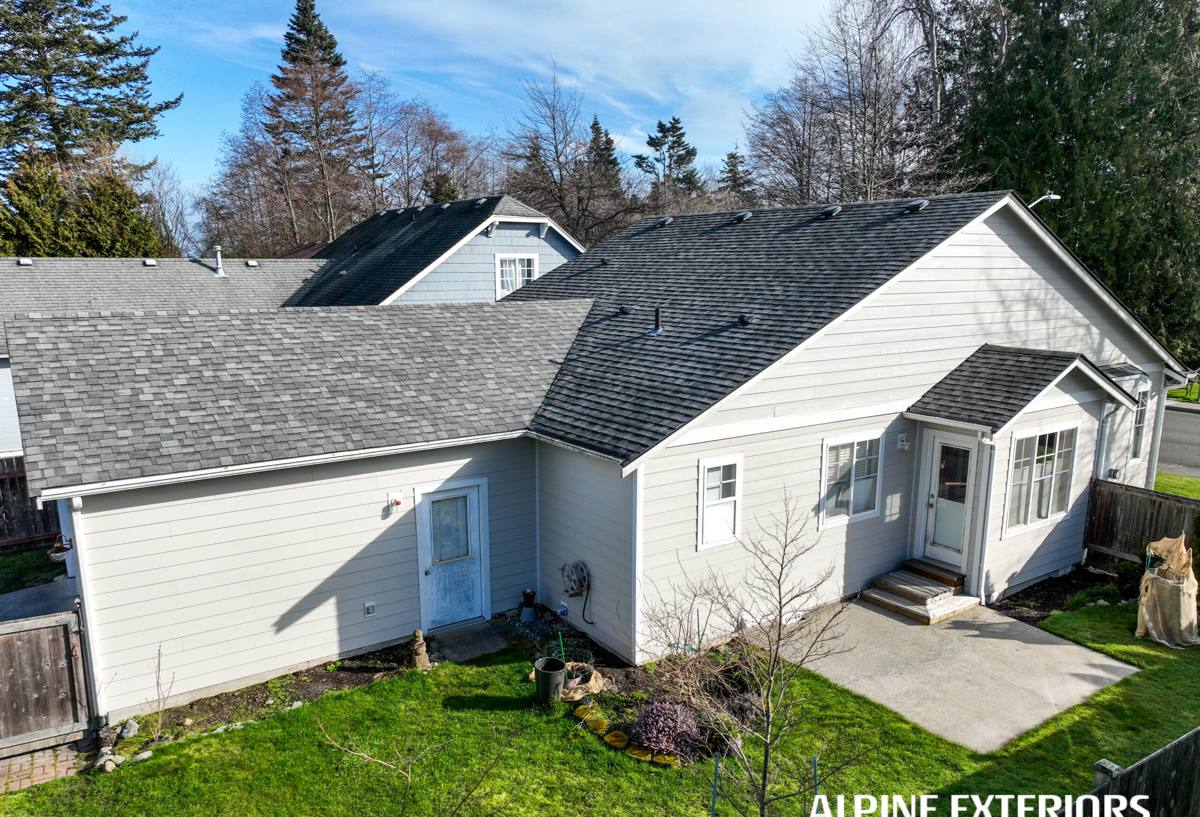
What Salt Air and Driving Rain Actually Do to a Home
Salt Air
Airborne salt from the Strait doesn't just affect boats and metal fixtures. It settles on siding, trim, and fasteners, and over time it accelerates corrosion on lower-grade hardware and can degrade certain paint and coating systems faster than the same product would wear inland. Homes closer to the water see this first, but prevailing winds carry salt air further inland than most people assume, especially during winter storm patterns.
Driving Rain
Wind-driven rain doesn't behave like a normal rainstorm. It gets pushed sideways and upward into laps, seams, and trim joints that were never designed to handle water moving in that direction. A siding system with poor water management at the joints, or caulking relied on as a primary defense instead of a backup, tends to show problems years before a properly engineered assembly does.
Moss Season
Between the tree cover common on Cherry Point properties and the region's long stretch of wet, mild months, moss and algae growth is close to a year-round concern rather than a seasonal one. Moss holds moisture against a surface, and on the wrong material that sustained dampness is what eventually leads to soft spots, rot, or coating failure — not the moss itself, but what it traps underneath.
Why We Install Only James Hardie Fiber Cement Siding
We don't install vinyl, LP SmartSide, Cemplank, Allura, primed spruce, or cedar siding. That's a deliberate standard, not a limitation of what we're capable of installing. Each of those products has legitimate strengths, but each also carries a trade-off that we don't think holds up well against Cherry Point's specific mix of salt exposure, sustained moisture, and moss pressure.
- Vinyl can warp or become brittle with UV and temperature swings, and its seams give wind-driven rain more opportunities to find a way behind the panel.
- Wood-based engineered siding (LP SmartSide) uses treated wood strand technology that performs well in many climates, but any wood-based product depends heavily on maintained caulking and coatings to keep moisture out over the long term.
- Primed spruce and cedar are natural wood products that require the homeowner to stay ahead of repainting, refinishing, and moisture monitoring — a real maintenance commitment in a climate where things rarely fully dry out for months at a time.
- Cemplank and Allura are fiber cement competitors to Hardie, and while fiber cement as a category is the right call for this climate, we've standardized on one manufacturer so we can guarantee installation detail, factory finish consistency, and warranty terms we stand behind fully.
James Hardie fiber cement is non-combustible, dimensionally stable in wet-dry cycling, and available in HZ5 and HZ10 formulations engineered for exactly the freeze-thaw and moisture patterns the Pacific Northwest sees. The ColorPlus factory finish is baked on under controlled conditions rather than field-applied, which matters directly for a home dealing with year-round dampness — a factory finish doesn't depend on the day's weather to cure correctly, and it comes with a stronger, more consistent warranty than most field-painted systems can offer.
Siding Material Comparison for Cherry Point Conditions
| Material | Salt Air Resistance | Moisture/Rot Risk | Maintenance Burden |
|---|---|---|---|
| James Hardie Fiber Cement | Strong | Low when installed to spec | Low — factory finish, occasional wash |
| Vinyl | Moderate | Low material risk, but seams leak | Low, but limited lifespan in UV/wind |
| LP SmartSide / Engineered Wood | Moderate | Moderate — depends on sealed edges | Moderate — coating upkeep required |
| Cedar / Primed Spruce | Lower without diligent upkeep | Higher — natural wood absorbs moisture | High — repainting, sealing cycles |
Roofing, Windows, and Decks for the Same Conditions
Siding is only one piece of a home's defense against this climate. We also handle roofing, window replacement, and deck construction, and the same coastal logic applies across all of them.
Roofing
A roof out here needs to shed driving rain at every transition point — valleys, flashing, penetrations — not just on a flat plane. Moss control on roofing is just as important as it is on siding; moss holding moisture against shingles or underlayment shortens roof life the same way it does with the wrong siding material.
Windows
Wind-driven rain finds poorly sealed window flanges quickly. Correct flashing and integration with the siding system is what actually keeps water out — the window unit itself is only half the equation.
Decks
Decks facing the water take the most direct exposure on a property: full sun, full salt air, full rain. Material choice and proper fastener selection (to resist the same corrosion pressure that affects siding hardware) matter more here than almost anywhere else on the exterior.
Why a Local Crew Matters
Installation quality is what separates a siding system that performs for decades from one that fails early — and that's true no matter which material a homeowner chooses. Flashing details, control joint placement, fastener selection, and clearances at grade all have to be right, and they have to account for wind-driven rain patterns specific to a shoreline property rather than a generic install spec. A crew that works this stretch of Whatcom County regularly understands where water actually wants to go on a Cherry Point home, not just where a manual says it should.
Manufacturer specs exist for a reason, but they're written for a general case. Local experience is what tells us where to add extra attention — a north-facing wall that never fully dries, a low section of a property that catches more wind-driven rain than the rest of the lot, or a heavily treed section prone to moss buildup years before the rest of the home shows it.
What to Check Before Hiring an Exterior Contractor Here
- Ask whether the crew installs to the manufacturer's written installation manual, not just "how we've always done it"
- Confirm licensing, bonding, and insurance directly — don't take a business card's word for it
- Ask specifically how they handle flashing at windows, doors, and roof-wall intersections
- Ask what warranty applies to both material and labor, and get it in writing
- Ask how they'd address moss and moisture concerns specific to a shaded or shoreline-facing lot
- Get a written estimate that itemizes material, labor, and any tear-off or disposal costs
What Affects the Cost of a Cherry Point Exterior Project
| Factor | Why It Matters Here |
|---|---|
| Home size and wall complexity | More corners, gables, and transitions mean more flashing detail and labor time |
| Existing siding removal | Tear-off and disposal of old material adds cost but is often necessary to inspect for hidden moisture damage |
| Access and site conditions | Shoreline bluffs, steep lots, or heavy tree cover can affect equipment access and scaffolding needs |
| Product line selection | Hardie's various HZ formulations and plank profiles carry different price points |
| Underlying repairs | Rot or water damage found during removal needs to be addressed before new siding goes on |
Get a Straight Answer About Your Home
Every property along the Cherry Point shoreline sits a little differently — some more sheltered, some taking the full brunt of wind and salt off the water, some dealing with moss more than others depending on tree cover. Rather than guess at what your home needs, we'd rather walk it with you and tell you honestly what we see. If you're weighing a siding replacement, a roof that's showing its age, tired windows, or a deck that needs rebuilding, request a free, no-pressure estimate below and we'll give you a straight assessment of what your home actually needs.