 Birch Bay Siding
 Point Roberts sits on its own small point of land with water on most sides of it, which means wind-driven rain and salt-laden air reach nearly every exposed wall of a home there, not just the one wall that happens to face the water on a typical inland lot. That's the same kind of exposure that shows up across this stretch of Whatcom County, but a point catches more of it, from more directions, more often. Add in a moss season that runs long on this coastline, and siding on a Point Roberts home tends to show real wear years before a comparable house set back from the shoreline would.
Birch Bay Siding Company already puts crews on this part of the coast on a regular basis, so a Point Roberts repair call isn't a case of figuring out the area for the first time. We know what salt air, driving rain, and a long wet moss season do to siding out here, and we know which repairs actually hold up against it and which ones are just a patch that buys a season or two before the same spot fails again.
Why Point Roberts Homes Need Siding Repair Sooner Than Most
On a sheltered inland lot, one or two walls usually take most of the weather and the rest of the house ages slowly. Point Roberts doesn't offer much of a sheltered wall. Depending on the season, wind can drive rain sideways into siding from more than one direction, and moss takes hold anywhere shade and moisture overlap — which, on a point surrounded by water, can be most of a property rather than just the north-facing side. That's the practical reason a repair call out here often turns up more than one problem area, even when the homeowner only noticed trouble in one spot.
Age and Exposure Compound Each Other
Siding that would hold up for decades in a calmer setting can start showing real problems a good deal sooner on an exposed point like this, especially once caulking or paint film starts to fail and lets moisture behind the material instead of shedding it. That's not a reason to panic about every hairline crack, but it is a reason to have exposed siding looked at sooner rather than later here — small gaps that would sit harmlessly for years somewhere calmer don't get the same grace period this close to the water.
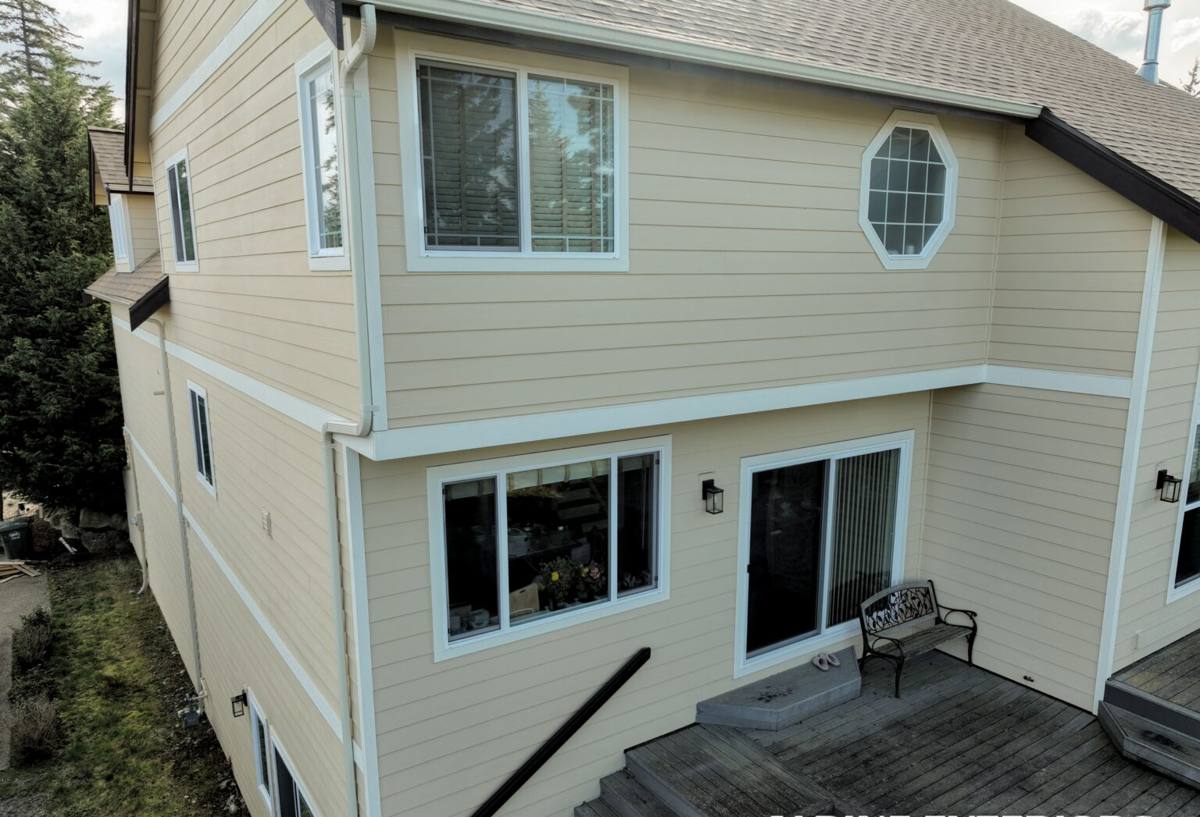
Where Siding Damage Actually Shows Up First
Repair calls in Point Roberts tend to cluster around the same handful of spots, because those are the places where water, wind, and moss have the easiest path in.
- Horizontal joints and butt seams — where two pieces of siding meet is where caulking failure and wind-driven rain do the most damage, since a small gap here has a direct path to the wall behind it
- Bottom courses near grade — the lowest rows of siding sit closest to splash-back, standing moisture, and vegetation, and take on more sustained dampness than anything higher on the wall
- North- and shade-facing walls — slower to dry out, which is exactly what a long moss season needs to get established and hold moisture against the surface
- Fasteners and trim hardware — salt-laden air corrodes lower-grade fasteners and hardware faster than a drier inland environment would, and a failed fastener can loosen a whole course of siding
- Window and door flashing transitions — anywhere the siding meets another material is a seam, and seams are where a failed flashing detail shows up as damage well before the siding field itself does
Most of what we get called out for isn't the siding material itself failing outright — it's moisture finding one of these transition points and working behind the surface where it isn't visible until the damage has already spread.
Repair or Replace? How We Make That Call
Not every damaged section needs a full re-side, and we don't default to recommending one just because it's a bigger job. The honest answer depends on how far the underlying moisture damage has traveled, not just how bad the visible siding looks.
When Repair Is the Right Call
If the damage is isolated to a section or two, the sheathing and framing behind it are still sound once we open it up, and the rest of the siding is in reasonable shape for its age, a targeted repair is the honest recommendation. That includes replacing the affected boards, correcting the flashing or caulking detail that let water in, and matching the new material to what's already there.
When Repair Isn't Enough
If we find rot that's spread into the framing, damage repeating across multiple walls, or siding that's simply reached the end of its service life across the whole house, patching one section doesn't solve the underlying problem — it just delays the same conversation. We'll tell you plainly which situation you're in before any work starts.
| Factor | Points Toward Repair | Points Toward Replacement |
|---|---|---|
| Extent of damage | Isolated to one or two sections | Spread across multiple walls or the whole house |
| Underlying framing | Sound once opened up and inspected | Soft, rotted, or showing repeated moisture damage |
| Age of existing siding | Mid-life, otherwise performing well | Near or past its expected service life |
| Material match | Current siding still available or closely matchable | Discontinued profile or badly faded finish that won't blend |
| Cost over time | Lower upfront, appropriate for the scope | Repeated repairs starting to add up to replacement cost anyway |
What a Correct Siding Repair Job Involves
Diagnosing the Real Cause, Not Just the Symptom
A soft or stained section of siding is a symptom. Before we replace anything, we find out why water got behind it in the first place — a failed caulk joint, a flashing detail that was never right, a fastener pattern that let wind work a board loose. Replacing the visible damage without fixing the cause just means the same repair call again in a few years.
Checking for Hidden Moisture Damage
Once we open up a damaged section, we check how far the moisture actually traveled — into the sheathing, the framing, or the wall assembly behind it. On a Point Roberts home, given the exposure, it's common for the damage to extend further than what's visible from outside, and that hidden portion has to be addressed before new siding goes back on, not covered over.
Matching Material, Profile, and Finish
A repair that doesn't match the surrounding siding in profile, texture, and color reads as an obvious patch. We work to match the existing material as closely as possible, and we'll tell you honestly upfront if an exact match isn't realistic — older siding fades and discontinues over time, and that's a conversation worth having before the work starts, not after.
Rebuilding the Flashing and Water Path
This is the step that decides whether a repair actually lasts. New siding installed over the same faulty flashing detail that caused the original failure will fail again the same way. We rebuild the water path at the repair site — correct lap, correct flashing, correct sealant placement — so the fix addresses the mechanism, not just the appearance.
Before You Sign Off on a Siding Repair
- Ask what caused the damage, not just what's being replaced
- Ask whether the sheathing or framing behind the damage was inspected, not just the visible siding
- Get a clear answer on how closely the repair will match the existing siding's color and profile
- Confirm the flashing or caulking detail that failed is being corrected, not just covered over
- Ask what's covered under warranty for both the material and the labor
- Get the scope of work in writing before anything is removed from the wall
Matching James Hardie Siding During a Repair
Birch Bay Siding Company installs and repairs James Hardie fiber cement siding — it's the only siding product we put on homes, and that includes repair work. If your home is already sided in Hardie, matching a repair to the existing ColorPlus finish, profile, and plank width is generally straightforward, especially on siding that's still reasonably current. Older ColorPlus finishes can fade unevenly over years of sun and salt exposure, so on an older repair we'll be upfront about whether a perfect color match is realistic or whether the best result comes from refinishing a larger section together so the color reads evenly.
If your home is sided in something else — vinyl, older cedar, LP SmartSide, or another fiber cement brand — we'll still do honest repair work to address the immediate problem. What we won't do is install more of a product we don't stand behind just to patch a section. When a home's siding reaches the point where full replacement makes more sense than continued repair, our recommendation is James Hardie, for the same reasons we only install it in the first place: it's non-combustible, engineered for wet coastal climates, backed by a strong transferable warranty, and holds a factory finish well when installed to spec.
Our Repair Process, Start to Finish
- On-site inspection — we look at the damaged section and check how far it extends before quoting anything
- Honest diagnosis — what caused the failure, and whether repair or replacement is the right call for the scope we find
- Written scope and estimate — a clear plan for what's being repaired, what it will cost, and what's included
- Careful removal — damaged siding and any compromised trim or flashing come off without disturbing sound material around it
- Structural and moisture check — sheathing and framing behind the repair are inspected and addressed if needed
- Rebuild and match — new material is installed with corrected flashing, matched as closely as possible to the surrounding siding
- Final check — we walk the repair with you before we consider the job finished
Why a Point Roberts-Experienced Local Crew Matters
Point Roberts is an exclave — the only way to reach it by land is through Canada, which is enough of a logistical hassle that a lot of contractors based elsewhere in Whatcom County simply avoid taking jobs out there. That means homeowners here sometimes end up choosing between waiting longer for a crew willing to make the trip, or hiring whoever's available and hoping the work holds up. We already work this area regularly, so scheduling and material logistics for a Point Roberts repair aren't a special case for us — they're routine.
Familiarity with the area matters for the actual work too. A crew that's repaired siding on this specific point of land knows how much more exposure a wall out here takes compared to a similar wall a few miles inland, which transition points tend to fail first, and how much extra attention to flashing and sealant is worth investing even when it isn't strictly required by code. Those aren't judgment calls you want a contractor making for the first time on your house.
What to Ask a Contractor Before Hiring for Siding Repair Here
- Ask whether they regularly work in Point Roberts or if this would be their first job out here
- Confirm current Washington contractor licensing and insurance
- Ask how they diagnose the cause of damage, not just how they'll patch the visible section
- Get a written scope of work and a realistic timeline, including how the border crossing affects scheduling
- Ask what material they'll use for the repair and why
If you've spotted soft, discolored, or moss-covered siding on a Point Roberts home, it's worth having someone look at it before the damage spreads further than what's visible from the outside. We offer free, no-pressure estimates for siding repair in Point Roberts and the surrounding Birch Bay area — use the form below to get a time on the schedule.