 Birch Bay Siding
 Marietta sits in that stretch of Whatcom County where Puget Sound weather has full run of the neighborhood — open water on one side, low tree cover holding moisture on the other. Homes here take a steady beating from salt-laden air, wind-driven rain, and a moss season that can run eight or nine months out of the year. If you own a house in or around Marietta, you already know your siding works harder than siding fifty miles inland, and it shows up faster on the exterior than most people expect.
We run crews out of Birch Bay and cover Marietta as part of our regular service area. That matters more than it sounds like it should. A contractor who drives in from Bellingham or further south sees your street a handful of times a year. A crew that works this corridor week in and week out knows which walls take the worst of the southwest wind, which yards hold ground moisture longest into spring, and which install details actually hold up against this specific stretch of coastline — not a generic Pacific Northwest average.
What the Marietta Climate Actually Does to a House
Marietta's exposure is a mix of three things working against your exterior at the same time: salt air off the water, near-constant rain during the wet months, and shaded, damp conditions that keep surfaces from drying out between storms. None of these alone is unusual for Western Washington. Together, over years, they're what separates a house that needs a repaint every few seasons from one that needs real repair work.
Salt Air and Metal Fatigue
Airborne salt doesn't just affect boats and railings. It accelerates corrosion on fasteners, flashing, and any exposed metal trim, and it degrades cheaper paint films faster than inland exposure does. Siding materials and coatings rated for general Northwest weather don't always account for this — it's a coastal-specific stressor that shows up as premature chalking, fastener staining, and finish breakdown along the water-facing sides of a home.
Driving Rain and Wind-Driven Moisture
Rain that comes in sideways gets pushed into laps, seams, and butt joints that were only ever designed to shed water falling straight down. Over time, wind-driven rain finds every gap in a poor install — undersized overlaps, missing flashing, caulk used where flashing should have been. The siding material matters less here than the installation quality; even a good product performs poorly if it wasn't detailed for wind-driven exposure.
Moss, Shade, and Slow Drying
A lot of Marietta lots carry mature trees and enough shade that north- and west-facing walls stay damp long after a storm passes. That's exactly the environment moss and algae need. On porous or textured surfaces, organic growth takes hold in the finish itself, not just on top of it, which means pressure washing alone stops being enough after a few seasons.
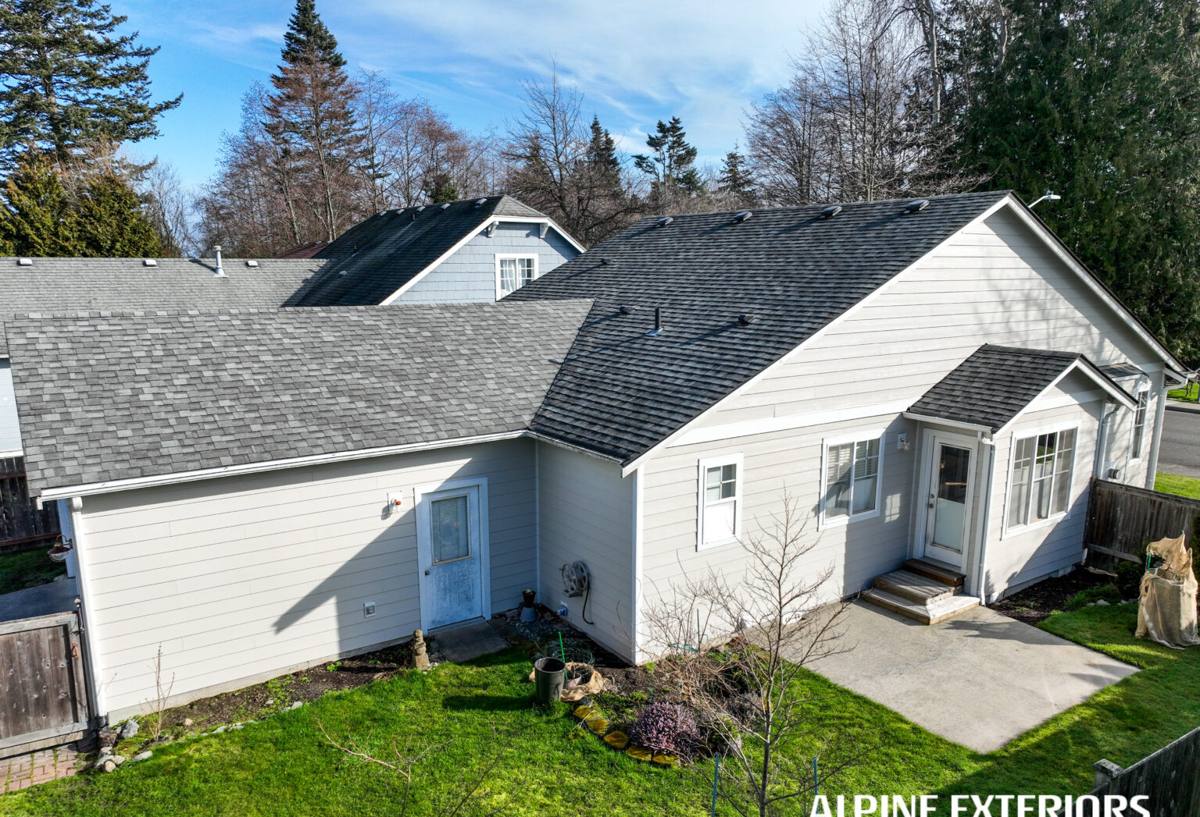
Why We Only Install James Hardie Fiber Cement
We made a decision years ago to stop installing anything other than James Hardie fiber cement siding, and coastal Whatcom County conditions are a big part of why that decision has held up. Fiber cement is non-combustible, dimensionally stable, and doesn't absorb water the way wood-based or wood-adjacent products do. That last point is the one that matters most in a place like Marietta — a siding material that swells, cups, or holds moisture in a climate this wet is a maintenance problem waiting to happen, regardless of how it looks on day one.
James Hardie's HZ5 product line is engineered specifically for climates with significant moisture exposure and freeze-thaw cycling, which fits this region better than a one-size-fits-all national product. The ColorPlus factory finish is baked on under controlled conditions rather than field-applied, which gives it more consistent coverage and better resistance to fading and chalking than a job-site paint job — a real advantage against UV and salt exposure over a 15- to 20-year horizon.
| Factor | James Hardie Fiber Cement | Typical Alternatives (vinyl, LP SmartSide, cedar) |
|---|---|---|
| Moisture response | Dimensionally stable, does not swell or rot | Vinyl can warp; wood-based products absorb moisture and can swell or delaminate if compromised |
| Salt air / coastal exposure | Engineered HZ formulations for wet, coastal climates | Not typically climate-zoned; finish breakdown more common near water |
| Fire resistance | Non-combustible | Vinyl melts/deforms with heat; wood-based products are combustible |
| Finish durability | Factory-applied ColorPlus finish, consistent cure | Field-applied paint/primer more prone to uneven wear |
| Long-term maintenance | Periodic caulk/paint touch-up on trim | Repainting cycles, caulk failure, or panel replacement more frequent |
We're not going to tell you every alternative is a bad product across the board — that's not honest, and it's not our call to make about products we don't install. What we will say is that for this specific coastline, with this much salt exposure and this little dry-out time between storms, we've found fiber cement to be the material that holds up with the least surprises, and that's the standard we've built our business around.
Siding Services for Marietta Homes
Most of the siding work we do in and around Marietta falls into a few categories:
- Full siding replacement — for homes where the existing material has reached the end of its useful life, or where moisture damage has gotten into the sheathing behind it
- Partial replacement and repair — targeted work on the sides of a house taking the worst weather exposure, without redoing the whole exterior
- New construction and additions — Hardie installed to spec from the start, including proper flashing and clearances
- Trim and accent work — Hardie trim boards paired with lap or panel siding for a finished, consistent look
Every job starts with an honest look at what's actually going on behind the existing siding, not just what it looks like from the curb. In a climate like this, hidden moisture damage is common enough that we'd rather flag it upfront than have it surface as a surprise mid-project.
Why Installation Quality Matters More Here Than Almost Anywhere
Fiber cement siding is only as good as the install behind it. James Hardie publishes specific installation requirements — clearances from grade, roofline, and decks; fastener spacing and placement; caulking and flashing details at every joint and penetration — and those requirements exist for a reason. In a low-exposure climate, a slightly loose install might go unnoticed for years. In Marietta's combination of wind-driven rain and salt air, sloppy installation shows up fast: staining at fastener heads, water intrusion at butt joints, premature caulk failure.
What a Correct Install Actually Involves
- Minimum clearances maintained between siding and grade, roof surfaces, and decks to prevent wicking
- Weather-resistant barrier installed and lapped correctly before siding goes on
- Proper flashing at windows, doors, and any wall penetration — not caulk used as a substitute
- Fasteners set to Hardie's spacing and depth specifications, not just "close enough"
- Butt joints and corners detailed to shed water rather than trap it
This is also where a local crew earns its keep. We're not learning this climate on your house — we've already made the adjustments that this coastline demands, and we install to that standard on every job, not just the ones where it's convenient.
Roofing, Windows, and Decks — The Rest of the Envelope
Siding doesn't work in isolation. A roof that's shedding water improperly, windows with failing flashing, or a deck ledger board holding moisture against the wall assembly can undermine even a perfect siding job. We handle roofing, window replacement, and deck construction alongside siding because in a climate this demanding, the building envelope needs to be looked at as one system, not four separate trades that don't talk to each other.
This matters in Marietta specifically because so much of the damage we see isn't a siding failure — it's a roof or flashing failure that eventually shows up as siding damage. Addressing the whole envelope at once, or at least understanding how the pieces interact, tends to save homeowners from paying for the same water intrusion problem twice.
What to Expect from a Local Estimate
When we come out to a Marietta property, we're looking at more than square footage. We're checking which walls face the prevailing weather, what condition the current siding and trim are in, whether there's any sign of moisture behind the surface, and how the roofline, gutters, and grading are working together — or not — to move water away from the house.
Cost Factors to Expect
| Factor | Why It Affects Price |
|---|---|
| Existing siding removal | Tear-off and disposal adds labor versus installing over a prepared surface |
| Hidden sheathing damage | Water-damaged sheathing found during tear-off needs repair before new siding goes on |
| Home size and complexity | Dormers, multiple gables, and cutouts increase labor time beyond flat square footage |
| Trim and accent detail | Additional trim work adds material and installation time |
| Access and site conditions | Slopes, tight lot lines, or limited equipment access affect labor time |
We give straight numbers based on what we actually find, not a lowball estimate that grows once the walls are open.
A Local Crew You Can Actually Reach
Part of why we cover Marietta directly out of our Birch Bay base is accountability. If something needs a follow-up look after a storm, or a warranty question comes up years down the road, you're not waiting on a call center or a company based somewhere else in the state. You're dealing with the same crew that did the work, based a few minutes away, that knows this stretch of Whatcom County and stands behind what we install here.
If your Marietta home is due for a siding evaluation — or you're seeing early signs of moss, staining, or moisture damage — we're happy to take a look. Reach out for a free, no-pressure estimate using the form below.