 Birch Bay Siding
 Building Decks for Semiahmoo's Waterfront Conditions
Semiahmoo sits right up against the water, and that location is exactly what makes it a hard place to build a deck that lasts. Salt-laden air moves off the bay and settles into every exposed fastener, hinge, and metal connector. Driving rain off Georgia Strait comes in sideways more often than most homeowners expect, working its way into ledger boards, joist ends, and railing posts if those connections aren't detailed correctly. And Whatcom County's long wet stretch from fall through spring means moss and algae get a real head start on any deck surface that doesn't shed water and dry out quickly.
None of that means a deck can't hold up here for decades. It means the build has to account for those three things from the framing stage forward, not patch around them after the fact with sealant and hope.
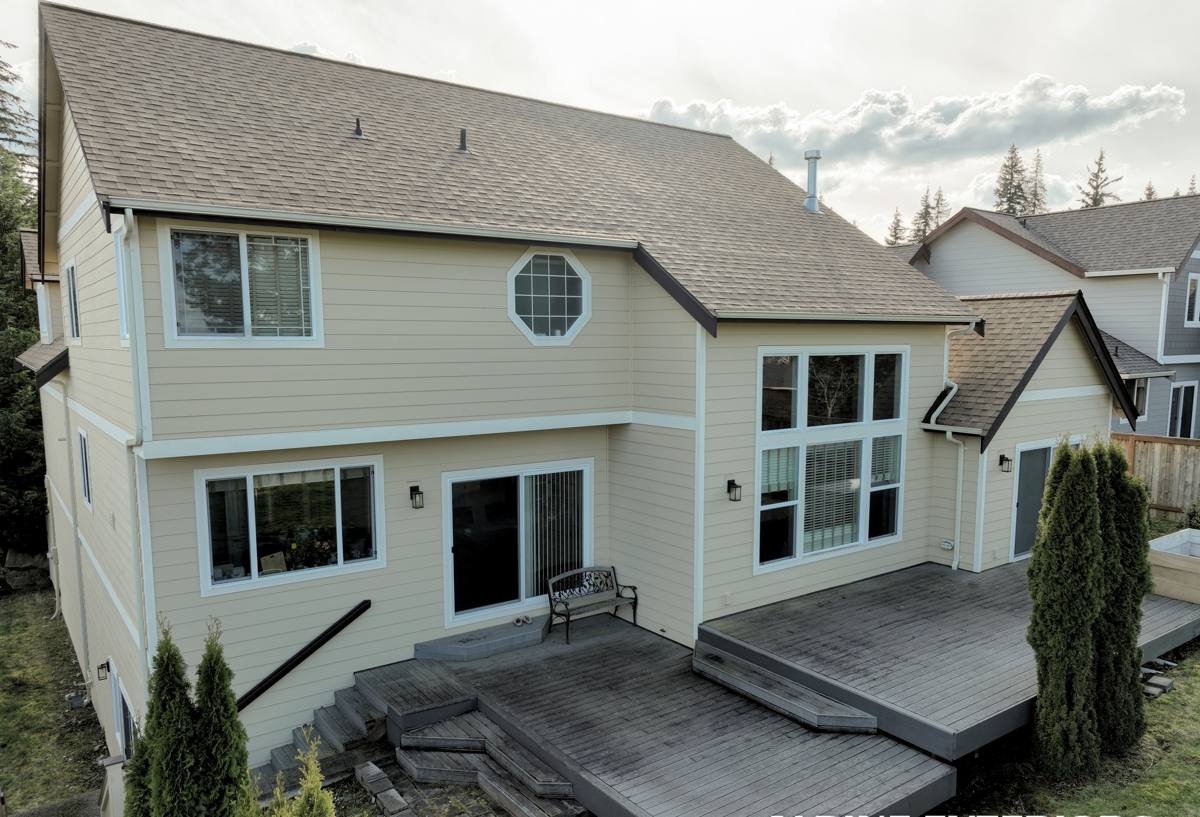
What Salt Air Actually Does to a Deck
Salt air is corrosive to bare and lightly coated steel, and it doesn't take direct ocean spray to cause damage — the moisture in the air alone is enough over a few seasons. On a deck, that shows up first in the small stuff: nail heads bleeding rust streaks down decking boards, joist hangers weakening at the bend points, and screw heads that strip or snap when you try to remove them a few years in. Once fastener corrosion starts, it's not a cosmetic problem — hangers and structural screws are what's holding the deck together.
The fix is straightforward but has to be specified up front: stainless steel or heavy hot-dip galvanized hardware rated for coastal exposure, not the standard-duty galvanized fasteners that are fine forty miles inland but undersized for a property near Semiahmoo's shoreline.
Driving Rain and the Places Decks Actually Fail
Most deck failures we see aren't from the decking surface itself — they're from water getting into the structure underneath. Two spots matter most:
The ledger board connection
Where the deck attaches to the house is the single most common source of rot on any deck in a wet climate, and driving rain makes it worse because water gets pushed up and behind trim rather than just running down it. A correct ledger installation uses proper flashing that laps over the house's water-resistive barrier — not caulk alone — with a drainage gap or flashing tape system behind the board so any water that does get in has somewhere to go besides the framing.
Joist tops and end cuts
Every joist top and cut end is exposed wood, and exposed wood facing repeated wetting is where rot starts. Joist tape over the top of each framing member, and sealing or capping cut ends, keeps water from soaking into the wood grain even when the decking above is doing its job.
Moss, Algae, and Deck Surfaces in This Microclimate
Whatcom County's damp season runs long, and shaded or low-airflow decks near the water hold moisture even longer than decks a few miles inland. Moss and algae need three things to establish: moisture, low light, and something to grip onto. A deck surface that's slow to dry — because of tight board spacing, poor airflow underneath, or heavy tree cover — will grow moss no matter what material it's built from.
Two things reduce this at the build stage: proper board spacing so water drains through rather than sitting on the surface, and adequate ventilation underneath the deck so air can actually move and dry things out between rain events. Material choice matters too, but it's a secondary factor behind drainage and airflow — even the most algae-resistant composite will grow moss if it never dries.
Choosing the Right Decking Material for a Semiahmoo Property
There's no single right answer here — it depends on how much upkeep you want to do and what look you're after. What we won't do is put a client into a product that fights the local climate. Here's how the common options actually compare for a coastal, wet-winter property:
| Material | Salt air performance | Moss/algae resistance | Maintenance |
|---|---|---|---|
| Pressure-treated wood | Good if fasteners are corrosion-rated; wood itself is unaffected by salt | Moderate — needs cleaning and occasional treatment | Annual cleaning, periodic staining/sealing |
| Cedar | Naturally rot-resistant, holds up well near water | Moderate — same drainage/airflow rules apply | Regular sealing to maintain color and resistance |
| Capped composite | Excellent — no bare wood or metal fiber exposed to corrode | Good — capped surface sheds moisture and resists staining | Occasional washing, no staining or sealing |
| PVC decking | Excellent — fully synthetic, unaffected by salt exposure | Good to very good depending on surface texture | Lowest — periodic washing only |
For homes closest to the water where salt exposure is heaviest and upkeep time is limited, capped composite or PVC decking tends to be the practical choice. For homeowners who want a natural wood look and are willing to stay on top of sealing, cedar performs well as long as the structure underneath is detailed correctly.
What we won't install without a conversation first
Uncapped or budget composite boards can absorb moisture at cut edges and fastener holes over time, which becomes a real issue in a climate this wet. We'll walk you through the trade-off honestly rather than let a lower material cost turn into a maintenance headache five years out.
Footings, Framing, and the Ground Under the Deck
Soil conditions vary across Semiahmoo properties, from sandier ground near the water to heavier soil further back from the shoreline. Footing depth and sizing need to match both the local frost line and what the soil can actually support — this isn't a spot to guess, and it's part of why a permitted, inspected footing plan matters even on a straightforward deck. Framing lumber should be rated for ground contact where it's within a few inches of grade, and any structural post base should be a raised, corrosion-rated connector rather than wood sitting directly on or in concrete, which traps moisture against the post.
Railings and Hardware Near the Water
Railings take direct weather exposure and get touched constantly, so material choice here affects both longevity and feel underhand. Aluminum railing systems are a strong option near Semiahmoo's shoreline because they're inherently corrosion-resistant and need almost no upkeep. Wood railings can look great but require the same sealing discipline as wood decking. Cable railing is popular for the unobstructed water views many Semiahmoo properties have, but the cable and hardware need to be true stainless (not just stainless-coated) or the salt air will find the weak point within a few seasons.
Our Deck-Building Process
- On-site assessment — we look at sun exposure, prevailing wind and rain direction, drainage, and how close the site is to the water, since that changes fastener and material recommendations.
- Design and material selection — we walk through decking, railing, and structural options against your budget and how much maintenance you actually want to do.
- Permitting — we handle the Whatcom County permit and inspection process so footing and structural work is signed off correctly.
- Framing and structural work — corrosion-rated hardware, flashed ledger connections, joist tape, and properly sized footings, done in that order and not skipped to save a step.
- Decking, railing, and finish work — installed with attention to drainage gaps and airflow underneath so the deck can actually dry between rain events.
- Final walkthrough — we go over care and maintenance specific to the material you chose before we consider the job done.
Checklist: What a Correctly Built Semiahmoo Deck Includes
- Flashed, gapped ledger connection at the house — not caulk-only
- Stainless or heavy-duty galvanized hardware rated for coastal/salt exposure
- Joist tape or sealed end grain on all cut framing members
- Footings sized for local soil and frost conditions, permitted and inspected
- Decking spacing and underdeck airflow planned for fast drying, not just appearance
- Railing hardware matched to the railing material's actual corrosion rating
- A maintenance plan you were actually told about before the invoice, not after a callback
Maintenance in a Long Moss Season
Even a well-built deck needs some seasonal attention here. A yearly rinse and light scrub before the wet season sets in keeps moss from getting a foothold, and clearing leaves and debris from between boards and off the ledger flashing area prevents standing moisture. Wood and cedar decks need sealing on a schedule — skipping a year in this climate shows up faster than it would inland. Composite and PVC surfaces need far less, but periodic washing still keeps algae from staining the cap surface. None of this is difficult, but it matters more here than in a drier part of the state, and we'll tell you exactly what your specific deck needs before we leave the job site.
Why Local Experience on This Specific Job Matters
A deck built to a generic spec sheet can look fine the day it's finished and still fail early near the water. Knowing which fastener grade actually holds up on a Semiahmoo property, how far the ledger flashing needs to extend given the prevailing rain direction, and how much airflow a given deck footprint needs to fight off moss isn't something you get from a manual — it's something you learn building decks in this exact climate, on this exact stretch of coastline. That's the difference between a deck that needs re-fastening in five years and one that's still solid in twenty-five.
If you're planning a new deck or replacing one that's showing its age, we're happy to take a look and walk you through what your property specifically needs. Reach out for a free, no-pressure estimate using the form below.