 Birch Bay Siding
 A Roof Built for Point Roberts' Particular Kind of Weather
Point Roberts sits out on its own point of land, surrounded on three sides by the Salish Sea, which means every home there takes a steadier dose of salt-laden wind than a house even a few miles inland. Add in the driving rain that blows through Whatcom County off the water, long gray stretches where roofs barely get a chance to dry out, and the moss season that follows, and you've got a roofing environment that's harder on materials than most manufacturers' warranty language assumes. A roof that performs fine in a drier part of the state can fail early out here, not because it was installed wrong, but because it was never designed for this kind of exposure.
Metal roofing, done correctly, holds up well against all three of those pressures — salt, wind, and moisture — better than most other roofing materials available at a comparable price point. But "metal roofing" covers a wide range of products and installation quality, and on a site like Point Roberts, the details matter more than the marketing.
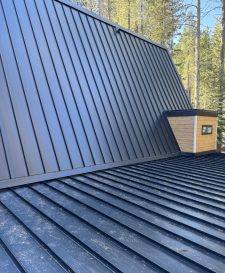
Why Metal Makes Sense Here
The case for metal roofing in this area comes down to how it handles the specific stresses of a coastal, moss-prone climate:
- Salt exposure — properly coated metal resists the corrosion that eats away at fasteners, flashing, and cheaper roofing hardware over time near saltwater.
- Wind uplift — a correctly fastened metal roof system, especially standing seam, has a much higher wind rating than most shingle products, which matters on an exposed point of land.
- Moss and moisture — metal doesn't hold water in a mat of overlapping fibers the way shingles do, so it dries faster and gives moss less to grab onto, though it isn't immune to growth in shaded, damp spots.
- Longevity — a well-installed metal roof is a decades-long investment, which matters on a peninsula where every roofing job means a longer trip for whoever's doing it.
None of that means metal is maintenance-free or automatically the right call for every house. It means that when the climate is working against your roof this consistently, metal's strengths line up well with the problem.
Panel Types, Fasteners, and Coatings — What Actually Matters
Not all metal roofing is built the same, and the differences matter more in a salt-air environment than they would somewhere drier. The two broad categories homeowners run into are standing seam and exposed-fastener panels.
| System | How it's fastened | Coastal performance | Typical use case |
|---|---|---|---|
| Standing seam | Concealed clips, no exposed screws through the panel face | Best long-term resistance to leaks and fastener corrosion; no exposed screw heads to fail | Full roof replacements, higher-exposure sites, longer-term ownership |
| Exposed-fastener panel | Screws driven through the panel face into the deck | Lower upfront cost, but every screw and washer is a future maintenance point in salt air | Outbuildings, budget-conscious projects, shorter time horizons |
On an exposed-fastener roof, the washers and screw heads are the first thing to show wear near the water — they can loosen, back out slightly, or degrade well before the panel itself does. Standing seam avoids that failure point entirely because there's nothing penetrating the panel face. It costs more up front, but on a site like this, that's often the more honest long-term value.
Coating matters just as much as panel style. We favor panels with a PVDF (often sold under names like Kynar-type finishes) coating system over cheaper polyester finishes. PVDF coatings hold color and resist chalking and corrosion in coastal air far longer — the difference shows up as the roof ages, not on day one, which is exactly why it's easy to overlook when comparing quotes.
Fasteners and Flashing Metal
The fasteners and flashing are where a lot of otherwise-good metal roofs go wrong near the water. Mixing incompatible metals — say, an uncoated steel fastener against an aluminum panel — sets up galvanic corrosion that eats away at the contact point over time. We match fastener and flashing metal to the panel system on every job, and we use stainless or properly coated fasteners rated for coastal exposure rather than whatever's cheapest at the supply house.
The Installation Details That Actually Prevent Leaks
A metal roof's weather resistance comes almost entirely from the details underneath and around the panels, not the panels themselves. This is where a rushed install shows up as a leak two or three winters later.
Underlayment. We install a high-temperature synthetic or peel-and-stick underlayment as a second line of defense, particularly at eaves, valleys, and anywhere wind-driven rain can push water sideways and up under a panel edge.
Flashing at every penetration and transition. Vents, chimneys, wall-to-roof transitions, and valleys all need custom-formed flashing, not caulk. Caulk is a maintenance item, not a waterproofing strategy, and it fails faster in salt air than most people expect.
Ventilation. A roof deck that can't breathe traps moisture underneath the metal, which leads to condensation, rot, and premature failure of the decking itself — even if the metal on top looks fine. We check and correct intake and exhaust ventilation as part of the job, not as an afterthought.
Panel layout and seams. On standing seam roofs, panel runs and seam placement are planned to shed water efficiently given the roof's actual slope and prevailing wind direction, rather than just running panels edge to edge in the fastest configuration.
Moss, Algae, and Salt: The Maintenance Reality
Metal roofing needs less maintenance than shingles, but "less" isn't "none," especially in a climate that stays damp and shaded for long stretches of the year. A basic annual check catches small problems before they become roof problems.
- Clear debris and organic buildup from valleys and low-slope areas where moss is most likely to take hold
- Check gutters and downspouts are clear so water isn't backing up under the roof edge
- Look at exposed fasteners (if present) for early signs of corrosion or backing out
- Check sealant and flashing at penetrations rather than assuming it's still doing its job
- Rinse off salt residue and organic growth on shaded or north-facing slopes where moss tends to establish first
- Watch for any panel movement, oil-canning, or fastener loosening after major wind events
None of this is heavy work, but it's easy to skip when a roof is out of sight, and it's the kind of thing that's simpler to handle when you already have a relationship with the crew that installed it.
Why a Crew That Already Works Point Roberts Is Different
Point Roberts is a U.S. exclave — the only practical way in or out by land is through Canada, which means every trip for materials, equipment, or a callback involves a border crossing. That's not a small logistical detail. A contractor who hasn't planned for it will either pass the cost and delay on to you, show up without the right materials on hand, or simply avoid quoting the job at a fair price because the trip is a hassle for them.
We already build our scheduling and material staging around that reality. Measurements, material orders, and crew logistics get sorted out before the crossing, not improvised on the day, so a Point Roberts job doesn't turn into a string of extra trips at your expense. It also means that if something needs a follow-up visit — a flashing detail, a warranty check, storm damage — you're not starting from scratch with a contractor who's never made the trip before.
Our Process, Start to Finish
- On-site assessment. We look at your existing roof, deck condition, ventilation, and any problem areas — not just measure for panels.
- Written estimate. You get a clear scope: panel type and coating, fastener and flashing plan, underlayment, and what happens with tear-off and disposal.
- Material staging. Panels and hardware are ordered and confirmed before the crew crosses over, so the job isn't waiting on a second trip mid-project.
- Tear-off and deck check. We inspect the decking once the old roofing is off and flag any rot or soft spots before covering them up.
- Install. Underlayment, flashing, and panels go on in that order, with attention to the transitions and penetrations that actually determine whether the roof leaks.
- Final walkthrough. We go over the finished roof with you, including what basic maintenance looks like going forward.
What Affects the Cost of a Point Roberts Metal Roof
Every roof is different, so exact pricing depends on your specific home, but these are the factors that move the number most:
| Factor | Why it affects cost |
|---|---|
| Panel system (standing seam vs. exposed-fastener) | Concealed-fastener systems cost more in material and labor but reduce long-term maintenance and leak risk |
| Coating quality | PVDF-type finishes cost more upfront than basic polyester coatings but hold up longer in salt air |
| Roof complexity | Valleys, dormers, and multiple roof planes require more custom flashing and labor time |
| Deck condition | Rot or soft decking found during tear-off adds repair cost before new roofing goes on |
| Tear-off vs. overlay | Removing old roofing adds cost but lets us properly inspect and prep the deck underneath |
| Site access and logistics | Point Roberts' location adds planning and trip coordination that we account for upfront, not as a surprise line item |
We'd rather walk you through these trade-offs honestly during the estimate than quote a bare-bones number that turns into surprises later. A cheaper exposed-fastener system isn't wrong for every situation, but you should know what you're trading for the lower price, not find out during the next windstorm.
Is Metal the Right Call for Your Home?
Metal roofing isn't automatically the best answer for every house. If your roof has a lot of complex geometry, a tight budget, or a shorter ownership horizon, other roofing materials might make more sense, and we'll tell you that in the estimate rather than push metal because it's what we're standing on your roof to sell. What we won't do is install a metal system without the flashing, underlayment, and fastener details it needs just to hit a lower price — that's how a roof that should last decades ends up leaking in year three.
If you're weighing a metal roof for a home in Point Roberts, we're glad to take a look and give you a straightforward read on your specific roof — no pressure, no upsell script. Fill out the form below and we'll set up a free estimate.