 Birch Bay Siding
 Siding Repair Built for Lynden's Weather, Not a National Playbook
Homes in and around Lynden deal with a specific combination of conditions: damp marine air pushed inland off Birch Bay and the Salish Sea, long stretches of driving rain through fall and winter, and a moss season that can run most of the year in shaded, north-facing spots. That combination is hard on siding in ways that a generic "we fix siding" company doesn't always plan for. A repair crew that works this area regularly knows where water actually gets in on homes built for this climate, not just where a manual says it should.
Siding repair done right is not cosmetic patchwork. It is diagnosis first, then a fix that matches the performance of the surrounding wall system. That is the standard we hold every repair to, whether it is one damaged board or a full section that has been quietly failing behind the surface.
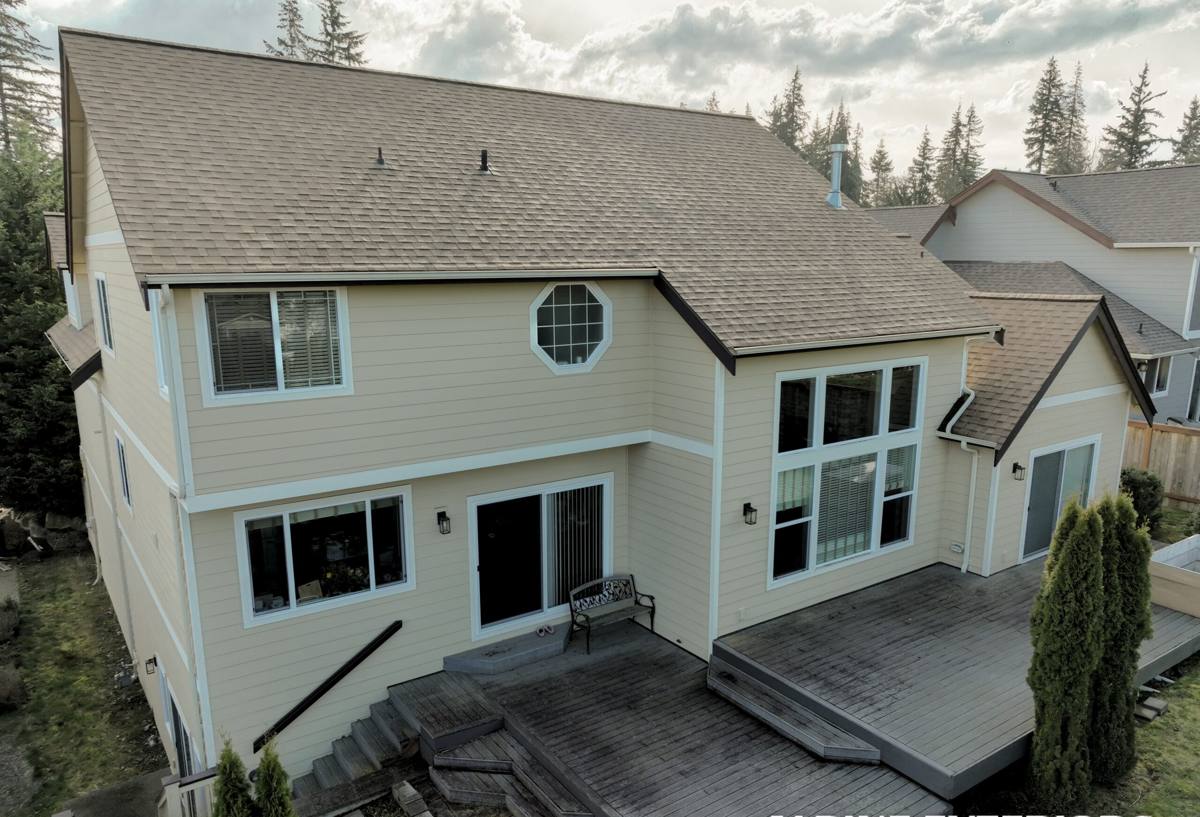
What Salt Air, Rain, and Moss Actually Do to Siding
Salt-Laden Air
Proximity to Birch Bay means airborne salt is a real factor, even a few miles inland toward Lynden. Salt accelerates corrosion on exposed fasteners, flashing, and metal trim, and it can degrade some paint and coating systems faster than manufacturers' inland test data predicts. Repairs that don't account for this often fail again within a few years.
Driving Rain
Whatcom County's wind-driven rain doesn't just fall straight down — it gets pushed sideways into laps, joints, and butt seams. Siding that was installed with tight or improperly caulked seams, or without correct lap spacing, gives that wind-driven water a path behind the cladding. Once water gets behind siding, the damage is almost always worse than what's visible from the outside.
Extended Moss Season
Shaded walls, tree cover, and consistently damp conditions let moss and algae establish on siding surfaces for much of the year in this area. Beyond appearance, sustained moss growth holds moisture against the siding surface longer than open sun-exposed walls, which matters most for products that aren't dimensionally stable when saturated.
Common Repair Scenarios We See in the Lynden Service Area
- Swollen or delaminating boards at ground level or near downspouts, where splash-back keeps siding wet longer than the rest of the wall
- Cracked or buckled panels around window and door trim where caulking has failed and let water track behind the siding
- Soft or spongy sections discovered during a routine inspection, often indicating moisture has been present behind the cladding for some time
- Failed caulk joints at seams and penetrations, especially on walls that take direct driving rain
- Persistent moss or algae staining on shaded elevations that keeps returning after cleaning
- Impact damage from storm debris, ladders, or landscaping equipment
- Fastener corrosion showing as rust streaking or popped nail heads, more common closer to the bay
Why "Just Patch It" Is the Wrong Question
The first question on any repair call shouldn't be "can you patch this board," it should be "why did this board fail, and is it isolated." A board that swelled or cracked is often a symptom, not the problem. Common root causes we check for before doing any repair work include:
| Root Cause | Why It Matters in This Climate |
|---|---|
| Missing or damaged flashing above windows/trim | Driving rain finds this gap first; a patched board will fail again without a flashing fix |
| Incorrect lap or panel spacing at original install | Allows wind-driven rain behind the siding on exposed elevations |
| Caulk used where flashing or drainage was needed | Caulk alone doesn't manage bulk water in a high-rainfall area long-term |
| Trapped moisture from moss/debris buildup | Extends how long the wall assembly stays wet, speeding deterioration |
| Original product not rated for this exposure | Some siding materials handle sustained moisture and salt exposure worse than others |
Skipping this step is how homeowners end up paying for the same repair twice. We diagnose the cause first, then scope the repair to actually solve it.
Our Repair Process
1. On-Site Inspection
We look at the damaged area and the surrounding wall system — trim, flashing, caulk lines, and drainage paths — not just the board that's visibly failing. On homes with James Hardie siding already installed, we also check whether the damage is isolated or a sign of an installation issue elsewhere on the same elevation.
2. Honest Scope and Options
We explain what we found in plain terms: what needs to be replaced, what's just cosmetic, and what the underlying cause was. If the fix is a simple board swap, we say so. If it's part of a larger moisture problem, we say that too.
3. Matched Material Repair
Where the home already has James Hardie fiber cement, we repair with Hardie product matched to the existing line, profile, and ColorPlus finish so the repair doesn't stand out as a patch job. Where a repair area is part of a broader replacement, we install Hardie's climate-engineered HZ5 product, which is specified for the Pacific Northwest's wet, moderate-freeze conditions.
4. Correct Flashing and Drainage
Any repair we do includes correcting the flashing, lap spacing, or drainage detail that let water in, not just swapping the damaged piece for a new one installed the same way.
5. Finish and Cleanup
Fastener patterns, caulk lines, and paint finish are matched so the repaired section reads as part of the wall, not a visible add-on.
Why We Only Repair and Replace With James Hardie
We don't install LP SmartSide, vinyl, Cemplank, Allura, primed spruce, or cedar, and that includes repair work. Those products have real strengths in the right application, but on the coastal, high-rain side of Whatcom County we've standardized on one system because it holds up consistently:
- Non-combustible fiber cement — doesn't feed a fire the way wood-based products can
- Dimensionally stable when wet — resists the swelling and buckling that shows up on wood composite products in sustained damp conditions
- Climate-engineered HZ5 line — formulated for the moisture cycles common in this part of Washington
- Factory-applied ColorPlus finish — better long-term color and coating adhesion than field-applied paint on repair sections, and better resistance to the fading and chalking that salt-air exposure can accelerate
- Strong transferable warranty — backed by the manufacturer when installed to spec, which matters if the home changes hands
When we repair a Hardie-sided home, we're extending a system we trust. When a repair calls for replacing a section of a different product, we'll say plainly why we'd recommend transitioning that section to Hardie rather than sourcing a matching product we don't stand behind.
What a Correct Repair Should Include — Homeowner Checklist
- A written explanation of the root cause, not just the visible symptom
- Confirmation that flashing and drainage details are corrected, not just the board
- Material matched to the existing siding line, profile, and finish where applicable
- Fastener and caulk work appropriate for a coastal, high-rain exposure
- A check of adjacent areas on the same elevation for early signs of the same failure
- Clear scope in writing before work begins — no surprise add-ons mid-job
When Repair Isn't the Right Call
Not every damaged section should be repaired in isolation. If moisture has been present long enough to affect the sheathing or framing behind the siding, or if the same failure pattern shows up in multiple spots on one elevation, patching individual boards just delays a larger fix. Part of an honest inspection is telling you when a targeted repair makes sense versus when a section — or the whole elevation — needs a full re-side. We'll walk you through that difference rather than defaulting to the smaller, more billable job.
Why Local Experience in Lynden and Birch Bay Matters
A crew that regularly works this stretch of Whatcom County has already seen how the salt air, rain exposure, and moss conditions specific to this area play out on real homes over time. That means faster, more accurate diagnosis, fewer surprises once a wall is opened up, and repair decisions grounded in what actually holds up here rather than generic manufacturer guidance written for a different climate. It also means a crew that's still local and reachable if a repaired section needs a follow-up look.
If you've got a section of siding that's cracked, swollen, stained, or just not looking right, we're glad to take a look. Fill out the form below for a free, no-pressure estimate — we'll tell you honestly what we find and what it would take to fix it right.