 Birch Bay Siding
 Why Lynden Roofs Wear Differently Than You'd Expect
Lynden sits inland from the water, but it doesn't escape the weather pattern that defines this part of Whatcom County. Moist marine air moves in off the Sound and settles over the whole region, and Lynden gets its share of long, low-pressure stretches where rain doesn't fall so much as blow sideways for days at a time. Add in the shaded, tree-lined lots common to older Lynden neighborhoods, and you get a roof climate built for moss, slow leaks, and flashing that fails quietly before anyone notices a stain on the ceiling.
None of that means a Lynden roof needs constant repair. It means the repairs it does need are specific ones — moss-related shingle damage, valley and flashing failures from driving rain finding the one gap it can, and slow rot in areas that stay damp longer than they should because of shade and poor airflow. A repair that ignores those root causes tends to fail again within a season or two.
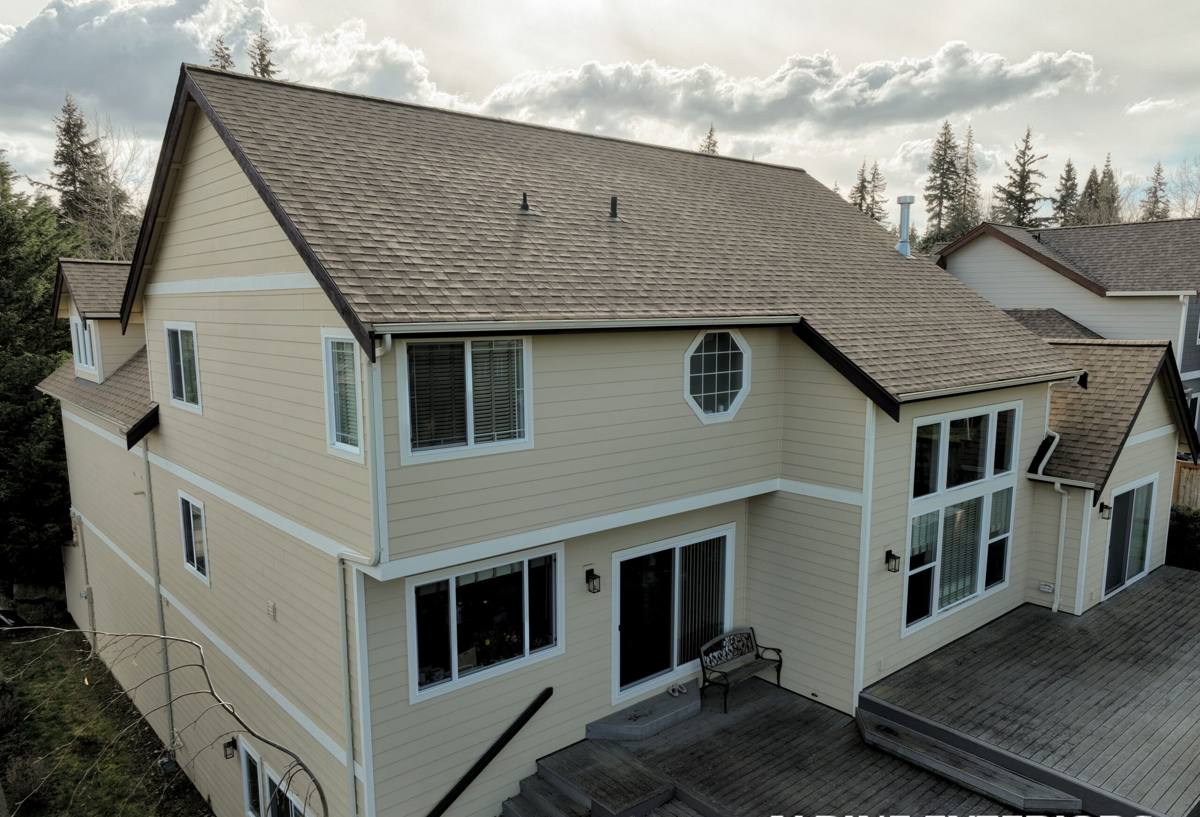
Signs a Lynden Roof Needs a Real Repair, Not Just a Look
Most roof problems don't show up as a hole. They show up as small, easy-to-dismiss signs first. Homeowners who catch these early usually pay for a repair instead of a replacement.
- Dark streaks or green-black patches on north-facing or shaded slopes — early moss and algae growth
- Granules collecting in gutters or at downspout outlets — shingles losing their protective coating
- Soft spots or slight sagging along a valley or eave
- Water stains on interior ceilings that appear after a hard, wind-driven rain but not after a light one
- Daylight visible through the attic at roof edges, ridges, or around vent pipes
- Curling, cracked, or lifted shingle edges, especially on slopes that get the most direct rain
Any one of these is worth a look. Several together usually mean water has already found a path in, even if it hasn't shown up inside the house yet.
What a Correct Roof Repair Actually Involves
A proper repair isn't patching the spot you can see and calling it done. It's tracing the water back to its actual entry point, which is frequently several feet from where the stain or soft spot appears, since water travels along the underlayment and framing before it drips somewhere visible.
Diagnosis Before Anything Gets Touched
We start on the roof, not the ceiling. That means checking flashing at every penetration — chimneys, vent stacks, skylights — along with valleys, ridge caps, and the transitions where different roof planes meet. These are the parts of a roof that are built from separate pieces joined together, and joints are always where failures start.
Matching the Fix to the Cause
A nail pop, a cracked pipe boot, a valley that was flashed with the wrong material, moss that's lifted shingle edges and let wind-driven rain underneath — each of these gets a different repair. Using the same generic patch for all of them is how a "fixed" roof ends up leaking again the next wet season.
The Problem Areas We See Most Often
Moss and Shaded Slopes
Moss doesn't just look bad. As it grows, it holds moisture against the shingle surface and works its way under tabs and edges, lifting them slightly and creating a path for rain to get underneath even on a mild storm. Left long enough, moss growth can accelerate shingle wear years ahead of schedule, particularly on north-facing slopes that never fully dry out between rains.
Flashing and Valleys
Valleys carry more water than any other part of a roof, and they're where driving, wind-blown rain is most likely to get pushed uphill under a shingle edge instead of running straight down. Flashing that was installed short, or sealed with caulk instead of properly lapped metal, is one of the most common repair calls we get regardless of the roof's age.
Vent Boots and Penetrations
Rubber pipe boots crack with age and sun exposure well before the shingles around them wear out. It's a small part, but it's one of the most frequent sources of a slow attic leak that goes unnoticed for a season or more.
Our Repair Process, Start to Finish
- Roof and attic inspection — we check the suspected area and the attic space beneath it, since attic staining and insulation condition often reveal how long water has been getting in
- Written diagnosis — we explain what's actually failing and why, in plain terms, before any work starts
- Scope and estimate — a clear description of the repair, materials, and what it will and won't address
- The repair itself — removing and replacing only the damaged materials, correcting the underlying cause (flashing, ventilation, moss growth) rather than sealing over it
- Cleanup and debris removal — old shingles, moss, and granule debris cleared from gutters and the ground
- Follow-up — a plain explanation of what to watch for and when, if ever, the repaired area might need further attention
Repair or Replacement? How We Actually Decide
Not every roof with a leak needs to come off. But a roof with widespread granule loss, multiple failed flashing points, or moss damage across most slopes is often past the point where isolated repairs make financial sense. Here's how we think through that decision honestly.
| Factor | Repair Usually Makes Sense | Replacement Usually Makes Sense |
|---|---|---|
| Age of roofing | Roof is well within its expected service life | Roof is at or past the age where the material naturally wears out |
| Extent of damage | Isolated to one valley, vent, or slope | Multiple areas failing independently across the roof |
| Granule loss | Localized to the damaged area | Widespread, visible in gutters roof-wide |
| Decking condition | Solid, no soft spots underneath | Soft, spongy, or visibly rotted sheathing |
| Moss coverage | Light, treatable, confined to shaded slopes | Heavy coverage that's already lifted shingles across large areas |
We'll tell you plainly which side of that line your roof falls on, including when a repair is the right call even though a replacement would be more profitable for us to sell.
Materials and Methods We Use — and Why
For flashing and valley repairs, we use properly lapped metal flashing rather than caulk or sealant as a primary water barrier. Caulk and roofing cement have their place as a secondary seal, but relying on them alone to keep water out of a valley is a maintenance burden that never really ends — they degrade with UV exposure and need reapplication, whereas correctly lapped flashing sheds water by shape and gravity, not adhesion.
For moss-affected shingles, we treat the underlying growth and address the airflow or shading issue that's letting moss establish itself in the first place, rather than just replacing shingles that will grow moss again within a couple of years for the same reason. Where ventilation is part of the problem, we'll say so directly, since a repair that ignores poor attic airflow is only a temporary fix.
Why a Crew That Already Works Lynden Matters
A roof repair isn't just about the materials — it's about correctly reading how a specific roof responds to the specific weather it actually gets. A crew that regularly works Whatcom County roofs already understands how driving rain behaves in a valley, how long moss takes to establish on a shaded slope in this climate, and which repair shortcuts fail within a year versus which hold up. That's not something you get from a general handyman or a crew that mostly works drier inland climates.
It also means faster, more accurate estimates. We're not guessing at how the regional weather affects a repair — we're applying what we've already seen hold up, and what hasn't, on roofs facing the same rain and moss conditions as yours.
Between Repairs: A Homeowner's Maintenance Checklist
A good repair lasts longer when it's not fighting neglect in between. These are the basics that meaningfully extend the life of any roof repair in this climate.
- Clear gutters and downspouts at least twice a year, more often under overhanging trees
- Have moss treated at the first sign of growth rather than waiting for visible shingle damage
- Trim back tree limbs that overhang the roof to reduce shade, debris, and abrasion
- Check the attic after major windstorms for new water stains or daylight at the roofline
- Avoid pressure washing a roof — it strips protective granules and can force water under shingles
- Have flashing and valleys visually checked every couple of years, even without an active leak
If you're dealing with a leak, moss buildup, or storm damage on a Lynden roof, we're happy to take a look and give you a straight answer — repair or otherwise. Fill out the form below for a free, no-pressure estimate.