 Birch Bay Siding
 Building Decks for Point Whitehorn's Marine Climate
Point Whitehorn sits close enough to the water that every deck we build there has to answer to the same conditions: salt-laden air moving in off the Strait of Georgia, driving rain that comes in sideways more often than straight down, and long stretches of gray, damp weather where a deck surface may not fully dry out for days at a time. Add in the tree cover that's common on lots out this way, and you get moss and algae growth that starts early in the fall and doesn't quit until late spring. A deck built to a generic spec, without those specifics in mind, tends to show its age fast here — cupped boards, rusted fasteners, slick green film on the walking surface, and rot starting at the ledger or post bases within a handful of years.
We build decks in Birch Bay and the surrounding Whatcom County waterfront communities regularly, and Point Whitehorn's mix of exposure, tree canopy, and coastal humidity is something we plan for from the first conversation, not something we patch after the fact. This page covers what that actually looks like: material choices, structural details, drainage, and the maintenance realities specific to building a deck that's going to sit exposed to this coastline for the next few decades.
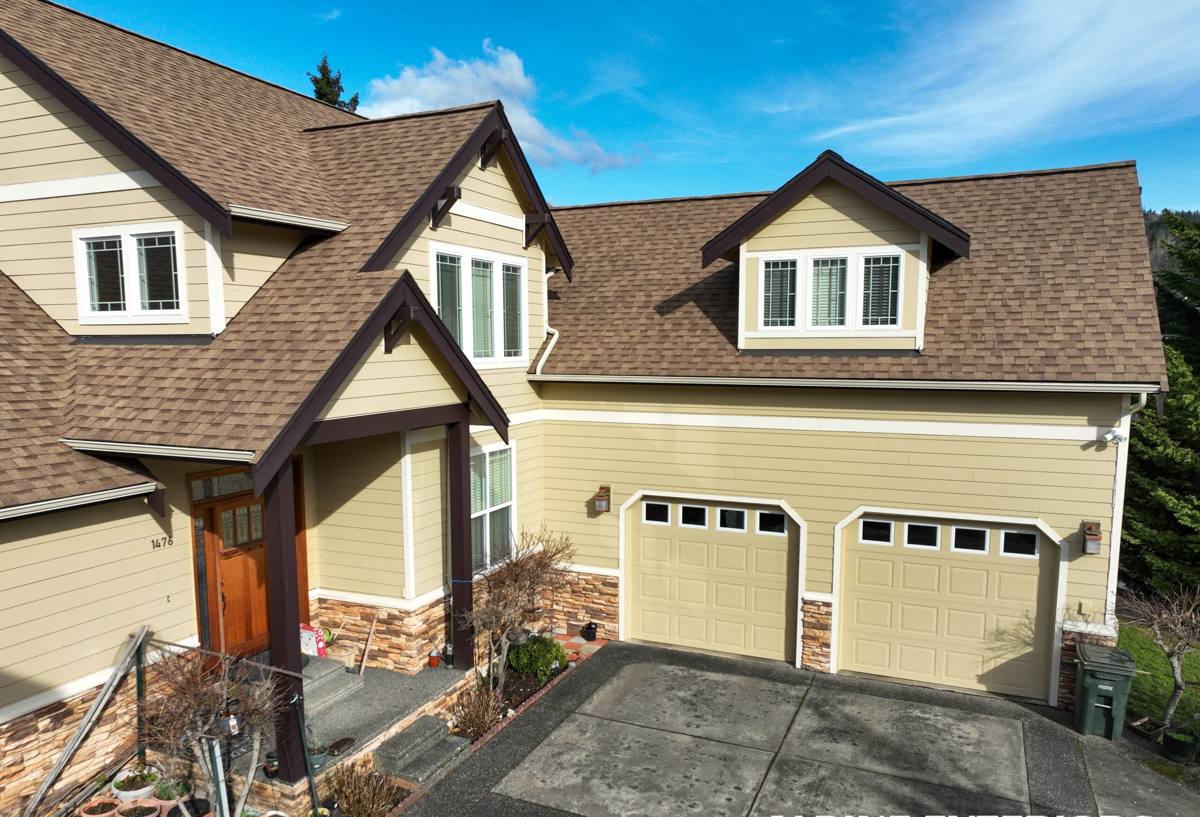
What the Local Climate Actually Does to a Deck
It helps to be specific about the failure modes we're designing against, rather than just saying "it's wet here."
Salt Air and Metal Fasteners
Airborne salt accelerates corrosion on anything metal — nails, screws, joist hangers, post bases, and railing hardware. Standard electro-galvanized fasteners that might hold up fine forty miles inland can start staining, weeping rust, and losing grip within a few seasons this close to the water. That rust doesn't stay put; it streaks down the face of the decking and stains wood and composite alike.
Driving Rain and Water Intrusion
Wind-driven rain off the water finds its way into places vertical rain never would — under railing caps, behind ledger boards, into end grain and fastener holes. Once water gets past the surface of a deck board or into a ledger connection, it doesn't evaporate quickly in our humidity, and that's when rot and structural decay start, usually out of sight.
Moss, Algae, and a Long Damp Season
Shaded or partially shaded decks near tree lines — common on Point Whitehorn lots — stay damp longer than open, sunny decks. That extended dampness is exactly what moss and algae need to establish. Beyond looking bad, a mossy deck surface is a real slip hazard, and moss holds moisture directly against the wood or composite surface, which shortens its life.
Decking Material Options and How They Hold Up Here
There's no single "best" decking material for every Point Whitehorn property — it depends on budget, how much shade the deck gets, and how much maintenance you're willing to keep up with. Here's how the common options actually perform in this specific climate.
| Material | Moisture & Salt Air Behavior | Moss/Algae Resistance | Maintenance Reality |
|---|---|---|---|
| Pressure-treated fir/hem-fir | Prone to checking and cupping as it cycles wet-dry; needs sealed cuts and fastener holes | Low — porous surface holds moisture, moss takes hold fast in shade | Annual cleaning, re-sealing every 1-2 years |
| Cedar | Naturally moisture- and insect-resistant, but still needs sealing against salt air graying and checking | Moderate — still needs regular cleaning in shaded spots | Sealing every 1-2 years, periodic cleaning |
| Composite decking | Doesn't absorb water or rot; stable in wet-dry cycling | Moderate to good depending on the product's surface texture — still needs periodic washing | Occasional washing, no sealing or staining |
| PVC/capped composite | Fully sealed surface, best resistance to moisture intrusion and salt staining | Good — smooth cap sheds moss and algae more easily than wood-grain composites | Occasional washing |
For a shaded, tree-lined Point Whitehorn lot, we're often steering homeowners toward composite or capped composite for the decking surface simply because it removes the wood's absorption problem from the equation. That said, plenty of homeowners want the look and feel of real wood, and cedar can be a solid choice if you're realistic about the sealing schedule it needs to stay ahead of the moisture and salt air.
The Structural Details That Actually Matter
The decking surface is what you see, but the framing, connections, and drainage underneath are what determine whether the deck is still sound in fifteen years. This is where a lot of decks — built by crews without local experience — start to fail first.
Ledger Attachment and Flashing
Where the deck attaches to the house is the single most common point of hidden water intrusion. We flash the ledger connection properly so driving rain can't work its way behind the board and into the house's rim joist. This detail matters more here than in a drier inland climate, precisely because of how much wind-driven moisture this coastline sees.
Fasteners and Hardware
We use stainless steel or high-grade coated fasteners and connectors rated for coastal/marine exposure rather than standard-grade hardware. It costs more up front. It's also the difference between hardware that's still solid in twenty years and hardware that's rust-streaked and loosening in five.
Post Bases and Footings
Posts that sit directly in or near standing moisture are where rot starts fastest. We keep post bases elevated off the concrete with proper standoff hardware so wood never sits in a puddle of trapped water, and we size footings to the frost and soil conditions typical of Whatcom County sites.
Airflow Underneath
A deck built low to the ground with poor airflow underneath stays damp longer after every rain, which speeds up rot in the joists and accelerates moss growth on the surface above. Where grade and design allow, we build in enough clearance and gapping to let air actually move underneath.
Drainage: The Detail Most Decks Get Wrong
Water has to go somewhere, and on a property with the rainfall totals this part of Whatcom County sees, "somewhere" needs to be a deliberate design choice, not an afterthought.
- Decking boards are spaced and sloped slightly away from the house so water sheds off the surface instead of pooling
- Board gapping accounts for our regional humidity and the material's expansion behavior, so gaps don't close up and trap moisture in wet months
- Ledger flashing directs any water that does get behind the board back out and away from the house framing
- Grading and downspout routing near the deck footprint are checked so runoff isn't pooling against posts or footings
- Railing post connections are sealed and capped so water can't collect in the post itself
Skip any one of these and the deck will still look fine for a season or two — the problems that come from poor drainage are slow-developing, which is exactly why they're so often missed by crews that aren't building for this specific climate day in and day out.
Our Deck Building Process
The process itself isn't unusual, but a few steps get extra attention because of where Point Whitehorn sits.
1. On-Site Assessment
We look at sun and shade exposure across the day, tree cover, prevailing wind and rain direction relative to the house, and existing drainage patterns on the lot before we design anything. Shade patterns especially change how we spec the decking material and how aggressive the moss-prevention detailing needs to be.
2. Design and Material Selection
We walk through decking material trade-offs honestly — wood versus composite, upfront cost versus long-term maintenance — based on your budget and how the deck will actually be used, not a one-size answer.
3. Permitting
Deck projects in Whatcom County typically require permitting depending on size, height, and attachment to the structure. We handle that process as part of the job so it's not something you have to navigate on your own.
4. Framing and Structural Work
This is where the ledger flashing, post base hardware, and fastener grade decisions covered above get built in — the part of the job that's invisible once the decking goes down but determines how long everything above it lasts.
5. Decking, Railing, and Finish Work
Surface material goes down with the spacing and slope needed for proper drainage, followed by railings, stairs, and any trim or finish details.
6. Walkthrough
We go over the finished deck with you, including what maintenance it actually needs going forward given the material you chose and where the deck sits on your property.
Keeping a Point Whitehorn Deck in Good Shape Long-Term
Even a well-built deck needs some upkeep in this climate — the goal of good construction is to reduce that burden, not eliminate it entirely.
- Sweep debris and standing leaves off the surface regularly, especially in shaded areas where moss gets a foothold fastest
- Rinse or lightly scrub the surface a couple times a year to knock back early moss and algae before it establishes
- Check railing posts and stair connections annually for movement or loose hardware
- Reseal wood decking on the schedule appropriate to that species — don't wait until it's visibly graying and checking
- Keep gutters and downspouts near the deck clear so runoff isn't dumping directly onto or against the structure
- Watch for any soft spots underfoot or discoloration around fastener heads, which can signal moisture getting past the surface
Why Hire a Crew That Already Works Point Whitehorn
Deck building isn't exotic work, but building one that holds up specifically against salt air, driving rain, and a long moss season is a different exercise than building one for a dry, inland lot. A crew that hasn't worked this stretch of Whatcom County coastline regularly may default to standard hardware, standard fastener spacing, and standard sealing schedules — none of which are wrong in general, but none of which are matched to what Point Whitehorn actually throws at a deck year-round. We've built and repaired decks throughout Birch Bay and this part of the county, which means the flashing details, hardware grade, and material recommendations on this page aren't theoretical — they're what we've seen actually hold up, and what we've seen fail when it's skipped.
If you're planning a new deck or replacing one that's showing its age, we're happy to come take a look at your property and talk through what makes sense for your specific site — the shade pattern, the exposure, and your budget. Reach out for a free, no-pressure estimate using the form below.