 Birch Bay Siding
 Cherry Point Is a Harder Place on Siding Than Most of Whatcom County
Cherry Point sits right on the water along the Strait of Georgia, and that location changes how siding ages. Homes here take a steady diet of salt-laden air, wind-driven rain coming almost straight off the water, and a moss season that runs long even by Pacific Northwest standards. None of that is unique to any one house in the area — it's the baseline. Siding that would hold up fine twenty miles inland can start showing real problems here years earlier, especially on the water-facing and north-facing walls that never fully dry out between storms.
That's the backdrop for every repair call we get out here. A patch that only addresses what's visible on the surface tends to fail again within a season or two, because the thing that caused the damage — trapped moisture, a bad flashing detail, an old caulk joint that gave out — is still there. A repair that's actually going to hold has to deal with the cause, not just the symptom.
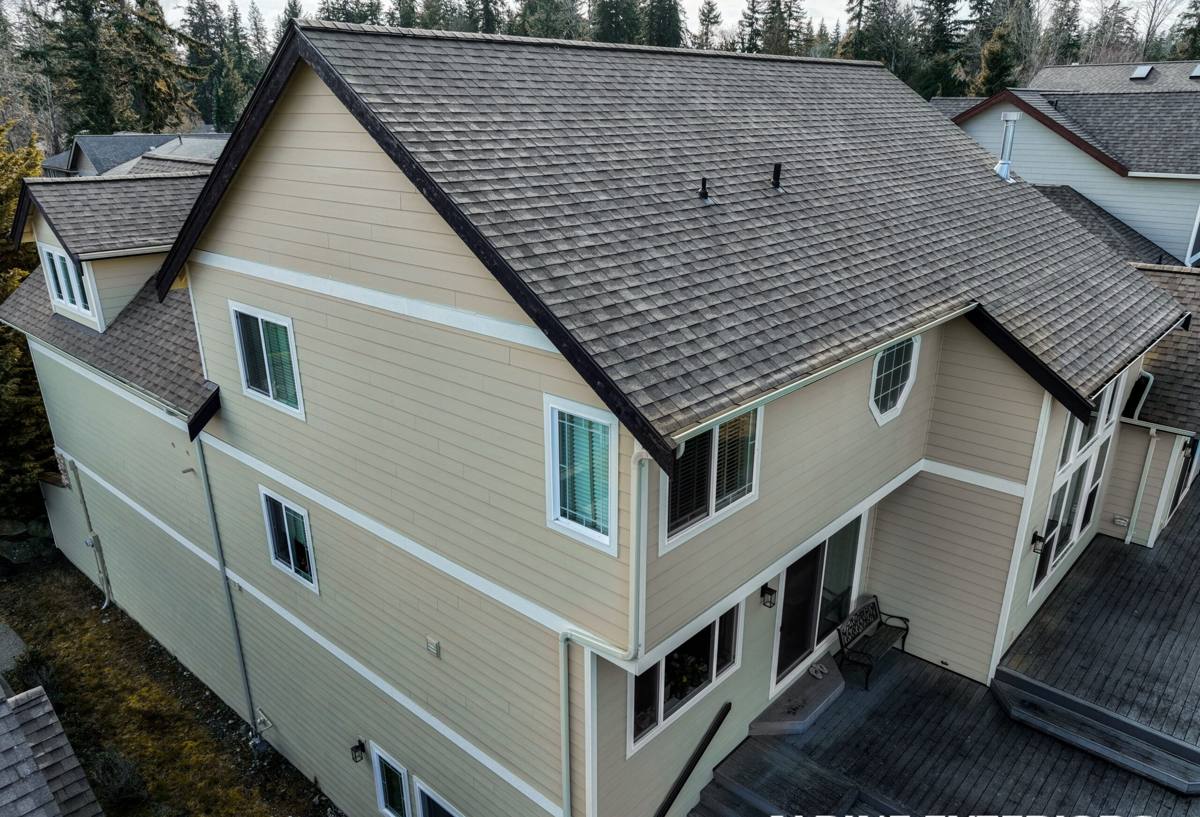
What Salt Air, Rain, and Moss Actually Do to Siding
Salt Air
Airborne salt is corrosive to metal fasteners, flashing, and trim, and it also accelerates the breakdown of paint films and caulk. On homes closer to the water, we see fastener corrosion and caulk failure well before the siding panels themselves show real wear. Once a fastener starts to corrode, it loses its grip and the panel around it starts to move — and movement is what lets water in.
Driving Rain
Wind off the water doesn't just drop rain straight down — it pushes it sideways, up under laps, and into any gap that isn't sealed correctly. Siding systems are designed to shed water downward and outward; wind-driven rain defeats that design when joints, seams, and penetrations (hose bibs, light fixtures, vents) aren't detailed correctly. That's usually where we find the actual damage during a repair inspection, even when the homeowner called about a completely different spot.
Moss
Whatcom County's wet season is long, and shaded or north-facing walls near trees stay damp for extended stretches. Moss and algae growth on siding isn't just cosmetic — it holds moisture against the surface, and on the wrong substrate that constant dampness works its way into seams and fastener holes over time. A repair on a mossy wall that doesn't also address why that wall stays wet is treating half the problem.
Signs a Cherry Point Home Needs Siding Repair
Most repair calls start with one visible problem, but a proper inspection usually turns up a short list. Here's what we look for and what homeowners can check themselves before calling:
- Soft or spongy spots when you press on the siding, especially near the bottom courses and around windows
- Visible cracking, chipping, or gaps at panel seams and butt joints
- Bubbling, peeling, or discolored paint in a localized area rather than across the whole wall
- Staining or dark streaks running down from a window head, trim piece, or roofline
- Fasteners that are rusting, backing out, or leaving rust streaks on the siding face
- Persistent moss or algae buildup in one section that keeps coming back after cleaning
- Warped, buckled, or separated boards, particularly on the side of the house that faces the water or prevailing wind
- Soft trim boards or corner boards near ground level
Any one of these can be a small fix. Several of them clustered in the same area usually means water has been getting in for a while, and the repair needs to open the wall up rather than just cap it over.
What a Repair Done Right Actually Involves
A siding repair isn't just cutting out a bad board and nailing in a new one. On a home in a marine environment, skipping steps is exactly how the same spot fails again.
Find the Real Source
Before any siding comes off, we trace the damage back to its cause — a failed sealant joint, a flashing detail that was never installed correctly, a gap where trim meets siding, or a penetration that was never flashed at all. If we don't fix the entry point, the new material fails on the same timeline as the old.
Check What's Behind the Siding
Once the damaged section is removed, we inspect the water-resistive barrier and sheathing underneath. If moisture has reached the sheathing, that gets addressed before anything new goes back up — covering damaged sheathing with new siding just hides a bigger problem.
Match the Material and the Finish
We repair with James Hardie fiber cement, matched to the existing plank width, texture, and ColorPlus finish wherever the original siding is Hardie. Patching a fiber cement wall with a different material creates a seam that behaves differently in the weather — different expansion, different moisture response, different long-term color — and that mismatch shows.
Reflash and Reseal Correctly
Every penetration, joint, and transition in the repaired area gets flashed and sealed to manufacturer spec, not just caulked over. In a location that gets this much wind-driven rain, correct flashing detail matters more than the caulk gun.
Fasten for the Environment
We use fasteners rated for the exposure, driven to the correct depth and spacing. Overdriven or corrosion-prone fasteners are one of the most common repeat-failure points we find on repair calls in this area.
Repair or Replace? How We Make That Call
Not every damaged wall needs a full re-side, and not every problem area is a quick patch. The right call depends on how far the damage has spread and what's happening underneath.
| Situation | Repair Is Usually Right | Full Replacement Is Usually Right |
|---|---|---|
| Extent of damage | Isolated to one or two wall sections | Recurring problems across multiple walls |
| Sheathing condition | Sound, no rot found on inspection | Soft or rotted sheathing found in multiple spots |
| Age of existing siding | Siding is mid-life and otherwise sound | Siding is near or past its expected service life |
| Material match | Existing product and color can be matched closely | Discontinued product or no reasonable match available |
| Underlying cause | Cause is a single fixable detail (flashing, sealant, fastener) | Cause is systemic (original install-wide moisture barrier failure) |
We'll tell you honestly which category your home falls into. If a repair will genuinely hold, we don't push a full re-side just to make the job bigger.
Why We Repair With James Hardie Fiber Cement — and Only Hardie
This company installs and repairs with James Hardie fiber cement exclusively. We don't install vinyl, LP SmartSide, or other fiber cement brands, and that's a deliberate standard, not a limitation of what we're capable of.
Vinyl siding can crack in cold snaps and warp or bow when it's exposed to sustained heat reflected off nearby surfaces, and its seams and J-channels give wind-driven rain more places to work its way in over time. LP SmartSide is a wood-strand product with an engineered resin coating; it performs reasonably when installation and caulking are kept up perfectly, but any breach in that coating exposes an engineered wood substrate, and coastal moisture exposure isn't forgiving of maintenance gaps. Both are legitimate products elsewhere. In a salt-air, high-moisture environment like Cherry Point, they ask more of ongoing maintenance than we're comfortable putting on a homeowner.
James Hardie fiber cement is non-combustible, dimensionally stable in wet-dry cycling, and doesn't support rot the way wood-based products can. The ColorPlus factory finish is baked on under controlled conditions and holds up to UV and salt exposure noticeably better than field-applied paint, and Hardie's HZ product lines are engineered specifically for climates like ours. When we repair a Hardie wall, we're extending a system that was built for this exposure in the first place — and if a homeowner's existing siding isn't Hardie, that's part of the conversation we'll have honestly about what a repair versus a longer-term switch makes sense.
Our Repair Process
- On-site inspection. We look at the damaged area and the surrounding wall, not just the spot that was reported.
- Diagnosis. We identify the actual water or damage source before proposing a fix.
- Written scope. You get a clear explanation of what's being repaired, why, and what it involves — no surprises once the wall is open.
- Removal and inspection behind the siding. We check the water-resistive barrier and sheathing before closing anything back up.
- Repair. Matched Hardie material, correct flashing and fastening, and sealants appropriate for this climate.
- Finish check. Color and texture match reviewed against the surrounding wall before we call the job done.
Why a Crew That Already Works This Stretch of Coastline Matters
Siding repair in Cherry Point isn't identical to siding repair in inland Whatcom County, and it's not identical to repair work in a drier climate either. A crew that hasn't worked exposed, water-facing homes before can miss the flashing details that matter here, or match material without accounting for how it'll actually perform under this level of wind and salt exposure. A crew that already works this area knows which wall orientations take the worst of the weather, what kind of damage patterns show up first, and how to detail a repair so it isn't a repeat call in two years.
There's also a practical side to this: local crews aren't guessing at drive time, permitting norms, or what typical Whatcom County homes in this area are built like. That translates into more accurate estimates and fewer surprises once work starts.
After the Repair: Keeping It From Happening Again
A correct repair should hold for years, but this climate doesn't let anyone fully set-and-forget their siding. A few habits go a long way:
- Rinse salt buildup off the siding periodically, especially on walls that face the water directly
- Keep gutters and downspouts clear so water isn't sheeting down the wall face
- Trim back vegetation that's shading a wall and keeping it damp, which is what drives moss growth
- Walk the exterior once or twice a year and check caulk joints around windows, doors, and trim for cracking or gaps
- Address small issues — a loose piece of trim, a cracked sealant bead — before the next storm season rather than after
If you're seeing damage, staining, or persistent moss on your siding and you're in the Cherry Point or greater Birch Bay area, we're glad to come take a look. The estimate is free, there's no pressure to sign anything on the spot, and you'll get a straight answer about whether you're looking at a repair or something bigger.