 Birch Bay Siding
 Point Whitehorn's Weather Is Rougher on Siding Than It Looks
Point Whitehorn sits close enough to the water that homes here take a different beating than siding just a few miles inland in Whatcom County. Salt-laden air off the strait works on fasteners, caulk, and finish coatings year-round. Wind-driven rain doesn't just wet a wall's surface — it gets pushed sideways and upward under trim and at panel seams if a wall system isn't built to handle it. And the wooded, waterfront-adjacent lots common in this area hold shade and moisture longer than an open, sun-exposed lot would, which stretches the region's already-long moss and algae season even further.
Board & batten siding has a lot going for it in this kind of setting — the vertical lines shed water differently than horizontal lap siding, and the style has deep roots in Pacific Northwest architecture. But board & batten also has more seams and more trim than a standard lap job, and every one of those seams is a place water can try to get in. In a climate like Point Whitehorn's, the material and the installation details matter more than the look does.
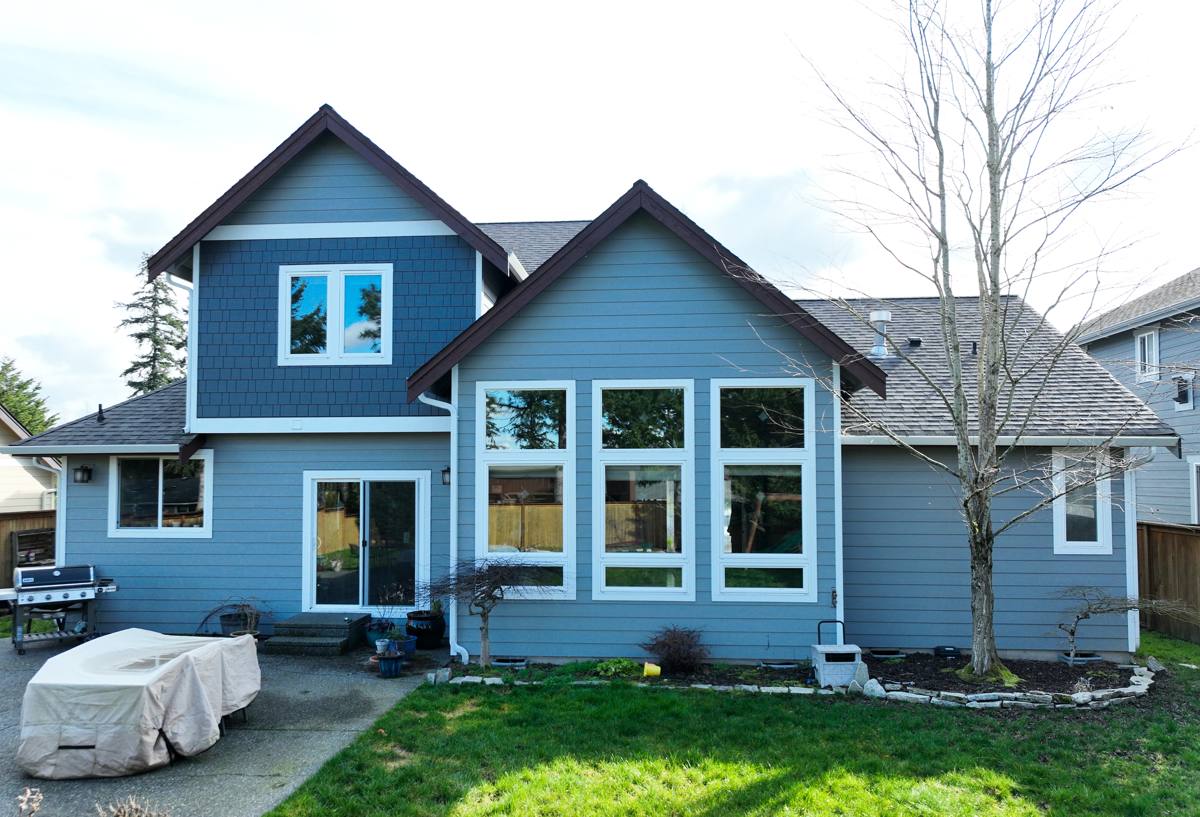
What Board & Batten Siding Actually Is
Board & batten is a vertical siding pattern: wide flat panels (or boards) installed vertically, with narrower strips called battens covering the seams between them. It reads as clean, linear, and a little more architectural than standard lap siding, which is why it shows up on farmhouse-style homes, craftsman remodels, and accent walls throughout this region. Done right, it's also a genuinely durable siding pattern — the vertical orientation encourages water to run down and off the wall rather than pooling on a horizontal ledge.
The look is simple. The engineering behind a correct installation is not. A batten that isn't fastened and sealed properly does the opposite of what it's supposed to do — instead of shedding water, it channels it straight into the wall assembly.
Why We Install Board & Batten Only in Fiber Cement
We install James Hardie fiber cement exclusively, and board & batten is one of the patterns where that choice matters most. Wood board & batten looks great on day one, but bare-edge cuts, batten joints, and the sheer number of exposed fastener points give driving rain and salt air a lot of opportunities to start rot and finish failure early — especially on the shaded, moisture-holding lots common around Point Whitehorn. Vinyl board & batten avoids rot but it's a thinner, more visibly artificial product, and it doesn't hold up well to the freeze-thaw and impact conditions this region sees.
Hardie's fiber cement is non-combustible, dimensionally stable in wet-dry cycling, and comes with a factory-applied ColorPlus finish that's baked on rather than field-painted — which means far less exposure to moisture during the finish process itself and a longer stretch before the home needs a repaint. Hardie also engineers its siding by climate zone (HZ5 for the Pacific Northwest), which is a level of region-specific engineering wood and vinyl products simply don't offer.
HardiePanel Vertical vs. the Artisan Board & Batten Collection
Most board & batten jobs in this area use HardiePanel vertical siding with separate Hardie trim battens over the seams — the classic, most cost-effective approach. Hardie's Artisan line offers a more refined, deeper-reveal batten profile for homeowners who want a higher-end architectural look. Both are the same engineered fiber cement base; the difference is trim profile and price, not durability.
What a Correct Board & Batten Installation Involves
This is the part that determines whether board & batten siding lasts 30+ years in a coastal climate or starts failing in five. A correct installation includes:
- A weather-resistive barrier behind the panels, installed shingle-style so water is always directed outward and down
- A rainscreen gap (furring strips or a drainage mat) between the barrier and the panels, so any water that gets past the batten seams has somewhere to drain instead of sitting against the sheathing
- Panels installed with the correct gap at the bottom for drainage, never tight to the foundation or trim
- Battens fastened at the correct spacing directly into framing or blocking, not just into the panel
- Corrosion-resistant fasteners — stainless steel or hot-dip galvanized, given the salt exposure this close to the water
- Flashing at every window, door, and roofline intersection, installed before the siding goes on, not caulked in afterward
- Factory-cut edges sealed and touched up with matching ColorPlus product where field cuts expose raw material
Skip the rainscreen gap or the flashing sequence and the wall can look finished while trapping moisture behind it — a problem that often doesn't show up until it's already caused sheathing damage.
Common Problems We See With Improperly Installed Board & Batten
A lot of the board & batten repair calls we get in this area trace back to a handful of recurring issues, not to the siding material failing on its own:
Trapped moisture
Battens installed flush against the wall with no drainage gap behind them turn every seam into a potential moisture trap. In a driving-rain climate, that moisture has nowhere to go, and it works on the sheathing behind the siding long before anything shows on the surface.
Caulk failure at seams
Caulk is a maintenance item, not a permanent seal. When it's the only thing keeping water out of a batten joint — instead of a proper flashing and drainage system — it eventually cracks, shrinks, or pulls away, and the wall behind it is exposed.
Moss and algae on shaded elevations
North-facing and tree-shaded walls in Point Whitehorn hold moisture longer through the fall, winter, and spring, and that's exactly where we see moss and algae take hold first — especially on siding that wasn't finished with a factory coating built to resist it.
Our Process
We start with an on-site assessment of the existing wall, siding, and any trouble spots — corners, window returns, areas near grade or tree cover. If we're replacing failing siding, we remove it and check the sheathing underneath before anything new goes up; siding installed over hidden rot just hides the problem longer. From there we install (or verify) the weather-resistive barrier and rainscreen gap, install the Hardie panels and battens to manufacturer spec with corrosion-resistant fasteners, flash every penetration and transition as we go, and finish with trim, caulking, and any factory-finish touch-up needed at field cuts. We walk the finished job with the homeowner before we call it done.
Maintaining Board & Batten Through the Moss Season
Even correctly installed fiber cement siding benefits from basic seasonal attention in this climate:
- A gentle wash-down once or twice a year, more often on shaded or tree-covered elevations
- Checking gutters and downspouts before the wet season so runoff isn't sheeting down the wall
- A yearly look at caulk lines around windows, doors, and trim for cracking or separation
- Trimming back vegetation that keeps a wall shaded and damp longer than the rest of the house
None of this is heavy maintenance — it's the kind of upkeep that keeps a correctly built wall system performing the way it was designed to for decades, rather than letting small issues turn into repairs.
Board & Batten Material Comparison
| Factor | James Hardie Fiber Cement | Wood | Vinyl |
|---|---|---|---|
| Moisture & rot resistance | Engineered for wet-dry cycling; won't rot | Prone to rot at seams and cut ends without diligent upkeep | Won't rot, but seams can trap moisture behind panels |
| Salt air & moss resistance | Factory ColorPlus finish resists staining and fading | Finish breaks down faster; more frequent repainting needed | Resists moss growth but chalks and fades over time |
| Fire resistance | Non-combustible | Combustible | Can soften, warp, or melt under heat |
| Typical lifespan (installed to spec) | 30+ years | 15-25 years with regular maintenance | 20-30 years, but brittle in cold and impact-prone |
| Maintenance burden | Low — occasional wash, caulk checks | High — regular repainting/staining, rot inspection | Low, but repairs and color-matching are difficult |
Signs Your Board & Batten Siding Needs Attention
- Soft or spongy spots when you press on a panel or batten, especially near the bottom edge
- Caulk that's cracked, pulled away, or missing at batten seams
- Persistent moss or algae streaking that comes back quickly after cleaning
- Peeling, bubbling, or chalky paint on wood siding
- Rust staining running down from fastener heads
- Visible gaps or warping where battens have pulled away from the wall
- Musty smell or staining on interior walls that back up to exterior siding
Why Hire a Crew That Already Works Point Whitehorn
Installation details that matter everywhere matter more here — rainscreen gaps, fastener selection, and flashing sequencing all have to account for wind-driven rain and salt exposure that a crew working inland simply doesn't deal with as often. A crew that already works Point Whitehorn and the rest of the Birch Bay area knows which elevations tend to hold moss longest, which fastener spec actually holds up to the salt air here, and how to sequence a job around wooded or waterfront-adjacent lot access. That familiarity shows up in the durability of the finished wall, not just in how fast the job goes.
If you're weighing a board & batten project for your Point Whitehorn home, we're happy to take a look and walk through what your home specifically needs — no pressure, no obligation. Reach out for a free estimate using the form below.