 Birch Bay Siding
 Why Siding in Blaine Wears Differently Than Siding Inland
Blaine sits right along the water in northern Whatcom County, and that location shapes everything about how siding ages there. Homes here take on salt-laden air off the coast, wind-driven rain that gets pushed sideways into wall assemblies instead of just falling straight down, and a moss and algae season that runs longer than most of the country ever deals with. None of that is unique to one street or one neighborhood — it's a function of being a coastal Pacific Northwest community, and it means siding on a Blaine home is doing more work, more of the year, than siding on a similar house a hundred miles inland.
We're based in Birch Bay, just down the coast, so we're working in this same climate on our own properties, not reading about it in a spec sheet. That matters when you're trying to figure out whether a section of damaged siding is a quick fix or an early warning sign of something bigger happening behind the cladding.
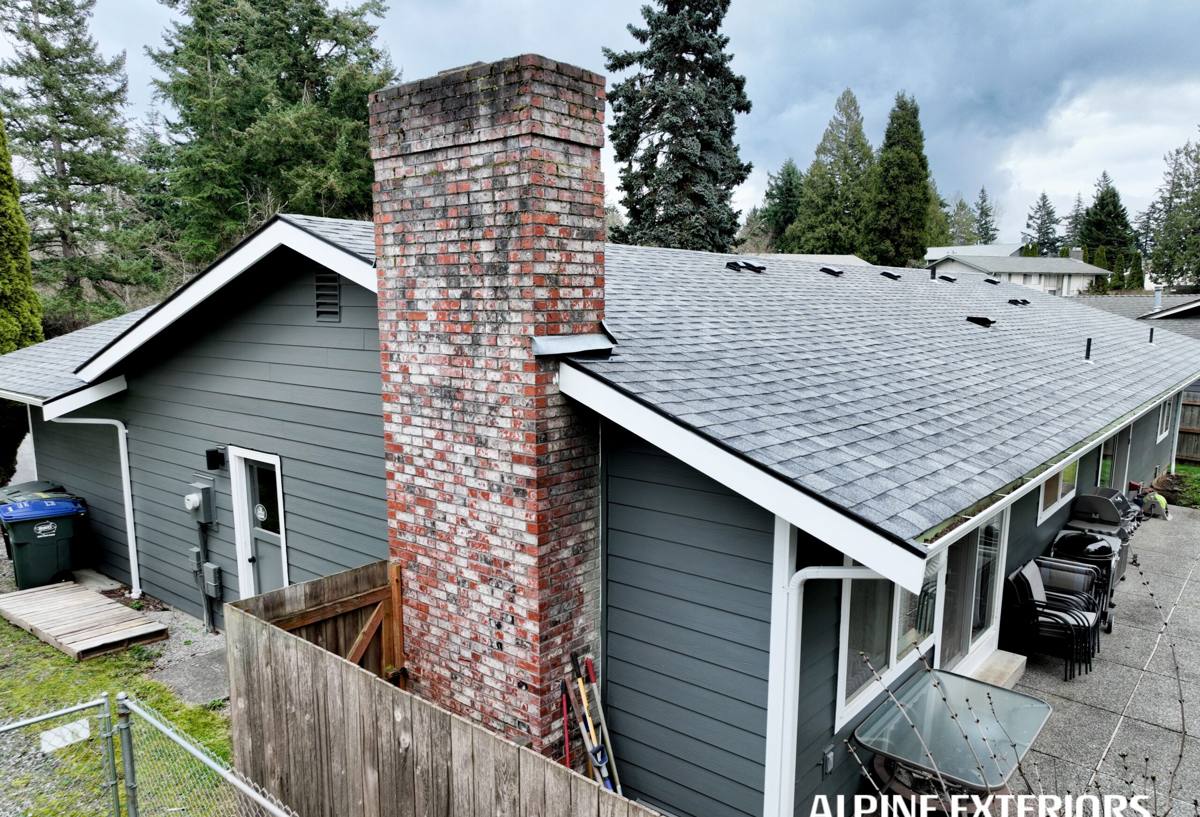
Common Signs a Blaine Home Needs Siding Repair — Not Full Replacement
Most siding problems don't show up as a single dramatic failure. They show up as small, localized symptoms that are easy to write off as cosmetic until you know what to look for. On the coastal stretch of Whatcom County, we see the same handful of issues repeat house after house:
- Cracked, chipped, or split boards, usually at corners or anywhere siding gets bumped or flexed
- Soft or spongy spots near the ground line, where splashback and standing moisture do the most damage
- Persistent moss, algae, or dark staining on north- and west-facing walls that stay shaded and damp
- Caulking that's cracked, shrunk, or pulled away from trim, window, and door joints
- Panels that have separated slightly, gapped, or started to bow away from the wall
- Paint or factory finish that's bubbling, peeling, or chalking in patches rather than evenly
- Fasteners that have backed out or left visible rust streaks below them
Any one of these, caught early, is usually a repair. Several of them clustered together, or spread across multiple walls, is a sign the whole assembly may be past the point where patching makes sense.
What's Actually Going Wrong Under the Surface
Moisture Behind the Cladding
Siding's real job isn't just looking good — it's the first line of defense that keeps wind-driven rain from reaching the weather-resistant barrier and sheathing behind it. In a climate like Blaine's, where storms regularly push rain horizontally into walls, any gap, crack, or failed seal gives water a path in. Once moisture gets behind the siding, it doesn't dry out quickly in our damp, mild winters — it sits, and that's when rot, delamination, and mold start.
Failed Flashing and Trim Joints
A huge share of the repair calls we see aren't failures of the siding material itself — they're failures of the flashing and trim details around it. Window heads, corner boards, and butt joints are where water intrusion almost always starts. Fixing the visible board without correcting the flashing underneath it just buys a year or two before the same spot fails again.
Fastener and Panel Movement
Wood and fiber cement expand and contract with moisture and temperature. Siding that wasn't fastened to spec — nailed too tight, missing expansion gaps, or hung with the wrong fastener — tends to crack, buckle, or pop loose well before it should, especially with the freeze-thaw and wet-dry cycling typical of a Whatcom County winter.
What a Correct Repair Actually Involves
A repair done right isn't just pulling a bad board and nailing up a new one. On every repair call in Blaine, we work through the same sequence:
- Identify the actual source of the damage — moisture intrusion, impact, failed flashing, or material fatigue — not just the symptom
- Remove damaged siding carefully enough to inspect the weather-resistant barrier and sheathing underneath
- Repair or replace any compromised house wrap, flashing, or sheathing before new siding goes back up
- Install matching material, fastened to manufacturer spec with correct clearances and expansion gaps
- Re-seal and finish so the repair blends into the surrounding wall rather than standing out as an obvious patch
Skipping the second and third steps is the single most common shortcut in this trade, and it's exactly why the same spot fails again a year or two later.
Repair vs. Replacement: How We Make the Call
Not every damaged section needs a whole-house response, and not every homeowner needs to hear "you need all new siding" when a targeted repair will genuinely hold up. Here's roughly how we weigh it:
| Factor | Usually Points to Repair | Usually Points to Replacement |
|---|---|---|
| Extent of damage | Isolated to one wall or a few boards | Spread across multiple walls or elevations |
| Condition of remaining siding | Sound, still within its expected service life | Widespread cracking, warping, or finish failure |
| Moisture intrusion | Surface-level, caught early | Signs of rot or damage reaching the sheathing |
| Material match | Matching profile and finish available | Discontinued or significantly mismatched product |
| Cost relative to full re-side | Repair cost is a fraction of replacement | Repair cost approaches what re-siding would run |
We'll walk you through where your home falls on that spectrum honestly — our goal is the right scope of work, not the biggest invoice.
Why We Repair — and Replace — Only With James Hardie Fiber Cement
We don't install or patch with vinyl, LP SmartSide, primed spruce, cedar, or other fiber cement brands. That's a standard we hold across every job, including repairs, and it's worth explaining why rather than just stating it. Mixing materials on a repair — patching a Hardie wall with a different product, or vice versa — almost never matches in texture, finish, or long-term weathering, and it can create moisture behavior differences between old and new sections that cause problems down the line.
James Hardie's HZ5 fiber cement line is engineered specifically for the wet, coastal conditions we get in the Pacific Northwest — it resists moisture absorption, won't rot, and isn't a food source for the moss and algae that thrive in our long wet season. The factory-applied ColorPlus finish also means repaired sections can be matched far more precisely than a job-site paint match on lumber siding ever could. For a coastal community like Blaine, that combination of moisture resistance and finish durability is the reason we standardized on it — not brand preference for its own sake.
Our Process for a Blaine Repair Call
Repair calls in Blaine follow the same steps every time, so there are no surprises partway through:
- Free on-site inspection where we look at the damage and, just as important, what's causing it
- A plain-language explanation of what we found and whether it's a repair or a bigger issue
- A written scope and price before any work starts — no verbal estimates that shift later
- The repair itself, done to manufacturer spec, including any flashing or barrier work behind it
- A final walkthrough so you can see the completed work before we consider the job done
Why a Crew That Already Works This Coastline Matters
Siding repair is one of those trades where local familiarity actually changes the outcome. A crew that works Birch Bay and Blaine regularly already knows how aggressively moss establishes on shaded coastal walls, how far wind-driven rain travels up an exposed elevation, and what fastening and flashing details actually hold up here versus what's fine in a drier climate. That's not something you get from a crew that mostly works inland and treats a coastal repair like any other job.
Being based nearby also means a faster response when a repair is time-sensitive — a cracked board that's letting water in during storm season shouldn't sit on a two-week wait for a crew driving in from out of the area.
Keeping Moss and Growth From Coming Back After a Repair
A repair is only as good as what happens to the wall after it's done. A few habits go a long way in Whatcom County's climate:
- Keep gutters and downspouts clear so runoff isn't sheeting down the siding face
- Trim back vegetation and tree cover that keeps a wall shaded and slow to dry
- Rinse moss and algae buildup off periodically before it gets established, rather than after
- Watch caulking and trim joints yearly — catching a small failure early is what keeps repairs small
If you're seeing any of these signs on a Blaine home, we're happy to come take a look. The estimate is free, there's no pressure to turn a repair into a bigger job than it needs to be, and you'll get a straight answer about what your siding actually needs.