 Birch Bay Siding
 Semiahmoo Sits Right in the Weather
Homes along the Semiahmoo shoreline near Birch Bay face a different set of conditions than houses even a few miles inland. Open water means more wind, more direct exposure to wind-driven rain, and a near-constant supply of salt-laden air moving across exterior walls. Add Whatcom County's long, wet shoulder seasons and a moss season that can stretch from fall through spring, and you have an environment that is genuinely harder on exterior cladding than most manufacturers design for by default.
That's not a marketing exaggeration — it's the reason siding choice matters more here than it does in a drier, more sheltered part of the state. A product that performs fine in Spokane or Yakima can struggle on a waterfront wall in Semiahmoo. We install James Hardie fiber cement siding exclusively, and on jobs in this specific area, the reasons why become obvious fast.
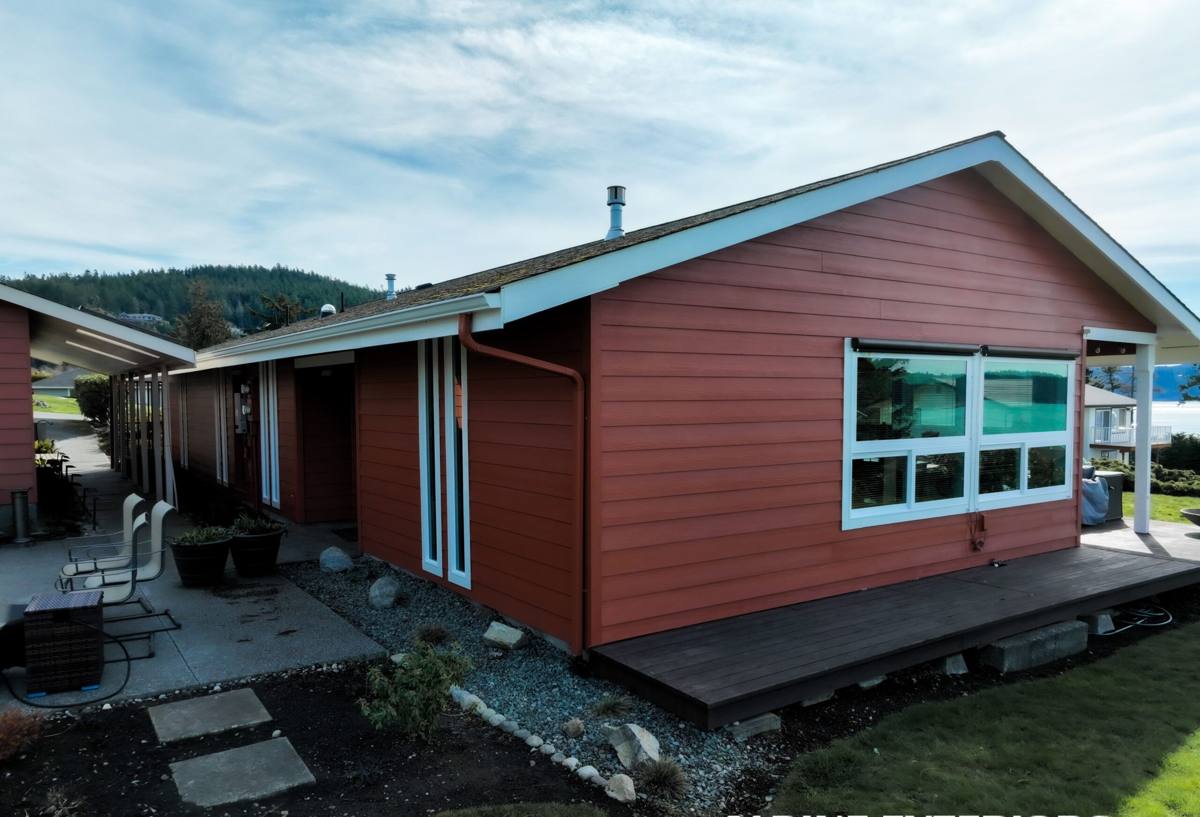
What Salt Air, Driving Rain, and Moss Actually Do to a Wall
Salt Air
Airborne salt doesn't just affect metal fasteners and flashing — it also accelerates the breakdown of paint films and lower-grade composite materials. Salt is hygroscopic, meaning it pulls moisture out of the air and holds it against the surface it settles on. On siding with a weak factory finish or a field-applied paint job, that means more frequent chalking, fading, and coating failure than you'd see a few miles inland.
Wind-Driven Rain
Rain that comes in sideways behaves differently than rain that falls straight down. It gets forced up under laps, into seams, and around penetrations that a standard installation might not fully account for. On a waterfront lot with little wind break, this is a near-daily occurrence for large parts of the year, not an occasional storm event.
Moss and Sustained Dampness
Whatcom County's mild, wet winters are ideal moss-growing conditions. Moss and algae hold moisture against a wall surface far longer than bare siding would dry on its own, which matters most on north-facing walls and areas shaded by trees or neighboring structures. Materials that absorb water or swell when saturated are far more vulnerable to this cycle than materials that shed it.
Why James Hardie Fiber Cement Is the Right Answer Here
James Hardie siding is fiber cement — a mix of cement, sand, and cellulose fibers — not wood, not vinyl, and not a wood-based composite. That matters directly in a coastal environment:
- It doesn't absorb and swell the way wood-based products can. Fiber cement is dimensionally stable in wet-dry cycling, which is exactly the cycle Semiahmoo homes go through constantly.
- It's non-combustible. Not a coastal-specific benefit on its own, but it's part of why we standardized on Hardie for every home we work on, this area included.
- ColorPlus factory-applied finish is baked on under controlled conditions, not brushed or sprayed on site. That finish is engineered to resist fading and hold up to UV and moisture exposure far longer than a typical field-applied paint job — which matters when salt air is already working against any coating.
- It doesn't feed moss and mildew growth the way some organic and wood-fiber materials do. Moss can still grow on any exterior surface given enough dampness and shade, but fiber cement doesn't provide the same organic food source that accelerates the problem.
The HZ5 Product Line: Built for This Exact Climate
James Hardie engineers its siding differently depending on regional climate zones, and the Pacific Northwest falls under their HZ5 (moisture-focused) product engineering. HZ5 products are formulated with the wet, moderate climate of coastal Washington and Oregon in mind — a meaningfully different formulation than what's shipped to arid or freeze-heavy regions of the country.
For a Semiahmoo home sitting close to open water, that distinction isn't a technicality. It's the difference between a siding product engineered for exactly this weather pattern and one that happens to work well enough elsewhere. We install HZ5-engineered Hardie products on every job in this area for that reason.
What a Correct Installation Involves
Fiber cement siding performs the way it's supposed to only when it's installed correctly. In a high-exposure coastal setting, the installation details matter even more than usual, because there's less margin for water to find its way behind the cladding.
Water Management Comes First
A correct install starts with a properly lapped weather-resistant barrier, correctly integrated flashing at every window, door, and roof-to-wall intersection, and a drainage plane that lets any incidental moisture get out instead of getting trapped. On a wall that regularly takes wind-driven rain, a rainscreen gap (a small air space between the siding and the water-resistive barrier) is often the right call — it lets the wall dry from both sides instead of just one.
Fastening and Clearances
James Hardie specifies exact fastener types, spacing, and penetration depth, along with minimum clearances from grade, roof lines, decks, and other siding. Skipping these specs is one of the most common ways an otherwise good product fails early — over-driven nails crack the board's edge and create a water entry point; under-driven fasteners let the board move and eventually work loose.
Caulking and Joint Treatment
Butt joints, trim intersections, and penetrations need the right sealant, applied correctly — not just caulked over and hoped for. In a salt-air environment, we also pay attention to fastener and flashing material compatibility, since dissimilar metals can corrode faster when exposed to salt-laden moisture.
Installation Checklist We Follow on Every Semiahmoo Job
- Inspect and repair sheathing before any new siding goes on — covering up rot or soft spots guarantees a future failure
- Install a continuous, properly lapped weather-resistive barrier
- Flash every window, door, and wall penetration per manufacturer detail, not shortcuts
- Use a rainscreen gap on high-exposure elevations where it's warranted
- Fasten per James Hardie's published spacing and depth specs — no over-driving, no under-driving
- Maintain correct clearances from grade, roofing, and decking
- Use compatible, corrosion-resistant fasteners and flashing given the salt-air exposure
- Seal joints and penetrations with the correct sealant, not a generic caulk substitute
How Our Process Works
We keep the process straightforward, but we don't skip steps just to move faster:
- On-site assessment. We walk the exterior, check existing siding and sheathing condition, note exposure direction (which walls take the worst of the wind and rain), and identify any moisture or moss issues already present.
- Plan and product selection. We spec the right Hardie profile, plank width, and ColorPlus finish for the home, and flag any areas that need extra water-management detailing — corners, waterfront-facing walls, and low-clearance areas in particular.
- Prep and repair. Any compromised sheathing or trim gets addressed before new siding goes up. This is the step that gets skipped by crews trying to save time, and it's the one that causes the most callbacks down the road.
- Installation to spec. Weather barrier, flashing, fastening, and joint treatment all follow manufacturer installation guidelines — not a generalized approach applied to every house regardless of exposure.
- Final walkthrough. We review the finished work with the homeowner, including basic care expectations for a coastal property.
James Hardie Compared to Other Siding Options in This Environment
| Factor | James Hardie Fiber Cement | Vinyl | Wood-Based Composite (e.g., LP SmartSide) |
|---|---|---|---|
| Behavior in wet-dry cycling | Dimensionally stable; engineered HZ5 formulation for wet climates | Can warp or become brittle with temperature swings | Wood-fiber core can swell or degrade if moisture reaches cut edges or damaged coating |
| Salt air / coastal exposure | Non-organic material, factory finish resists fading and coating breakdown | Color can fade; material can become brittle over time near salt air | Edge sealing and coating integrity are critical; more maintenance-sensitive near salt exposure |
| Fire performance | Non-combustible | Combustible, can soften/melt under heat | Combustible (wood fiber core) |
| Finish durability | ColorPlus factory-applied finish, engineered for long-term UV/moisture resistance | Color is through-body but can fade and chalk over decades | Factory-primed or coated; performance depends heavily on maintaining that coating |
| Long-term maintenance | Periodic washing and repainting when eventually desired; no sealing of cut edges required with proper install | Low maintenance but limited repair options if damaged | Requires diligent edge-sealing and coating upkeep to avoid moisture intrusion |
We don't install vinyl, LP SmartSide, Cemplank, Allura, primed spruce, or cedar. Each of those products has legitimate uses, and none of them is a scam or inherently bad — but for the exposure levels we see on homes near the Semiahmoo shoreline, we don't think they hold up as consistently well as Hardie's HZ5 fiber cement over a multi-decade ownership period, and we'd rather stand behind one product we install correctly every time than offer several we're less confident in long-term.
Cost Factors Homeowners Should Know
Every home is different, so we won't quote a number without seeing the job, but these are the variables that actually move the price on a Semiahmoo-area James Hardie project:
| Factor | Why It Matters |
|---|---|
| Existing wall condition | Sheathing repair or rot remediation adds labor and material before new siding can go on |
| Home size and wall complexity | More corners, gables, and dormers mean more cutting, flashing, and labor time |
| Plank profile and finish selection | Different Hardie profiles (lap width, shingle-style, panel) and ColorPlus finishes carry different material costs |
| Rainscreen / water-management detailing | High-exposure elevations may warrant additional drainage detailing, which adds labor |
| Trim, soffit, and accessory work | Full exterior refresh projects often include trim and fascia work alongside the siding itself |
Why Hiring a Crew That Already Works This Area Matters
Installing James Hardie correctly isn't unique to Semiahmoo — the manufacturer specs are the same everywhere. What's different is knowing, before the first board goes up, which walls on a given lot are going to take the worst of the wind and rain, where moss is likely to become a recurring problem, and how much water-management detailing is actually warranted versus overkill. Crews with regular experience on Birch Bay and Whatcom County waterfront homes make those calls faster and more accurately than a crew seeing this kind of exposure for the first time.
It also matters for the parts of the job that aren't glamorous: knowing which fastener and flashing combinations hold up under sustained salt exposure, recognizing early moss or moisture damage on a tear-off before it becomes a bigger repair, and setting realistic expectations about maintenance on a waterfront-facing home versus a sheltered inland one.
Living With Hardie Siding on a Semiahmoo Home
Once it's installed correctly, James Hardie siding is low-maintenance, not zero-maintenance. In this specific environment, that means periodically rinsing salt residue and organic buildup off the surface, keeping gutters and downspouts clear so water isn't dumping directly onto walls, and trimming back vegetation that shades siding and keeps it damp longer than it should be. None of this is heavy lifting, but it's more attention than a home fifteen miles inland typically needs — and it's worth doing, because it protects both the finish and the long-term performance of the product underneath it.
If you're planning a siding project on a home near Semiahmoo or elsewhere along the Birch Bay shoreline, we're happy to take a look and walk you through what your specific home needs. The estimate is free, there's no pressure, and you'll get a straight answer about what the job actually involves.