 Birch Bay Siding
 Point Whitehorn sits close enough to the water that its decks live a harder life than decks a few miles inland. Salt-laden air off the water, wind-driven rain that gets under fascia boards other crews consider "protected," and a moss season that runs long through the Whatcom County winter all work on a deck year-round, not just in a few bad storms. A composite deck built for this stretch of coastline needs to be planned differently than one built for a dry backyard in a different climate, and that planning happens before the first board ever goes down.
Why Decks Near Point Whitehorn Wear Differently
Three things stack up against decking here: salt in the air, near-constant moisture, and shade-driven moss growth. Salt air accelerates corrosion on fasteners, brackets, and railing hardware faster than most manufacturers' warranty language assumes, because that language is usually written for a general climate, not a marine one. Driving rain off the bay pushes water sideways under fascia, around ledger boards, and into any gap that wasn't flashed correctly. And Birch Bay's tree cover and cloud-heavy winters mean north-facing and shaded sections of a deck can stay damp for days after a storm passes, which is exactly the condition moss and algae need to take hold.
None of this is unique to Point Whitehorn — it's the reality for most of the Whatcom County coastline. But it means a deck installed with generic assumptions about drainage, fastener grade, or board spacing will show problems here years before it would somewhere drier.
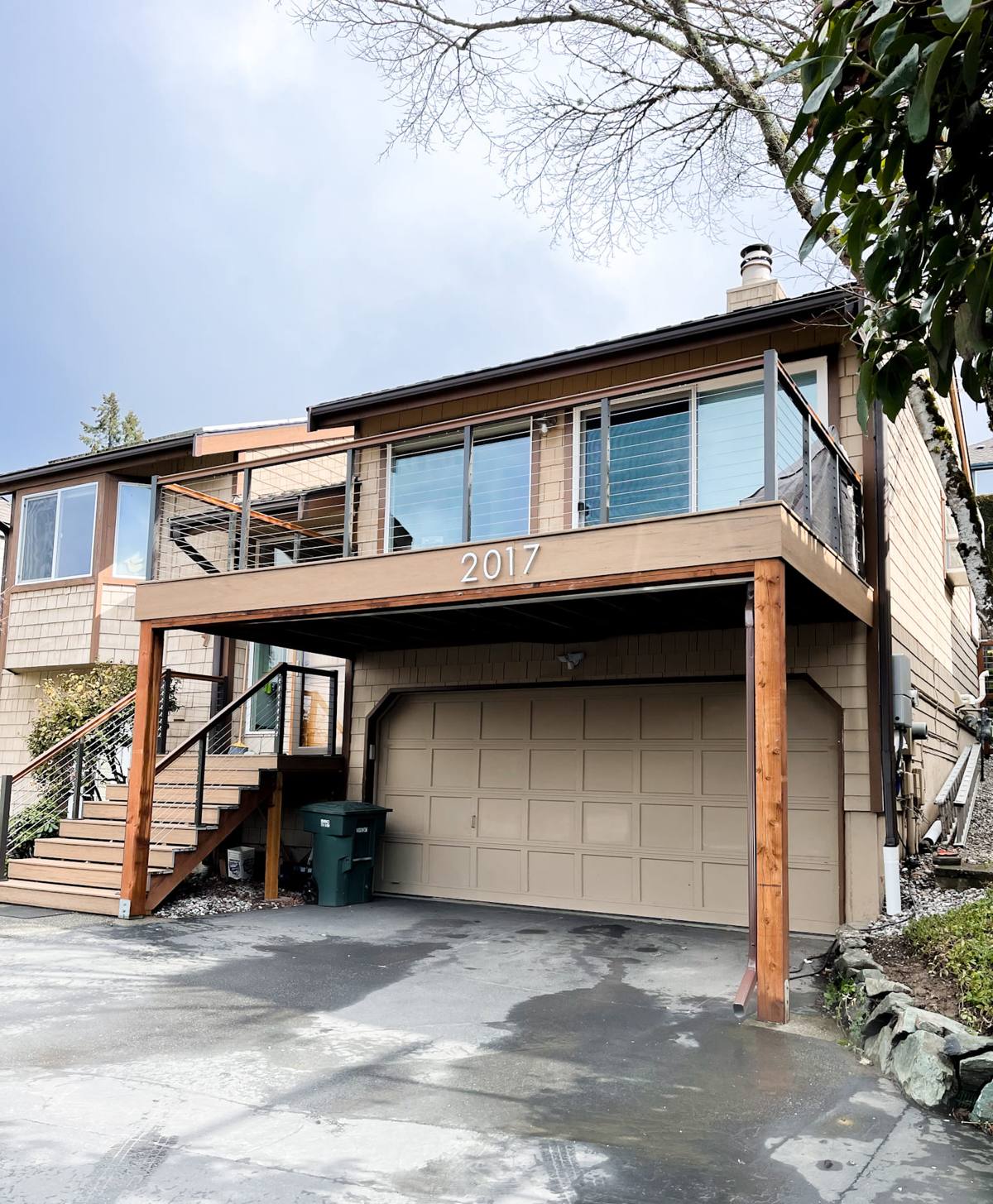
What Composite Decking Actually Solves — and Where It Doesn't
Composite decking earns its place in this climate because the boards themselves don't need annual staining or sealing, don't splinter, and resist rot in the wood-fiber core because of the capped shell around it. That's a real advantage over untreated or even pressure-treated wood decking, which needs consistent upkeep to hold up against this much moisture.
What composite decking does not solve on its own is a bad substructure. The board is only as good as what's underneath it. We've seen composite decking installed over undersized joists, unflashed ledgers, or framing with the wrong fastener grade — and in every case, the problems show up at the frame and connections long before the boards themselves fail. Composite is a durable surface material. It is not a substitute for correct framing, proper drainage, or the right hardware for a salt-air environment.
Where Homeowners Get Surprised
The most common surprise we hear from Point Whitehorn homeowners isn't about the decking itself — it's about how much of the job is actually below the boards. Ledger flashing, joist spacing, fastener corrosion resistance, and drainage slope all matter more here than they would inland, and none of it is visible once the deck is finished.
The Substructure Comes First
Every deck we build starts with the frame, not the boards. In a marine climate, that means a few things get non-negotiable attention:
- Ledger flashing: where the deck attaches to the house has to be properly flashed and often taped, since this is the single most common point where wind-driven rain finds its way into the wall structure.
- Joist spacing: composite boards typically need tighter joist spacing than wood — commonly 16 inches on center for straight runs, and often 12 inches on center for diagonal or picture-frame layouts — because composite behaves differently under load and heat than solid wood.
- Fastener grade: in salt air, standard galvanized fasteners corrode faster than their rated lifespan suggests. We use stainless or coated fasteners rated for coastal exposure at every structural connection, not just where it's easy.
- Footing depth and bearing: posts and footings need to be sized and set to the soil and frost conditions actually present on the site, not a generic assumption.
This is the part of the job nobody sees once it's finished, and it's also the part that determines whether a deck is still solid in fifteen years or starting to feel spongy in five.
Choosing the Right Decking Material for This Climate
Not all composite and composite-alternative products behave the same way in salt air and constant moisture. The table below reflects the trade-offs we walk homeowners through on-site, based on what each material actually requires to hold up here.
| Material | Salt Air / Moisture Behavior | Moss & Algae Resistance | Maintenance Needed | Notes for This Area |
|---|---|---|---|---|
| Untreated or pressure-treated wood | Absorbs moisture, prone to cupping and rot over time | Low — porous surface holds moisture | Regular sealing/staining, ongoing inspection | Lowest upfront cost, highest long-term upkeep in this climate |
| Uncapped composite | Better than wood, but core can absorb moisture at cut ends or damage | Moderate — surface can still stain and support growth | Occasional cleaning, watch cut ends and fastener points | Older composite technology; still installed in some budget projects |
| Capped composite | Strong — polymer shell sheds moisture, resists staining | Good — smooth cap resists moss/algae adhesion | Periodic rinsing and sweeping | Our standard recommendation for most Point Whitehorn homes |
| PVC decking | Excellent — no wood fiber core to absorb moisture | Very good — fully synthetic surface | Minimal; occasional cleaning | Higher upfront cost; performs well in the highest-exposure spots |
For most properties in this area, capped composite hits the right balance of upfront cost and long-term performance. For decks with direct, unobstructed exposure to wind and salt spray, PVC decking is worth the added cost, and we'll say so plainly rather than upselling it as necessary everywhere.
Our Installation Process
The process is the same discipline on every job, adjusted for the specific exposure of the site:
- Site assessment: we look at sun and shade patterns, prevailing wind and rain direction, drainage flow, and how close the deck sits to salt spray exposure.
- Ledger and flashing detail: where the deck ties into the house gets flashed and sealed before anything else is built, since this is the highest-risk point for hidden water intrusion.
- Framing: joists are set to the spacing the specific board and layout require, with corrosion-resistant fasteners and hardware throughout, not just at visible connections.
- Board layout: we plan board direction and any picture-framing or diagonal accents with drainage and appearance both in mind — a layout that looks good but traps water at a butt joint is a bad layout.
- Fastening: hidden fastener systems are installed with the manufacturer's specified gap for thermal expansion, which also happens to be the gap that lets water and debris drain through instead of pooling.
- Railing and fascia: installed to match the exposure level of the site, using hardware and materials suited to salt air rather than whatever is cheapest.
- Final walk-through: we go over the finished deck with the homeowner, including what maintenance actually looks like going forward.
Details That Matter More Here Than Elsewhere
A few specific details separate a deck that holds up on this stretch of coastline from one that starts showing problems early:
Airflow Underneath
Joist bays need to breathe. A deck built low to the ground or over unventilated space traps moisture underneath, and in a climate this damp, that trapped moisture is exactly what feeds rot at the frame and mildew on the underside of the boards. We plan clearance and, where the site allows, ventilation into the substructure rather than sealing it up tight.
Drainage Slope
The deck surface should have a slight slope away from the house so water sheds instead of sitting against the ledger or pooling in low spots. This is a small detail in the framing stage that's very difficult to correct after the fact.
Gaps and Cut Ends
Every cut end of a composite board is a point where the capped shell is interrupted and the core is exposed. Cut ends need to be positioned, sealed, or capped according to the manufacturer's guidance — an installer in a hurry who leaves raw cut ends exposed to weather is setting up a failure point that won't show up until years later.
Maintenance Reality for a Composite Deck Here
Composite decking is genuinely lower-maintenance than wood, but "low-maintenance" doesn't mean "no maintenance," especially this close to the water. A realistic seasonal routine looks like this:
- Rinse the deck periodically to clear salt residue, especially after storms with onshore wind.
- Sweep debris out of the gaps between boards so it doesn't hold moisture against the fastener line.
- Keep gutters and downspouts clear so runoff isn't sheeting onto the deck surface and feeding moss growth.
- Trim back overhanging vegetation to let sun and air reach shaded sections where moss takes hold first.
- Check railing hardware and fastener heads annually for early signs of corrosion.
- Address moss or algae as soon as it appears, using a cleaner approved for capped composite — some general-purpose deck cleaners and high-pressure washing can damage the cap and void manufacturer warranties.
None of this is heavy work, but skipping it in a climate this wet lets small issues become bigger ones faster than it would in a drier region.
Permits and Practical Considerations
New decks and significant deck rebuilds typically require a permit through Whatcom County, and properties close to the shoreline can also fall under additional shoreline or critical area review depending on their exact location and the scope of the work. We handle this conversation upfront so there are no surprises mid-project, and we'd rather flag a possible permit requirement early than have a homeowner find out about it after the fact.
Why a Crew That Already Works Point Whitehorn Matters
A contractor who works this specific stretch of coastline regularly already knows which sides of a lot take the worst wind-driven rain, which shaded corners hold moss longest, and which fastener and flashing details actually hold up against salt air rather than just meeting a generic code minimum. That's not something you can fully substitute with a spec sheet — it comes from having built and maintained decks in this exact environment.
It also matters for follow-up. If a question comes up two years after installation — a squeak, a spot that's slower to dry than the rest, a railing bracket that needs a look — a crew that's local and already familiar with the property can respond quickly, instead of a company for whom your job was a one-time drive-by.
If you're weighing composite decking for a home in or near Point Whitehorn, we're happy to walk the site, look at your sun, wind, and drainage conditions, and give you a straight answer on what the job actually needs. There's a form below — reach out for a free, no-pressure estimate.