 Birch Bay Siding
 Why Lynden Decks Take a Beating From Whatcom County Weather
Lynden sits inland from Birch Bay, but it doesn't escape the marine climate that defines this corner of Washington. The same moisture-heavy air that rolls in off the Salish Sea and Birch Bay carries a long, wet season, driving rain that gets pushed sideways by wind, and enough overcast, low-sun days each year to keep horizontal wood surfaces damp for weeks at a stretch. A deck is one of the few parts of a house that takes this weather head-on, flat, and unprotected. It's no surprise that decks in this area age faster than homeowners expect, even when they look fine from a distance.
Moss, Algae, and Trapped Moisture
Whatcom County's long moss season isn't just a roof problem. On a deck, moss and algae take hold anywhere moisture sits: in the shaded gaps between boards, under furniture and planters, and along the north side of the house where sun rarely reaches. Once moss establishes itself, it holds water against the wood constantly instead of letting it dry between rains. That's when rot starts, often from the underside of the board where nobody's looking.
Freeze-Thaw Cycles and Fastener Corrosion
Lynden gets enough cold snaps each winter for trapped moisture in wood fibers to freeze, expand, and split grain that's already softened by rot. At the same time, the region's damp, faintly salt-tinged air is hard on metal. Nails, screws, and joist hardware that aren't rated for coastal or wet-climate exposure corrode from the inside of the connection outward, long before the surface rust becomes visible.
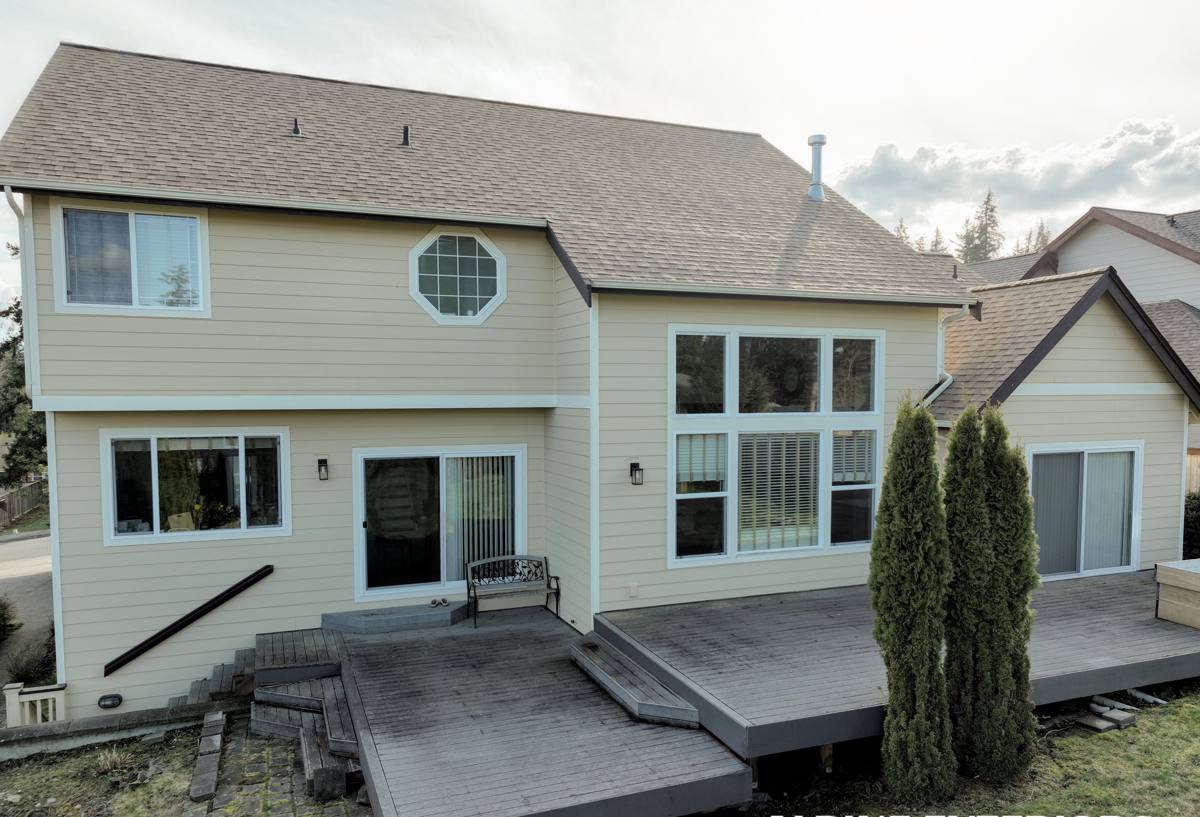
Signs Your Deck Needs Replacement, Not Just a Repair
Not every deck problem calls for a full rebuild. Part of doing this job honestly is telling a homeowner when a repair will genuinely hold up, and when it's just delaying an inevitable, more expensive failure. We look at the whole structure, not just the boards you can see.
Cosmetic Wear vs. Structural Failure
- Graying, cracked, or splintering surface boards with a solid, dry frame underneath — often repairable
- Soft or spongy spots when you press or walk on the decking — usually means rot has reached the framing
- Visible rot or dark staining where the ledger board meets the house — a structural issue, not cosmetic
- Rust streaks below fasteners or hardware — a sign connections are failing, not just aging
- Noticeable bounce, sway, or movement when the deck is loaded — a structural red flag regardless of how the surface looks
- Posts or footings that have shifted, heaved, or show rot at the base — the foundation itself is compromised
If the damage is limited to the decking boards and the frame underneath is sound, a board-and-fastener replacement can make sense. Once rot, movement, or corrosion reach the framing, ledger, or footings, patching individual boards just hides a problem that's still getting worse underneath.
What a Proper Deck Replacement Actually Involves
A deck replacement done right goes well beyond pulling up old boards and screwing down new ones. The parts of a deck that fail first — the framing, the ledger connection, the footings — are also the parts a quick cosmetic job never touches.
Full Tear-Out and Hidden Damage Inspection
We remove the decking and railing down to the frame so every joist, beam, post, and connection point can actually be inspected, not guessed at. This is usually where the real story of a deck's condition shows up — rot at the ledger, undersized or corroded hardware, footings that were never poured to proper depth in the first place.
Framing, Ledger Flashing, and Footings
The ledger board — where the deck attaches to the house — is the single most common point of failure on decks in wet climates, because water works its way behind the board if it wasn't flashed correctly the first time. Replacing a deck is the opportunity to correct that: proper flashing that sheds water away from the house, structural screws or bolts instead of nails, and footings set at a depth that accounts for our local frost line and soil conditions.
Fasteners and Hardware Rated for Wet Climates
Every screw, joist hanger, and post base we install is rated for exterior, high-moisture use. It costs more up front than standard hardware, but in a climate that stays damp for months at a time, mismatched or under-rated fasteners are one of the most common reasons a "new" deck starts showing rust and movement within just a few years.
Choosing Decking Material for Lynden's Climate
There's no single right answer for every homeowner — budget, maintenance tolerance, and how the deck gets used all factor in. What matters is picking a material with a clear-eyed understanding of how it actually performs in a wet, moss-prone climate, not just how it looks on day one.
| Material | Upfront Cost | Moisture & Moss Resistance | Maintenance | Typical Lifespan Here |
|---|---|---|---|---|
| Pressure-treated wood | Lower | Fair — needs sealing to hold up | Annual cleaning and re-sealing | Shorter without upkeep |
| Cedar | Moderate | Good natural resistance, but surface still needs care | Periodic cleaning and finish | Moderate |
| Composite decking | Higher | Very good — won't rot, but surface can still hold algae film | Occasional washing | Long |
| Capped composite / PVC | Highest | Best — sealed surface resists moisture and staining | Minimal | Longest |
Why We're Careful About Uncapped Composite
Standard composite boards without a fully capped surface can absorb moisture at cut ends and fastener holes over time, which in a climate this wet can lead to swelling or surface staining years down the road. That's a trade-off worth knowing before you buy, not a reason to avoid composite altogether — it's why we pay attention to end-cap detailing and manufacturer installation specs on every composite deck we build.
Our Deck Replacement Process, Start to Finish
- On-site assessment. We inspect the existing deck, ledger, and footings and give you a straight answer on whether replacement or repair fits your situation.
- Material walkthrough. We go over wood, composite, and capped-composite options based on your budget and how the deck will realistically be used and maintained.
- Permitting. We handle the paperwork and inspections required for structural work, so nothing gets built that has to be torn out later.
- Tear-out. Old decking, railing, and any compromised framing come out, with footings and posts reassessed as part of the process.
- Framing and flashing. New or reinforced framing goes in with proper ledger flashing and wet-climate-rated hardware throughout.
- Decking and railing installation. Boards, fasteners, and railing go in to manufacturer spec, with attention to drainage gaps and end-cutting.
- Final walkthrough. We review the finished deck with you and go over what upkeep it actually needs going forward.
Permits, Code, and What Gets Inspected
Deck replacement in Whatcom County is structural work, which generally means it falls under permitting and inspection requirements — not just a courtesy, but a real check on whether the framing, ledger attachment, and guardrails meet code before everything gets covered up with decking. Guardrails are typically required once a deck surface sits above a certain height, and footing depth needs to account for how deep the frost line reaches in a given winter. We build to pass inspection the first time, because a failed inspection costs everyone time and money.
Caring for Your New Deck Year-Round
A well-built deck in this climate still needs some seasonal attention. None of it is complicated, but skipping it is how a 20-year deck turns into a 10-year deck.
- Sweep leaves and debris off the surface regularly, especially in fall — trapped organic matter is what feeds moss and algae growth
- Rinse the deck periodically to clear pollen, dirt, and the early film that turns into moss if left alone
- Keep gutters and downspouts near the deck clear so runoff isn't pouring directly onto or under it
- Check for standing water after heavy rain and confirm drainage gaps between boards aren't clogged
- Inspect fasteners and railing connections once a year for early rust or looseness
- Re-seal wood decking on the schedule recommended for the specific product — don't wait until it's visibly gray and dry
Why Hiring a Crew That Already Works in Lynden Matters
A deck built by someone unfamiliar with this region's weather tends to look fine for a season or two before the shortcuts show up — the wrong fastener, a ledger flashed for a drier climate, footings poured without accounting for how wet the ground actually gets here. We work throughout Whatcom County, including Lynden and the surrounding area, which means we're not learning how this climate treats a deck on your project. We know which materials hold up, which don't, and what the local permitting process actually requires before we ever pick up a tool.
If your deck is showing its age — or you're just not sure whether it needs a repair or a full replacement — we're happy to take a look and give you a straightforward assessment. Reach out for a free, no-pressure estimate using the form below.