 Birch Bay Siding
 Building New on Lummi Island Means Building for the Water
If you're framing a new home or a major addition on Lummi Island, the windows you choose and how they're installed will matter more here than almost anywhere else in Whatcom County. The island sits fully exposed to Rosario Strait and the Salish Sea, which means salt-laden air moves across every exterior surface year-round, driving rain comes in sideways during winter storms, and the shaded, damp stretches of the island stay wet long enough each year to grow moss on anything that holds moisture. New construction gives you one real chance to get the window openings right before siding, trim, and interior finishes go on top of them. There's no do-over once the house is closed in.
We work new-construction window installs across Birch Bay and out onto Lummi Island regularly, and the pattern is consistent: the windows themselves are rarely the weak point. The weak point is what happens around them — the flashing details, the sequencing with the weather-resistive barrier, and the sill pan work that either sheds water or slowly feeds it into the framing. On a coastal lot, a small mistake at the sill compounds over years into rot that's expensive to find and expensive to fix.
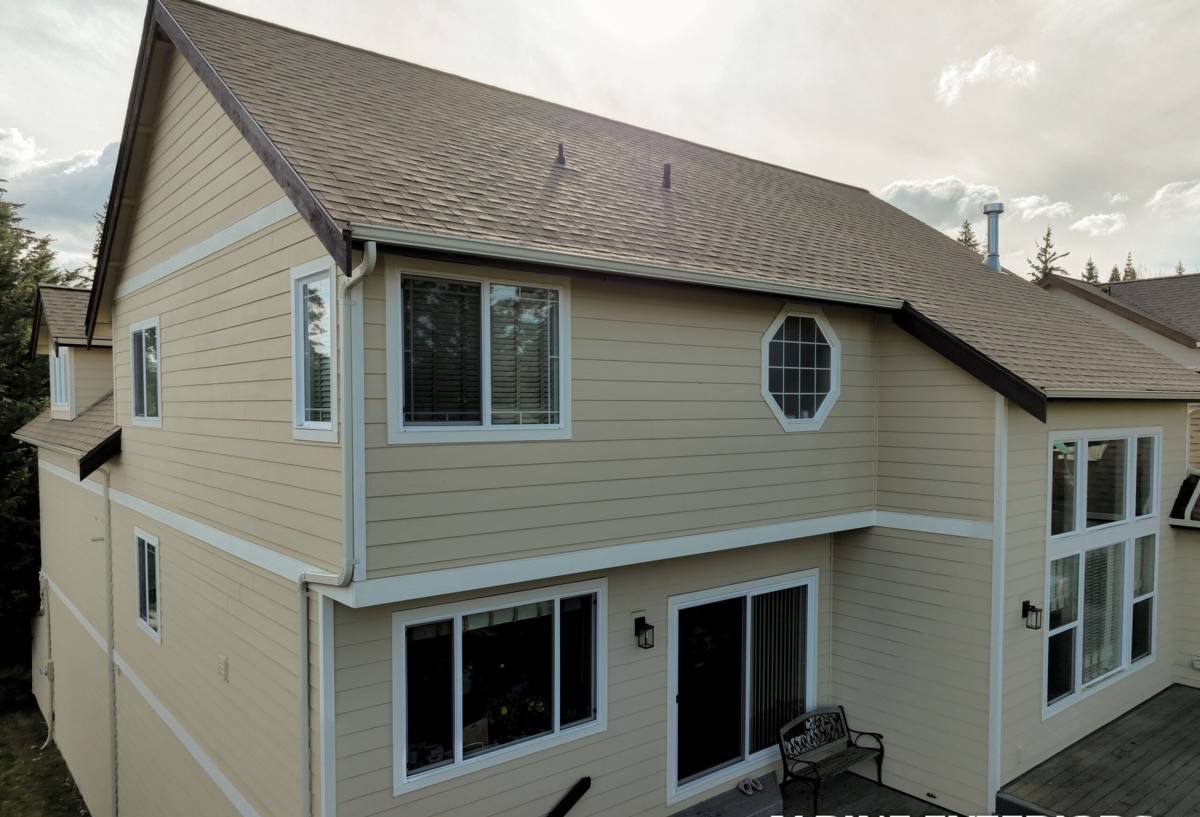
What Local Homes Actually Need From New-Construction Windows
New-construction windows use a nailing fin (sometimes called a nail flange) that attaches directly to the sheathing before siding goes on, as opposed to replacement windows that get inserted into an existing frame. That fin is your primary line of defense against wind-driven rain, and on Lummi Island it needs to be treated that way from the first course of flashing tape to the last bead of sealant.
Salt Air and Hardware
Salt air accelerates corrosion on fasteners, cladding, and hardware finishes faster than it does even a few miles inland. That affects which fastener types and cladding finishes we recommend for window installations close to the water, and it's a conversation worth having during the design phase, not after the windows are ordered.
Driving Rain
Wind off the water pushes rain horizontally and upward under eaves and around corners. Window openings on the windward sides of a Lummi Island home need flashing details sized for that reality — generous head flashing, properly lapped jamb flashing, and sill pans that direct any intrusion back outside rather than into the wall cavity.
Long Moss Season
Shaded north and east elevations on wooded or low-lying lots stay damp for months at a stretch. Moss and algae growth on trim and cladding around windows isn't just cosmetic — sustained moisture at those surfaces is exactly what shortens the life of caulking, paint, and unprotected wood trim. Detailing that sheds water cleanly away from the window unit reduces how much moss has to be dealt with later.
What Correct New-Construction Window Installation Involves
A proper install follows a sequence, and skipping steps or doing them out of order is where most problems start. On coastal builds we don't shortcut any of the following:
- Rough opening checked for square, level, and correct dimensions before the window ever arrives on site
- Sill pan flashing installed and sloped to drain outward, not just a bead of sealant across the bottom of the opening
- Weather-resistive barrier integrated with the flashing in the correct shingle-lap order (sill, jambs, then head) so water always sheds to the outside
- Window set plumb, level, and square, with shims at the correct load points per manufacturer instructions
- Nailing fin fastened per the manufacturer's schedule — not just "enough nails to hold it"
- Flashing tape and head flashing lapped over the fin, never tucked behind it
- Interior and exterior sealant beads placed correctly, with a gap left where the assembly needs to breathe
- Final check for operation, drainage, and visual squareness before trim and siding close the opening up
Every one of those steps is inspectable while the wall is still open. Once siding goes up, you're trusting that it was done right — which is exactly why we walk clients through this stage rather than rushing past it.
Choosing a Frame Material for a Coastal Lot
Frame material selection matters more on Lummi Island than on a sheltered inland lot in Whatcom County. There's no single "best" material — each comes with real trade-offs in maintenance, moisture behavior, and upfront cost. Here's how the common options actually compare in a salt-air, high-moisture environment:
| Frame Material | Salt Air Performance | Maintenance | Typical Cost Position |
|---|---|---|---|
| Vinyl | Good — won't corrode or rust; UV-stable formulations hold up well | Low — occasional rinse to clear salt residue | Lower to mid |
| Fiberglass | Very good — dimensionally stable, resists warping in temperature swings | Low | Mid to upper |
| Wood (unclad) | Poor without diligent upkeep — exposed wood is sensitive to sustained moisture and salt | High — regular refinishing needed, especially on exposed elevations | Mid to upper |
| Wood-clad (aluminum or vinyl exterior) | Good on the exterior face; interior wood still needs a dry envelope | Low exterior, moderate interior | Upper |
| Aluminum | Fair — can corrode over time without a quality finish; also thermally conductive | Moderate | Mid |
Our default recommendation for exposed elevations on Lummi Island builds is vinyl or fiberglass, specifically because they hold up to salt exposure with the least ongoing maintenance. We're not against wood or wood-clad windows — plenty of homeowners want that look — but we'll tell you honestly what upkeep it demands on a site this exposed before you commit to it.
Glazing and Weatherstripping Choices That Matter Here
Beyond the frame, the glazing package affects both comfort and moisture performance. Dual-pane units with a low-E coating and argon fill are standard on new construction now, and they help control condensation on interior glass during cold, damp stretches — a real issue in a marine climate where indoor humidity runs higher than in drier parts of the state. Quality weatherstripping and a well-adjusted sash also matter more here than in a dry climate, since a poorly sealed operable window is a direct path for wind-driven rain during a winter storm.
Our Process for New-Construction Window Installs
Before the Windows Arrive
We review rough openings against the window schedule, confirm flashing details with the builder or GC, and flag any framing dimension issues before they become install-day problems.
Logistics on the Island
Lummi Island is reached by ferry, which means material deliveries and crew scheduling need to be planned around sailing times rather than assumed to work like an on-mainland job site. We build that into our scheduling up front so a job isn't held up waiting on a window order or a tool that didn't make the last crossing.
Installation and Sign-Off
Each window is set, flashed, and sealed following the sequence above, then checked for square, level, and smooth operation before we move to the next opening. We photograph flashing details before they're covered by siding, so there's a record of the work even after the wall is closed in.
Mistakes We See — and Correct — on Coastal New Builds
Most of the window problems we're called to fix on coastal Whatcom County homes trace back to a handful of recurring issues:
- Sill pan skipped or replaced with sealant alone, which fails long before a proper pan would
- Flashing tape lapped in the wrong order, directing water behind the barrier instead of over it
- Fasteners that aren't rated for coastal exposure, leading to early corrosion and staining
- Openings framed slightly out of square, forcing the window to be shimmed unevenly and stressing the frame
- Sealant used as a substitute for proper flashing rather than as a secondary layer
None of these are visible once the house is finished — they show up years later as staining, soft trim, or a window that's suddenly hard to operate. Getting it right during new construction is the cheapest point in the entire life of the window to address it.
Why a Crew That Already Works Lummi Island Matters
A contractor who regularly works this part of Birch Bay and out to Lummi Island already understands the ferry logistics, already knows how exposed a given lot's elevations are likely to be, and isn't guessing at what a marine climate does to fasteners, trim, and caulking over time. That experience shows up in small decisions — which elevations get extra flashing attention, which fastener spec to use, how much lead time to build into scheduling around the ferry — that a crew unfamiliar with the island would have to learn the hard way, on your house.
We'd rather talk through your specific lot, its orientation to the water, and your builder's timeline before quoting anything, because those details change the right answer. If you're planning new construction on Lummi Island and want windows installed in a way that's built for this specific climate rather than a generic spec sheet, we're happy to take a look at your plans and offer a straightforward, no-pressure estimate using the form below.