 Birch Bay Siding
 Terrell Creek sits in the low, wooded drainage that feeds into Birch Bay, and that setting gives homes here a slightly different exposure than a house right on the open shoreline or one further inland in Whatcom County. There's still salt-laden marine air moving through on a regular basis, but the creek corridor also brings more shade, more standing dampness in the ground and understory, and longer stretches where a wall or roofline just doesn't get direct sun to dry out. For siding, that combination is demanding in its own way — it's not just about withstanding wind-driven rain, it's about a material that can sit in persistent low-level moisture and shaded conditions for months at a time without breaking down.
We install James Hardie fiber cement siding exclusively, and on Terrell Creek homes specifically, that choice comes down to how the material handles sustained dampness and organic growth, not just how it looks going on the wall. This page covers what this creek-side, moss-prone stretch of the Birch Bay area actually needs from its siding, what a correct fiber cement installation involves here, and why working with a crew that already knows this specific microclimate matters.
What Terrell Creek's Setting Does to Siding
Salt Air Combined with Shade
Being close to Birch Bay means Terrell Creek homes still get a steady dose of salt in the air, which speeds up corrosion on fasteners, flashing, and any metal trim that isn't rated for it. What makes this area different from a fully open waterfront lot is the tree cover along the creek corridor. Shade keeps walls cooler and slows evaporation, so any moisture that does land on a wall — from rain, condensation, or morning dampness off the creek — sticks around longer before it has a chance to dry. Salt exposure and prolonged dampness together are a tougher combination than either one on its own.
Driving Rain That Doesn't Just Fall Straight Down
This part of Whatcom County gets long stretches of wind-driven rain through fall and winter, and wind pushes water sideways into wall assemblies, window and door flashing, and roof-to-wall transitions rather than letting it run straight off. On a creek-adjacent lot with more tree cover, that sideways-driven water also has less sun and wind afterward to help dry it back out. Installation details that would be forgiving in a drier, more open setting have less margin for error here.
A Long Moss and Mildew Season
Shade, dampness, and mild temperatures are exactly the conditions moss and mildew need, and the tree cover along Terrell Creek gives them more of all three than a fully exposed lot would. North-facing walls, anything under overhanging branches, and lower courses of siding near landscaping tend to show growth first. Any siding material that's even slightly porous, or that holds moisture against the substrate instead of shedding it, becomes a growth surface here faster than it would on a sunnier property a few blocks away.
Why We Install Only James Hardie Fiber Cement Here
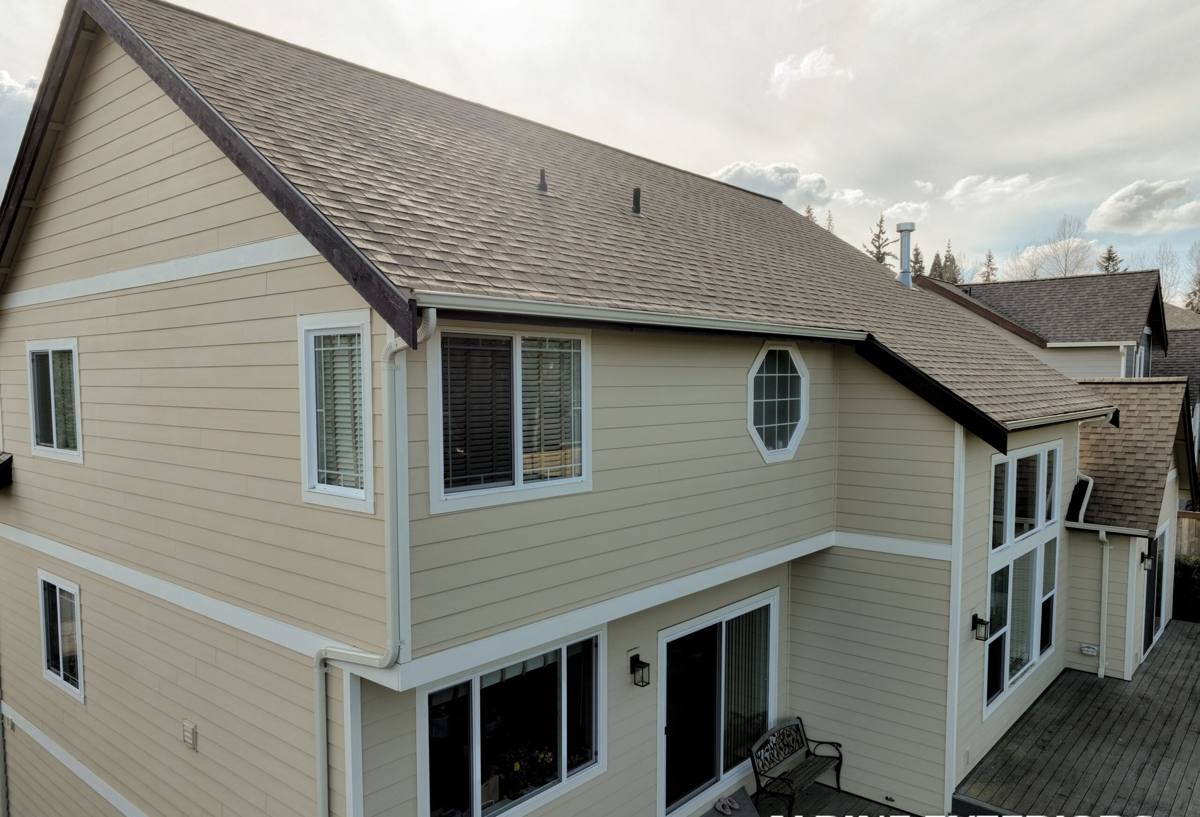
We used to install a broader range of siding products across the Birch Bay area. We stopped, and the shaded, damp conditions along creek corridors like this one are part of why. Fiber cement is a material that stays dimensionally stable and resists organic growth even when a wall doesn't get much direct sun, which is exactly the situation a lot of Terrell Creek homes are in.
- Non-combustible core: Fiber cement doesn't feed a fire the way wood-based siding products can, which matters for safety and can matter for insurance underwriting as well.
- Factory-applied ColorPlus finish: The finish is baked on under controlled conditions rather than brushed on in the field, so it holds color and resists moisture intrusion better than field-applied paint, especially on shaded walls that take longer to dry between wet spells.
- Climate-engineered HZ5 formulation: Hardie's HZ5 product line is built for regions with heavy moisture exposure and freeze-thaw cycling, which is a good match for a damp, tree-shaded corridor near the bay.
- Dimensional stability: Fiber cement doesn't swell, cup, or warp the way engineered wood products can when they repeatedly absorb moisture without a full dry-out period in between.
- Strong transferable warranty: Hardie backs correctly installed siding with one of the more robust warranty structures in the industry, and that warranty transfers if the home sells.
We don't install LP SmartSide, vinyl siding, Cemplank, Allura, primed spruce, or cedar. Every one of those products has homeowners who are satisfied with them in the right setting, and none of them is a bad product on its face. But in a shaded, moisture-holding environment like the Terrell Creek corridor, we'd rather stand fully behind one system than offer a lower-cost option that quietly shifts more maintenance and repair risk onto the homeowner down the road.
What a Correct Installation Involves Here
Fiber cement only performs the way Hardie designs it to when it's installed to spec, and that matters more on a shaded lot where mistakes have less sun and airflow to help mask or dry them out. A correct installation means the right fastener type and spacing for the HZ5 product, proper clearance from grade and any nearby landscaping or ground cover, and joints that are either factory-mitered or properly caulked rather than butted and hoped for.
Detailing That Matters Most in a Shaded, Damp Setting
On a creek-adjacent home, drainage plane and rain-screen detailing behind the siding carry more weight than they would on a sun-exposed wall, because any water that does get behind the panel has less help drying out. Flashing at windows, doors, and every roof-to-wall transition needs to be lapped correctly so water sheds outward instead of finding its way into the wall cavity. And because moss and organic debris collect more readily under tree cover, keeping the bottom edge of the siding at the right clearance from soil, mulch, and plantings is part of doing the job right, not an afterthought.
Comparing Siding Materials for a Creek-Shaded, Salt-Exposed Lot
| Material | Behavior in Shade and Moisture | Resistance to Moss/Mildew | Typical Longevity Here |
|---|---|---|---|
| James Hardie fiber cement | Dimensionally stable; doesn't swell or cup when slow to dry | Strong; dense material resists organic growth | 30+ years with correct install |
| Vinyl siding | Can warp with heat cycling; seams trap moisture and debris | Moderate; grime and moss can build in panel laps | Variable; shorter in shaded, damp spots |
| LP SmartSide / engineered wood | Wood-based core is sensitive at cut edges when slow to dry | Moderate; requires consistent edge sealing | Heavily dependent on installation and upkeep |
| Cedar / primed wood | Absorbs and releases moisture readily; slow drying in shade | Weak without regular treatment | Shorter without frequent refinishing |
Our Process for Terrell Creek Homes
We start with an on-site look at the existing siding and the specific exposure of the house — how much sun each wall gets, how close tree cover and landscaping sit to the siding, and where moisture and moss are already showing up. From there we put together a clear, written scope covering the HZ5 product, trim, and color selection, along with a realistic timeline. During installation, the flashing, clearance, and drainage details that matter most in a shaded, damp setting are handled as standard practice, not offered as an upgrade.
Signs a Terrell Creek Home's Siding Needs Attention
- Moss or dark streaking that keeps returning on shaded or north-facing walls after cleaning
- Soft spots, bubbling, or visible swelling, especially near ground level or under tree cover
- Caulk or joints that have cracked or separated at seams and trim
- Paint or finish that's chalking, peeling, or fading unevenly compared to sun-exposed walls
- Musty smell or visible staining on interior walls that back up to shaded exterior siding
Why a Crew That Already Works Terrell Creek Matters
A contractor who's worked this specific corridor knows that a shaded, creek-adjacent lot doesn't behave like an open waterfront property or an inland Whatcom County home, even though all three are within a few miles of each other. That shows up in small decisions — how much clearance to leave near landscaping, where to add extra drainage detailing, which walls need closer attention during a maintenance inspection — and those decisions are what separate siding that lasts decades from siding that starts showing problems in the first few wet seasons.
A Few Questions Worth Asking Before Hiring
- Ask what siding material they install and why, and whether they'll put a written warranty behind it
- Confirm current Washington contractor licensing and active liability insurance
- Ask how they handle clearance and drainage detailing on shaded, moisture-prone walls specifically
- Ask whether they've worked on homes along this creek corridor before, and what they've seen go wrong
- Get a clear, written scope of work before signing anything
If you're weighing siding options for a home along Terrell Creek, we're glad to walk the property with you and give an honest read on what the shaded and exposed sides of the house each need. Reach out below for a free, no-pressure estimate.