 Birch Bay Siding
 Why Ferndale Siding Takes a Different Kind of Beating
Ferndale sits close enough to the water that homes here deal with a mix of weather inland Washington towns rarely see all at once. Salt-laden air moves in off the Salish Sea, driving rain rides in sideways during winter storms, and the tree cover and damp shade that make this part of Whatcom County beautiful also give moss and algae months at a time to take hold on north-facing walls. Individually, none of those things are dramatic. Together, year after year, they're exactly the combination that wears down siding faster than a manufacturer's spec sheet would suggest.
That's the environment we're repairing siding in every week, not an occasional job we take on when it comes up. We know what damage looks like at month six versus year six on a Ferndale home, and that context changes how we diagnose and repair a wall compared to a crew that only sees this kind of exposure once in a while.
It also changes what "correct repair" means. A patch that would hold up fine in a drier climate can fail within a season here if it doesn't account for how much moisture the wall is actually exposed to and how long that moisture sits against it before it dries.
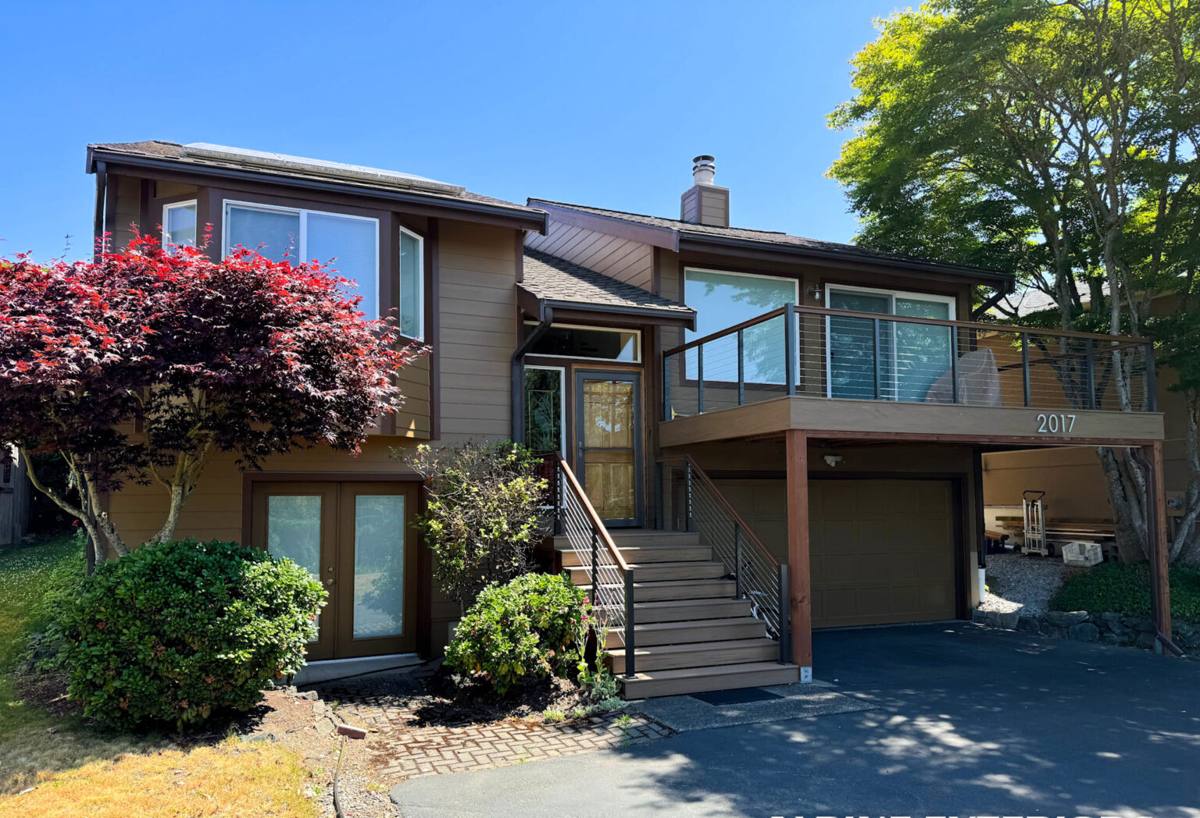
Signs Your Ferndale Home Needs Siding Repair
Some siding damage is obvious — a cracked board, a section knocked loose by a windstorm, a corner that's started to separate from the wall. Other damage is easy to miss until it's expensive:
- Dark streaking or persistent moss growth on siding that stays shaded most of the day
- Soft or spongy spots when you press on a board, especially near the bottom courses
- Paint that's bubbling, peeling, or chalking in patches rather than evenly across a wall
- Visible gaps at seams, corners, or trim where caulking has shrunk or failed
- Warping, cupping, or bowing boards, particularly on walls that face prevailing wind and rain
- Water stains or discoloration on interior walls near exterior corners
Any one of these can be a small, contained repair if it's caught early. Left alone through another wet season, most of them turn into a bigger job — sheathing repair, insulation replacement, or trim rebuilding — because moisture doesn't stay where it enters. It travels along framing and insulation until it finds a place to collect, which is often well away from where the damage first shows up on the outside.
What a Correct Siding Repair Actually Involves
Diagnosing the damage, not just patching the symptom
A repair that just replaces the board you can see is only half the job. Before we touch a wall, we're checking what's underneath it — house wrap condition, flashing at windows and trim, whether water has tracked sideways from the actual entry point. Siding that looks damaged in one spot has often been letting moisture in a foot or two away, at a seam, a nail hole, or a piece of trim flashing that was installed short. Repairing the visible board without finding the real entry point means the same failure shows up again in a year or two, usually a little worse than before.
Matching materials and matching behavior
Siding repair isn't just about matching color and profile — it's about matching how the material moves and sheds water. Mixing repair materials that expand, contract, or absorb moisture differently than the surrounding siding creates new stress points, even if the patch looks fine on install day. Caulking and flashing details matter just as much as the board itself; a repair with the wrong sealant at a seam can fail faster than the damage it replaced.
Repair vs. Replacement: How We Make the Call
Not every damaged section needs a full re-side, and we're not going to sell you one. The honest answer usually comes down to how much of the wall is affected and what's actually driving the damage.
| Situation | Usually Repair | Usually Replacement |
|---|---|---|
| Damage extent | Isolated boards or a single wall section | Damage spread across multiple walls or elevations |
| Underlying cause | Impact damage, isolated caulk failure, one bad flashing detail | Systemic moisture intrusion, failed house wrap, widespread rot |
| Siding age | Newer siding, still well within its expected service life | Original siding near or past the end of its practical lifespan |
| Material on the wall | James Hardie fiber cement in good condition elsewhere | A product prone to widespread moisture or warranty issues |
| Cost pattern | Lower cost, faster turnaround, addresses the immediate problem | Higher upfront cost, but resets the clock on the whole wall |
When damage is limited and the wall assembly underneath is sound, repair is the right call and we'll tell you that directly. When we find rot spreading behind the siding, or damage that's really a symptom of the material itself struggling across the whole house, we'll show you what we found and explain why patching it would just be delaying a bigger, more expensive problem down the road.
Our Process for Ferndale Siding Repair
- Inspection. We look at the damaged area and the wall assembly behind it — sheathing, house wrap, flashing — not just the siding surface.
- Diagnosis. We identify the actual entry point for moisture or the actual cause of failure, which is sometimes several inches from where the damage is visible.
- Written scope. You get a clear explanation of what's being repaired, what materials we're using, and why, before any work starts — no vague allowances.
- Repair. Damaged material comes out, the wall assembly underneath gets corrected if needed, and new siding, flashing, and caulking go in to spec.
- Finish match. We match factory finish and profile as closely as the product allows so the repair doesn't stand out from the rest of the wall.
- Walkthrough. We show you the completed work and explain any upkeep that'll help it hold up through the next wet season.
Why James Hardie Is the Right Material for Repair Work Here
We install James Hardie fiber cement exclusively, and that shows up in how we approach repairs too. Hardie's HZ product lines are engineered for exactly the kind of climate zone Whatcom County sits in — sustained moisture exposure, temperature swings, and the freeze-thaw pattern of a Pacific Northwest winter. It's non-combustible, it doesn't absorb and hold water the way wood-based products do, and the factory-applied ColorPlus finish resists the fading and peeling that turns a cosmetic issue into a repeating maintenance cycle.
That consistency matters for repair work specifically: when we replace a damaged section, we're not fighting the material to make it perform like the rest of the wall. It behaves predictably, which means the repair actually solves the problem instead of introducing a new weak point a few years down the line. Hardie also backs its product with a strong transferable warranty, which is worth more on a repair than it sounds — it means the section we replace carries the same manufacturer backing as the original installation, not a mismatched patch with no coverage behind it.
If your home currently has a different siding product and it's failing in ways that go beyond a clean, contained repair, we'll walk you through what we're seeing and where Hardie fits as a longer-term fix. But we're not going to push a full re-side when a proper, well-diagnosed repair will genuinely hold up.
Why Hiring a Crew That Already Works Ferndale Matters
Siding repair done wrong is worse than no repair at all, because it traps moisture behind a wall that now looks fine from the outside. A crew that works this area regularly already knows which wall orientations take the worst of the wind-driven rain, how much moss buildup is normal versus a sign of a deeper drainage problem, and how the local mix of humidity and shade affects cure times and material choices on site. That's not something you can fully substitute with a contractor working from a drier climate's assumptions about how siding should perform.
Here's a short checklist worth using with any contractor you're considering for siding repair, us included:
- Do they inspect behind the damaged siding, or just replace what's visible?
- Will they give you a written explanation of the cause, not just the fix?
- Do they work with a single, consistent siding material they can speak to in detail?
- Can they explain how the repair will hold up specifically through a Northwest wet season?
- Do they offer a clear scope and price before work begins, with no vague allowances?
Maintaining Your Siding After the Repair
A good repair buys you years, but a little upkeep buys you more. Rinsing moss and debris off shaded siding once or twice a year, keeping gutters clear so water isn't sheeting down a wall, and trimming back vegetation that holds moisture against siding all reduce the chance you're back here for the same reason. Checking caulking at trim and seams every year or two is a small habit that catches problems while they're still cheap to fix.
None of that is complicated, but in a climate that stays damp as long as this one does, it makes a real difference in how long a repair — or an entire siding job — actually lasts. Homes that get a little routine attention tend to need far less emergency repair work over time than homes that don't get looked at until something's visibly wrong.
If you're seeing damage on your Ferndale home, or you're just not sure whether what you're looking at is a quick fix or something bigger, we're happy to take a look. Fill out the form below for a free, no-pressure estimate — we'll tell you honestly what we find and what it'll take to fix it right.