 Birch Bay Siding
 Why Birch Bay Village Homes Wear Out Windows Faster
Birch Bay Village sits close enough to the water that salt air is a daily fact of life, not an occasional nuisance. That air works on window hardware, frame seams, and exterior finishes year-round, and it doesn't take a storm to do it — a steady onshore breeze on an ordinary afternoon carries enough salt to slowly pit metal fasteners, gum up weep holes, and dull finishes that would otherwise last decades further inland.
Add in driving rain that comes sideways off the water during winter systems, and you've got a combination that finds every weak point in a window's seal. Then there's the long stretch of gray, damp months each year that Whatcom County homeowners know well — the kind of weather that keeps north-facing walls and shaded corners of a house wet long after the rain has stopped, which is exactly the environment moss and algae need to take hold on sills, tracks, and trim.
None of this means windows in Birch Bay Village are doomed to fail early. It means the products and installation details that work fine in a drier inland town need to be chosen more carefully here, and installed by someone who treats that difference as normal, not an afterthought.
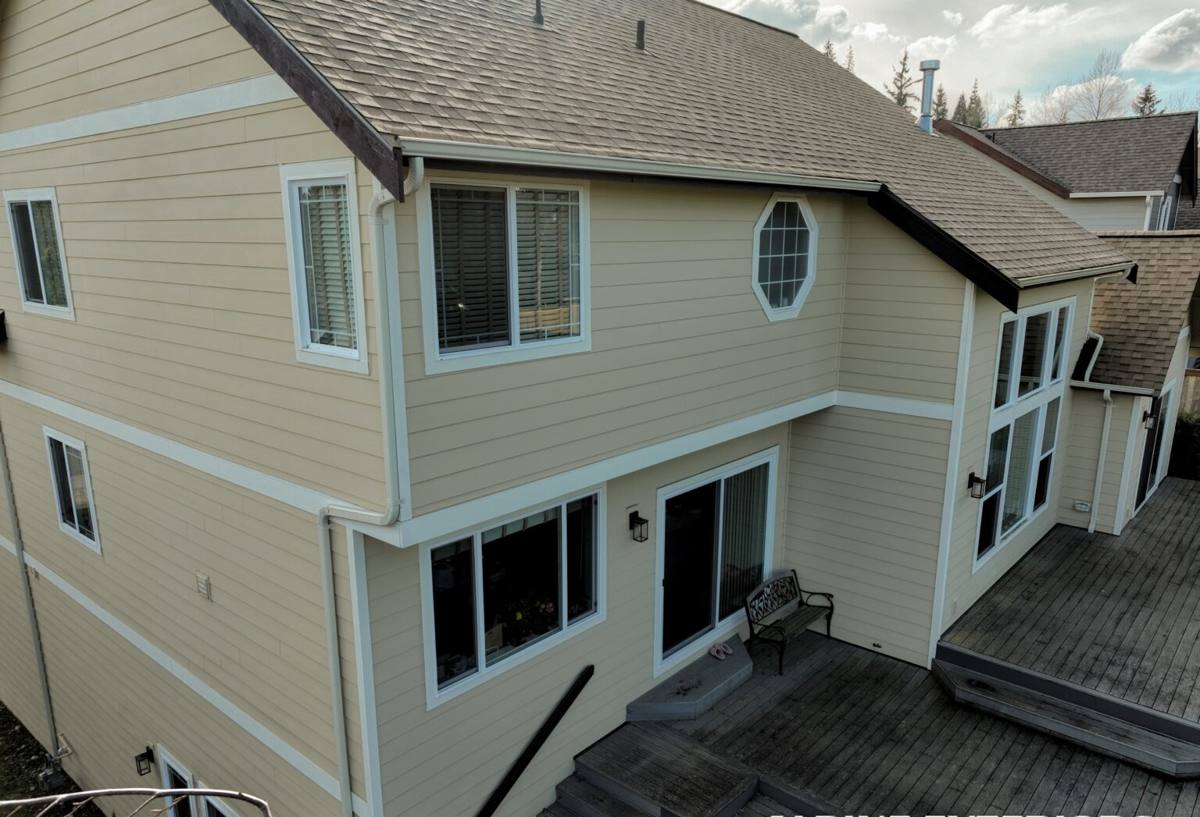
Signs Your Current Windows Are Losing the Battle
Most window failure in this area is gradual, so homeowners often live with early warning signs for a season or two before deciding to act. Watch for:
- Fogging or a permanent haze between panes — the seal has failed and the gas fill (or trapped air) is gone
- Sashes that stick, drag, or won't latch flush — often swelling from moisture intrusion into the frame
- Soft or discolored wood at the sill or bottom corners of the frame
- Visible pitting, chalky residue, or corrosion on hinges, cranks, or locks
- Green or black growth in the corners of frames or along exterior trim that keeps coming back after cleaning
- A noticeable draft or cold spot near the window even when it's fully closed and locked
Any one of these on its own might just mean a repair or a resealing job. Several of them on the same window, or the same symptom repeating across multiple windows on one side of the house, usually points to the frame material or original installation not being suited to the exposure that wall gets.
What "Custom" Actually Means for These Homes
Custom doesn't mean expensive or elaborate — it means the window is built to the actual opening and actual exposure of your house, instead of forced to fit a stock size with shims and extra caulk. Birch Bay Village has a mix of home ages and construction styles, and older openings in particular are rarely a perfect match for off-the-shelf replacement sizes. Custom sizing means:
- Exact measurements taken for each opening, accounting for settling or slight out-of-square conditions that are common in older framing
- Frame depth and mounting method matched to your wall assembly, not a generic new-construction or retrofit default
- Sill and jamb details chosen based on which direction that wall faces and how much weather it takes
- Hardware and cladding specified for salt exposure rather than a builder-grade standard finish
The payoff is a tighter seal on day one and fewer callbacks for gaps, whistling, or water intrusion later — which matters more here than in a drier climate, because a small gap in Birch Bay Village has more driving rain and more corrosive air finding its way through it.
Matching the Window to the Wall, Not Just the House
It's common for one side of a Birch Bay Village home to need a noticeably different window spec than the other three. A wall that faces open water or takes the prevailing wind may need heavier-duty weatherstripping and a different sill pan detail than a sheltered, tree-covered side of the same house. We spec each opening on its own rather than ordering one uniform product for the whole house.
Frame Material: More Consequential Here Than Inland
In a lot of the country, frame material is mostly a budget and style decision. Near the water, it's also a durability decision, and the trade-offs are worth understanding before you commit.
| Frame Material | Salt Air / Moisture Behavior | Maintenance | Typical Lifespan Here |
|---|---|---|---|
| Vinyl | Won't corrode or rot; UV and impact resistance vary by product grade | Low — occasional cleaning | 20–30 years with a quality product |
| Fiberglass | Excellent — dimensionally stable, doesn't expand/contract with humidity swings | Low | 30+ years |
| Aluminum-clad wood | Good exterior protection, but any breach in the cladding exposes wood underneath to rot | Moderate — cladding seams need periodic inspection | 20–25 years if maintained |
| Bare wood | Attractive but vulnerable — moisture and salt accelerate rot and finish failure | High — regular refinishing required | Highly variable; shortest of the group here |
We're not against wood-frame windows on principle — some homeowners want the look and are willing to keep up with the maintenance. Our standard recommendation for most Birch Bay Village homes is vinyl or fiberglass precisely because they hold up with the least upkeep in this climate, not because other options are inferior products in general.
Glass and Glazing Choices That Actually Matter Here
Double-pane glass with a low-E coating and argon fill is the baseline we install for most homes in this area — it cuts heat loss, reduces condensation on the interior pane, and holds up fine under normal wind loads. Triple-pane is worth the added cost on walls that take the brunt of wind off the water or where road noise and draft have been a persistent complaint; it's not something every window in the house needs.
A few glazing details that make a real difference in a coastal, high-moisture area like this:
- Warm-edge spacers resist seal failure better than older metal spacer designs, which is worth paying attention to since seal failure is the single most common problem we see in older double-pane units here
- Corrosion-resistant hardware (stainless or coated components) on cranks, hinges, and locks lasts meaningfully longer against salt air than standard-grade hardware
- Tempered or laminated glass near ground level or in larger picture windows adds impact resistance, which matters when winter storms are blowing debris around
Installation Details That Prevent Leaks
Most window failures we get called out to inspect aren't a bad window — they're a window that was installed without the flashing and sealing details this climate demands. Driving rain doesn't just test the glass and frame; it tests every seam where the window meets the wall.
What a Correct Installation Includes
- Removal of the old unit down to the rough opening, with the opening inspected for hidden rot or prior water damage before anything new goes in
- A sloped sill pan installed at the base of the opening so any water that does get past the window drains outward, not into the wall
- Self-adhered flashing membrane integrated with the house wrap in the correct shingle-lap order — top piece over the sides, sides over the sill — so water sheds down and out
- Backer rod and a high-quality exterior sealant rated for movement and UV exposure, not a bead of caulk over a gap
- Proper shimming and fastening so the frame is square and doesn't rely on the sealant to hold shape
- Interior air sealing and insulation of the gap between frame and rough opening, which affects both drafts and condensation
Skip any one of these steps and the window can look fine for a year or two before a leak shows up — usually as a stain on interior trim or soft drywall, well after the installer is long gone.
Our Process, Start to Finish
We keep this straightforward on purpose:
- On-site assessment — we look at each opening, note sun and wind exposure, and check for existing moisture damage before quoting anything
- Product selection — we walk through frame material, glazing, and hardware options suited to that specific wall, with honest pros and cons for each
- Custom measurement and ordering — every window is measured to its actual opening, not assumed to match a stock size
- Installation — full removal, opening inspection, sill pan, flashing, sealing, and finish work, done one opening at a time so your home isn't left exposed
- Cleanup and walkthrough — old windows and debris hauled off, and we walk the finished openings with you before calling the job done
What to Ask Before You Hire Anyone for This Job
Window replacement is one of those jobs where a rushed or corner-cutting install doesn't show up as a problem until a year or two later, so it's worth vetting a contractor before you sign anything. A short checklist:
- Do they install a sloped sill pan and proper flashing on every job, or just caulk and go?
- Can they explain why they'd recommend one frame material over another for your specific wall exposure?
- Are they licensed and insured in Washington, and will they show you proof without being asked twice?
- Do they offer a written warranty on both the product and their labor, separately?
- Will they give you a firm, itemized quote before work starts — not a rough verbal estimate?
- Do they have experience working on homes in this specific area, or is coastal installation new territory for them?
Why Local Experience in Birch Bay Village Specifically Matters
A window contractor who mostly works inland can install a perfectly good window and still get burned by details that only show up near the water — under-speccing hardware for salt exposure, skipping a sill pan because it's "usually fine," or scheduling installation during a weather window that doesn't actually hold near the coast. We work in Birch Bay and across Whatcom County regularly enough to know which frame materials hold up here, which installation details aren't optional, and how to plan around the driving rain and moss season instead of getting caught by them mid-job.
That local pattern recognition is the real value of hiring a crew that already knows this area, on top of the standard craftsmanship every window job deserves. It's the difference between a window that looks right at handoff and one that's still performing the way it should five or ten years later.
If you're weighing a window replacement for your Birch Bay Village home, we're happy to take a look and give you a straight, no-pressure estimate — just fill out the form below and we'll go from there.