 Birch Bay Siding
 Composite Decking for Bellingham's Marine Climate
Bellingham sits in the same wet, salt-tinged corner of Whatcom County as Birch Bay, and decks here take a beating that inland decks never see. Salt-laden air off the water accelerates corrosion on anything metal. Driving rain finds its way into every gap a builder didn't seal. And a long, gray moss season turns shaded north-facing decks green if they aren't built to shed water and dry out. Composite decking, installed correctly for this specific climate, holds up to all three far better than untreated or even pressure-treated wood — but "installed correctly" is doing a lot of work in that sentence, and it's where most decking problems actually start.
This page covers what a Bellingham composite deck actually needs, what a correct installation looks like, and why it matters to hire a crew that already works this part of Whatcom County rather than one driving in from somewhere drier.
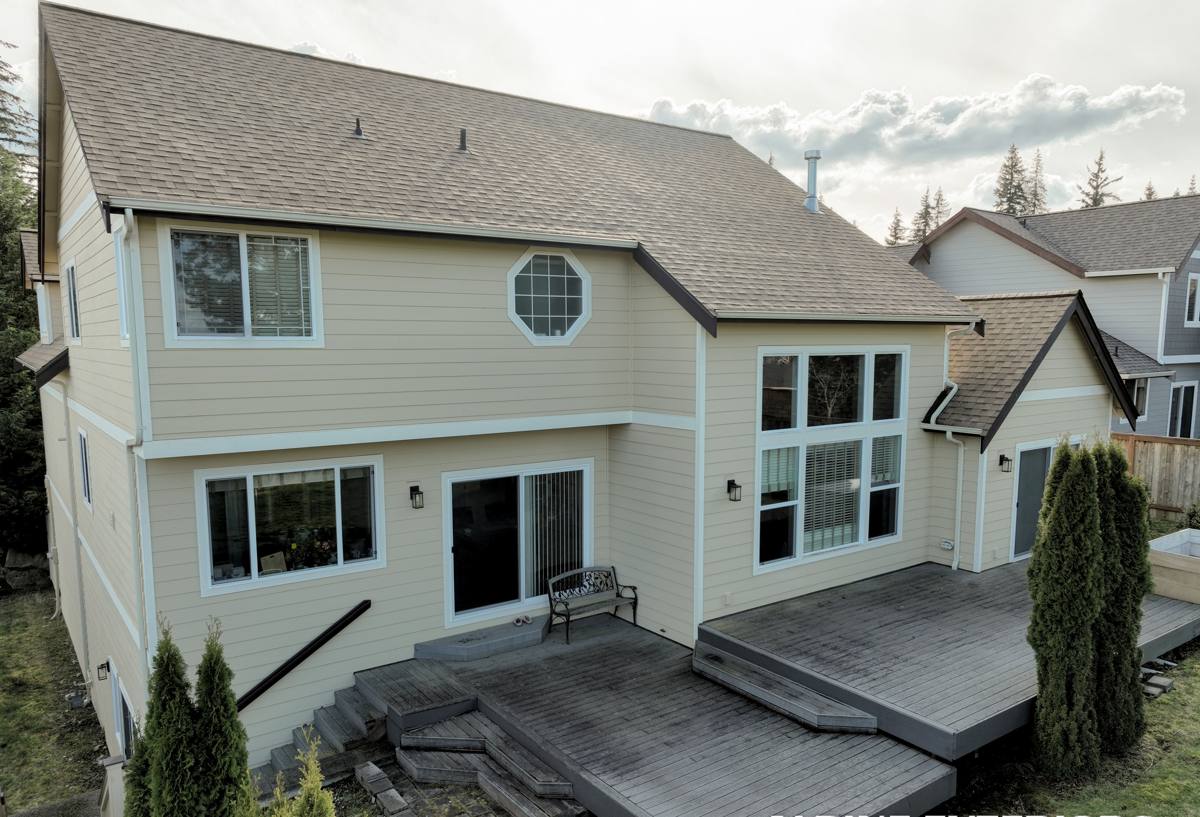
What This Climate Actually Does to a Deck Over Time
Salt Air and Hardware Corrosion
Proximity to saltwater doesn't just affect boats and cars. Airborne salt settles on exposed metal — screws, joist hangers, post bases, railing brackets — and speeds up corrosion, especially where two dissimilar metals touch or where a fastener coating has been scratched during installation. On a standard wood deck, this shows up as rust streaks and weakened connections years before the boards themselves fail. Composite boards are largely immune to this, but the deck is still held together with metal hardware underneath, and that hardware needs to be rated for the environment, not just whatever's cheapest at the local supply house.
Driving Rain and Water Intrusion
Storms here don't fall straight down — wind-driven rain gets pushed sideways into ledger boards, fastener holes, and any seam that isn't properly flashed. Water that gets behind a ledger board or under a rim joist doesn't dry out quickly in this humidity, and that's where rot starts in the framing even if the decking on top looks fine. This is one of the most common failure points we see on older decks in this area, and it's almost always a flashing and detailing issue, not a decking material issue.
Moss and Prolonged Dampness
Whatcom County's moss season runs long, and shaded or north-facing decks with poor airflow underneath stay damp for weeks at a stretch. Moss and algae need that sustained moisture to establish themselves, and once they do, boards get slick and start holding water against the surface. Composite doesn't rot from this the way wood does, but surface growth still happens on any decking material if drainage and airflow underneath aren't part of the design from day one.
Why Composite Makes Sense for a Bellingham Deck
Wood decking can absolutely be built well here, and we still install it for homeowners who want that look and understand the upkeep. But composite removes several of the maintenance burdens that this specific climate creates — no annual staining to fight off moss growth in bare wood, no splintering as boards weather unevenly in the damp-dry cycles, and no soft spots developing from repeated saturation. The trade-off is upfront cost and a different set of installation rules, which we cover below.
| Factor | Wood Decking | Composite Decking |
|---|---|---|
| Moss/algae resistance | Needs regular cleaning and treatment | Resists growth better; still needs periodic washing |
| Salt air exposure | Fasteners and surface both vulnerable | Board material unaffected; hardware still matters |
| Upfront cost | Lower | Higher |
| Long-term upkeep | Annual staining/sealing typical | Occasional cleaning, no staining |
| Warranty | Varies, often shorter | Typically 25-50 years, material-dependent |
| Look over time | Ages and grays if not maintained | Holds color longer, uniform wear |
What a Correct Composite Installation Involves
Substructure and Joist Spacing
Composite boards flex differently than wood, especially in temperature swings, and most manufacturers require tighter joist spacing than a traditional wood deck — often 16 inches on center, sometimes tighter for angled or picture-frame patterns. Building to wood-deck spacing with composite boards on top is a common shortcut that leads to bounce and premature sagging. The substructure itself should still be pressure-treated or otherwise rated for ground or moisture exposure, since composite decking only protects the walking surface, not the frame underneath it.
Fasteners and Hardware Grade
Given the salt air issue above, hardware selection isn't optional here. Stainless steel or high-grade coated fasteners and connectors cost more than standard hot-dip galvanized, but in a coastal-influenced climate like this one, that difference shows up as the gap between hardware that lasts and hardware that's rusting within a few seasons. Hidden fastener clip systems, common with composite boards, also need to be matched correctly to the board profile — mismatched clips are a frequent cause of squeaking and board movement.
Ledger Flashing and Waterproofing
Where the deck attaches to the house is the single most important waterproofing detail on the entire structure. Proper ledger flashing, correctly lapped with the house's existing water-resistive barrier or siding, keeps wind-driven rain from tracking behind the band board and into the wall framing. This is the detail we mentioned earlier as the source of most hidden rot — it's invisible once the deck is built, which is exactly why it has to be done right the first time.
Airflow and Drainage Underneath
Skirting, low clearance, and dense landscaping around a deck's perimeter all trap moisture underneath and create the damp, shaded conditions moss thrives in. A correctly built deck leaves enough clearance and, where skirting is wanted, incorporates venting so air can still move through the joist bays.
Choosing the Right Board for This Climate
Capped vs. Uncapped Composite
Capped composite boards have a plastic shell wrapped around a wood-plastic composite core, which resists moisture absorption, staining, and surface mold far better than older uncapped composite products. In a climate with this much sustained dampness and moss pressure, we generally recommend capped composite or PVC decking over uncapped composite — the price difference is worth it here in a way it might not be in a drier region.
Color Choice and the Marine Layer
Darker composite colors absorb more heat on sunny days, but Bellingham's marine layer and cloud cover keep true heat-related board issues less of a concern than they would be east of the mountains. Color here is mostly an aesthetic choice, though lighter colors do show pollen and organic debris less than very dark boards on shaded decks.
Our Process for a Bellingham Deck Project
- On-site assessment of the existing structure (if replacing a deck), ledger condition, drainage, and sun/shade exposure
- Design and material discussion — board profile, color, railing system, and any local permit requirements
- Permitting, where required, handled before any demo or construction begins
- Demo of the old deck (if applicable) with inspection of ledger and framing for hidden rot before rebuilding
- Framing to composite-rated joist spacing with treated lumber and corrosion-resistant hardware
- Ledger flashing and waterproofing tie-in to the house
- Composite board installation with correct fastener/clip system for the chosen product
- Railing, stairs, and final detail work
- Walkthrough with the homeowner before we consider the job done
Maintenance in a Moss-Prone, Salt-Air Environment
Composite cuts down on maintenance, but "low maintenance" doesn't mean "no maintenance," especially in this climate. A few habits keep a composite deck looking and performing the way it should for decades:
- Rinse or sweep debris off the deck regularly, especially in fall when leaves and organic matter accumulate and hold moisture against the boards
- Wash the surface with mild soap and water once or twice a year to prevent moss and algae from getting established, especially on shaded sections
- Keep gutters and downspouts near the deck clear so runoff isn't dumping extra water onto or near the structure
- Trim back vegetation encroaching on the deck perimeter to keep airflow and sunlight reaching the surface
- Check railing connections and stair hardware annually for any early signs of corrosion, even with upgraded fasteners
- Avoid dragging metal furniture or grills across the surface, which can scuff the capped finish
Cost Factors for a Bellingham Composite Deck
Every deck is different, but the same handful of factors drive most of the price variation we see on composite projects in this area:
| Factor | Impact on Cost |
|---|---|
| Deck size and shape | Larger footprints and angled/picture-frame board patterns increase material and labor |
| Board tier (uncapped vs. capped composite vs. PVC) | Material cost rises with moisture and stain resistance |
| Substructure condition | Rot or undersized framing found during demo adds repair cost |
| Height and access | Elevated decks need additional footings, stairs, and railing |
| Railing system | Composite, metal cable, and glass railing all price differently |
| Permitting requirements | Varies by jurisdiction and deck height/attachment |
We'll walk through these factors specific to your property during the estimate rather than quoting a number sight unseen — deck pricing without seeing the site and existing structure isn't a real number.
Why Hire a Crew That Already Works Bellingham
A contractor who works this stretch of Whatcom County regularly already knows how the local permitting process handles decks, what ledger and flashing details actually hold up against wind-driven rain off the bay, and which hardware grades are worth the extra cost versus which are overkill. That's different from general decking experience picked up somewhere with a drier, calmer climate. We're based out of Birch Bay and work this area consistently, which means we're not learning the local conditions on your project — we already build for them every time.
If you're weighing a new composite deck or a replacement for an aging wood deck, we're happy to take a look at your property and put together a straightforward estimate — no pressure, no sales script, just an honest assessment of what your deck needs and what it would take to do it right. The form below will get you started.