 Birch Bay Siding
 Siding Built for the Terrell Creek Microclimate
Terrell Creek sits in a part of Birch Bay where the land does two things at once: it drains toward the water and it holds onto shade under a mix of conifers and mixed woodland along the creek corridor. That combination matters more than most homeowners realize when it comes time to re-side a house. A property a half-mile inland from the bay can dry out differently than one closer to open water, and the tree cover common around Terrell Creek keeps siding damp longer after a storm than it would on an open, sun-exposed lot. Add in the salt-laden air that rolls off Birch Bay itself, and you've got a set of conditions that will find every weak point in a siding system within a few years if the material and the installation aren't matched to the environment.
This page is about one thing specifically: what it takes to get James Hardie fiber cement siding right on a Terrell Creek home, and why that's the only siding system we put on houses in this area.
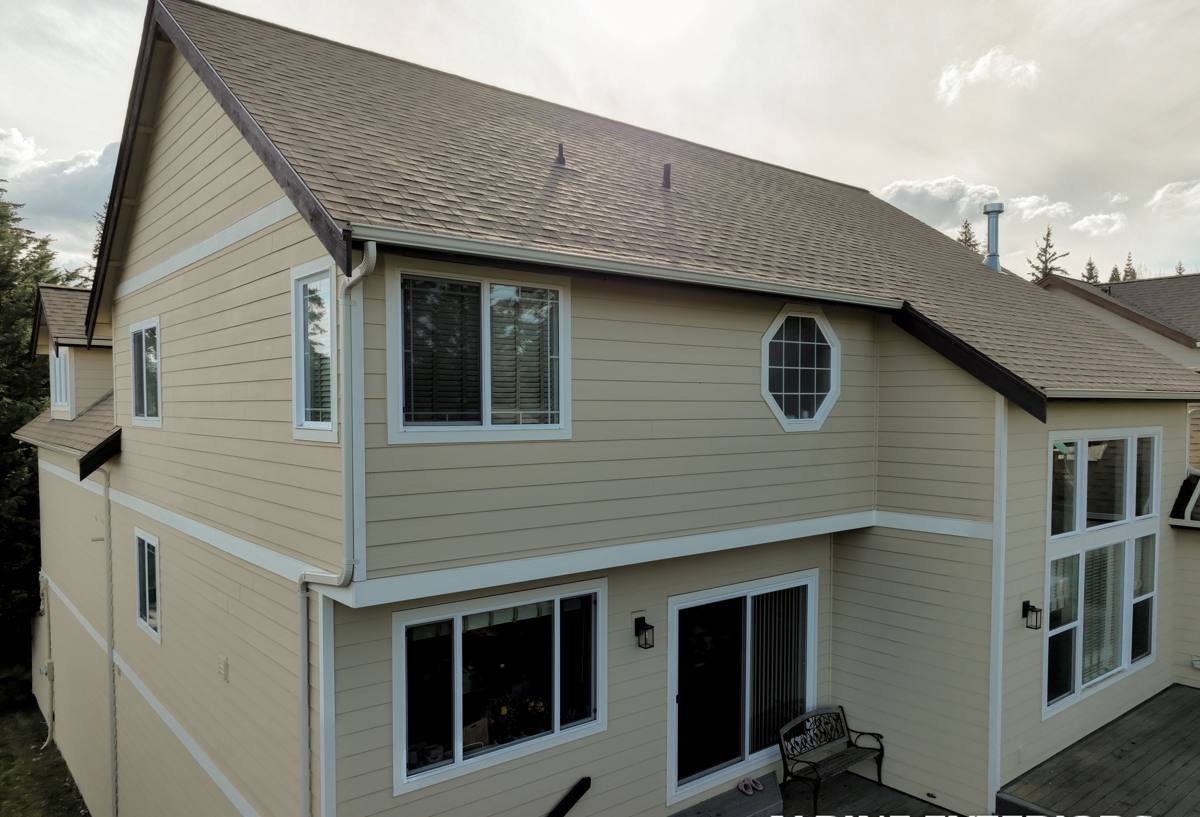
What Whatcom County's Climate Does to Siding Over Time
Salt Air
Birch Bay's marine air carries fine salt particles that settle on every exterior surface. Over years, that salt film attracts moisture, accelerates corrosion of exposed fasteners and trim metal, and breaks down finishes that weren't engineered to handle it. Siding that looks fine in a showroom photo doesn't always hold up once it's a few hundred yards from saltwater.
Driving Rain
Whatcom County doesn't just get rain — it gets wind-driven rain that hits siding at an angle instead of running straight down. That means water gets pushed up under laps, into seams, and behind trim in ways that vertical rain never would. A siding system depends on its lap spacing, flashing, and fastening details to shed that kind of weather, and any shortcut in those details shows up as a stain or a soft spot years later.
Moss and Shade
The tree cover near the creek corridor keeps roofs and siding surfaces shaded and damp longer after every rain event. That's exactly the condition moss, algae, and mildew need to establish themselves. On the wrong material, that growth isn't just cosmetic — it holds moisture against the surface and speeds up deterioration underneath.
Why We Only Install James Hardie Fiber Cement
We made a decision a long time ago to stop installing vinyl, LP SmartSide, primed spruce, and cedar siding, even though all of those products have a place in the market. In a climate like Birch Bay's, we found that fiber cement — specifically James Hardie — was the only system that consistently held up to salt exposure, driving rain, and constant moss pressure without needing repeated repair or early replacement.
- Non-combustible core: James Hardie siding is fiber cement, not wood or wood byproduct, so it doesn't feed a fire the way wood-based sidings can.
- Climate-engineered product lines: James Hardie builds different formulations for different climate zones. Homes in our region typically call for the HZ5 line, engineered for areas that see cold, wet winters, rather than the HZ10 formulation built for hot, humid Southern climates.
- ColorPlus factory finish: A baked-on factory finish resists fading and holds up to UV and salt exposure far better than field-applied paint, and it comes with its own finish warranty separate from the substrate warranty.
- Dimensional stability: Fiber cement doesn't swell, split, or rot the way wood-based products can when it stays damp for extended periods — a real advantage under the tree canopy near Terrell Creek.
- Transferable warranty: A meaningful warranty that survives a home sale is worth something to buyers and appraisers, not just the current owner.
None of this means other products are junk. LP SmartSide, vinyl, and cedar all have legitimate uses elsewhere. We simply won't put our name behind an installation we don't believe will perform in this specific climate for the long haul, and after years of callbacks and comparisons, fiber cement is what earned our trust.
What a Correct Installation Actually Involves
James Hardie siding performs the way it's rated to perform only when it's installed to the manufacturer's specification. A rushed or generic installation on a good product will still fail early — this is where most siding problems in our region actually originate.
Moisture Management Comes First
Before a single piece of siding goes up, the wall needs a proper weather-resistive barrier, correctly lapped and taped, with flashing integrated at every window, door, and penetration. On a creek-adjacent lot with more shade and slower drying, this layer is what actually keeps a wall assembly healthy over decades — the siding is the second line of defense, not the first.
Clearances and Gaps
James Hardie specifies minimum clearances from grade, roof lines, decks, and other siding transitions, along with specific gaps at butt joints and trim to allow for expansion and drainage. Skipping these clearances is one of the most common causes of moisture intrusion we see on homes that weren't installed by a crew familiar with the spec.
Fastening
Fasteners need to be the correct type, length, and placement for the substrate, driven flush without over-driving. Over-driven nails crush the fiber cement at the fastening point and create a weak spot that shows up as cracking later.
Caulking and Sealant Practice
Sealant belongs at specific transitions, not everywhere. Over-caulking can trap moisture behind trim just as easily as under-caulking lets water in. Correct practice follows the manufacturer's joint and sealant details rather than a "when in doubt, caulk it" habit.
Material Comparison for This Climate
| Material | Salt Air Resistance | Moss/Moisture Behavior | Typical Maintenance |
|---|---|---|---|
| James Hardie Fiber Cement | Strong — non-combustible, engineered finish | Doesn't swell or rot; surface growth cleans off without damaging substrate | Periodic washing; factory finish reduces repainting |
| Vinyl | Can become brittle and fade faster near salt air over time | Growth sits on surface but seams and J-channels can trap moisture | Low, but limited repair options if damaged or discolored |
| LP SmartSide (engineered wood) | Wood-based substrate is more sensitive to sustained moisture exposure | Prolonged dampness under shade is a known stress point for wood-based products | Ongoing caulk/paint upkeep to protect the substrate |
| Cedar | Natural material, but requires diligent finish maintenance near salt air | Prone to moss/mildew retention without regular treatment | Frequent refinishing and moisture monitoring |
Our Process for Terrell Creek Projects
- On-site assessment: We walk the property, check existing siding and sheathing condition, and look specifically at shaded and low-drainage areas where moisture tends to concentrate.
- Moisture and substrate check: Wherever we suspect trapped moisture — often around old trim, low corners, or areas under heavy tree cover — we check the sheathing before covering it back up.
- Removal and prep: Old siding comes off, damaged sheathing is addressed, and a proper weather-resistive barrier goes on with correctly lapped flashing at every opening.
- Installation to spec: HardiePlank, HardiePanel, or HardieTrim goes on following James Hardie's fastening schedule, clearances, and joint details for our climate zone.
- Final inspection: We check fastener placement, caulk lines, trim transitions, and clearances before calling the job finished.
Why Local Experience with This Area Matters
A crew that hasn't worked in Birch Bay before doesn't automatically know that a Terrell Creek lot is going to dry more slowly than a similar house closer to open water and full sun, or that salt exposure changes fastener and flashing choices along the coastline. That's not a knock on any particular contractor's skill — it's just the difference between general experience and local experience. We've installed and repaired siding across this specific stretch of Whatcom County long enough to know where the moisture problems actually start on homes like these, and we build the installation around that, not around a generic spec sheet.
What to Ask Before You Hire Anyone for This Job
- Are you James Hardie certified or factory-trained, and can you explain the fastening schedule you'll follow?
- Which James Hardie product line (HZ5 vs. HZ10) do you install here, and why?
- How do you handle flashing and weather-resistive barrier detailing at windows and doors?
- What clearance do you maintain from grade, decks, and roof lines?
- Have you worked on homes in the Birch Bay / Terrell Creek area before, and what moisture issues have you run into locally?
- What does your warranty cover, and is it transferable if the home is sold?
Maintenance in a Moss-Prone, Salt-Air Environment
Even the right siding system benefits from basic upkeep in this climate. A periodic gentle wash removes salt film and surface growth before it has a chance to build up. Keeping gutters clear and trimming back vegetation that shades siding year-round helps surfaces dry faster after storms. Because James Hardie's ColorPlus finish is factory-baked rather than field-applied, it holds color and resists the kind of fading and chalking that pushes homeowners into a repaint cycle with other materials — but it's still worth a visual check each year for any caulk lines or trim joints that need attention.
If you're weighing a siding project for a home in Terrell Creek or elsewhere around Birch Bay, we're happy to take a look and walk you through what your specific property needs — no pressure, no obligation. Use the form below to request a free estimate.