 Birch Bay Siding
 Ferndale's Roofs Take a Different Kind of Beating
Ferndale sits close enough to the Strait of Georgia and Birch Bay that its roofs deal with a combination most inland Washington towns don't: salt-laden air off the water, driving rain that comes in sideways during winter storms, and a moss season that runs longer here than almost anywhere else in Whatcom County. None of these forces are dramatic on their own. The damage builds slowly, then shows up all at once after a windstorm rips loose a section of shingles that had already been weakened for months.
When we get called out to Ferndale after a storm, the damage is rarely a single clean problem. It's usually a combination: wind-lifted shingles that had already lost granules to moss and grit, flashing that had started to corrode from salt exposure, and a soft spot in the decking underneath where slow moisture intrusion had been going on longer than anyone realized. Storm damage repair done right means treating the whole roof system, not just patching the spot that's visibly missing shingles.
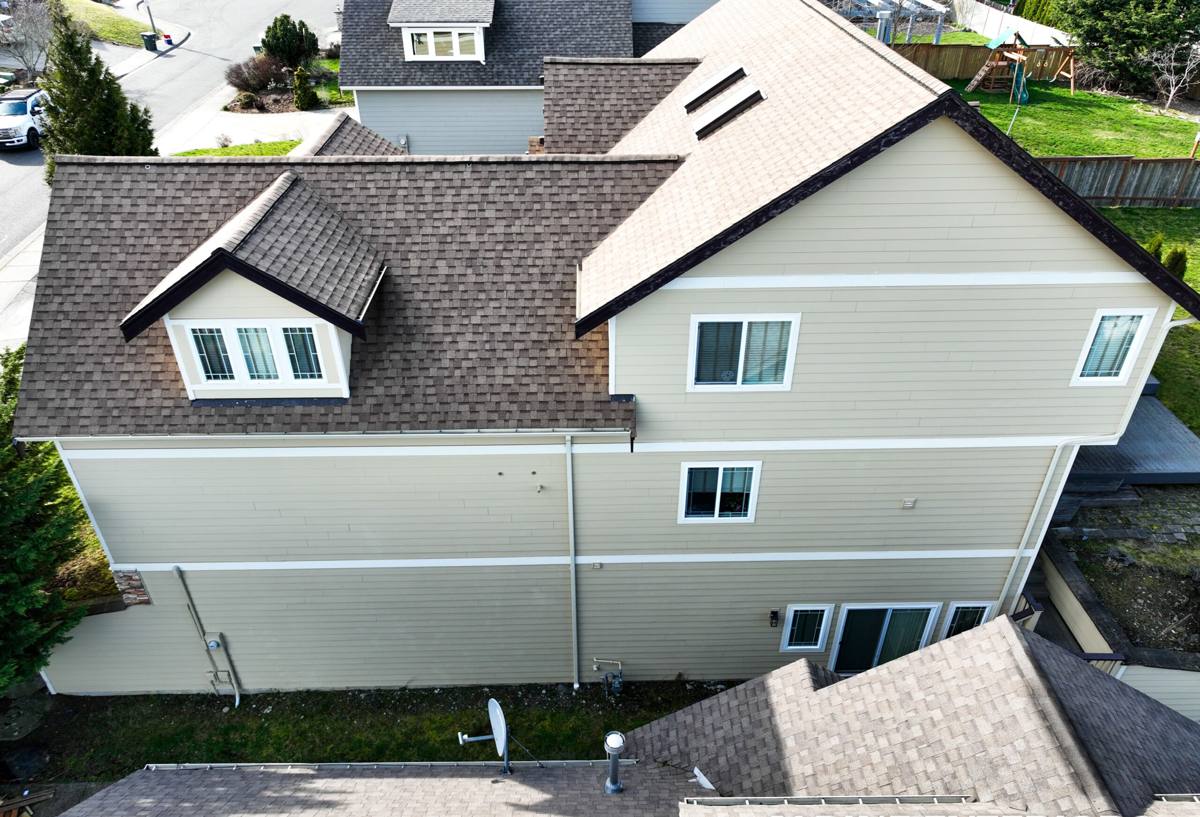
What Whatcom County Storms Actually Do to a Roof
Wind
Winter windstorms coming off the Strait can gust hard enough to lift shingle tabs, especially on roofs where the sealant strip has already weakened from age or UV exposure. Once a few tabs lift, wind gets underneath the whole course and can peel back a much larger section than the storm alone would suggest. The exposed underlayment or decking is then open to whatever rain follows.
Driving Rain
Rain that comes in nearly horizontal during a storm doesn't behave like rain falling straight down. It gets pushed up under shingle laps, around chimney and vent flashing, and into any gap that a calm-weather roof would shed without issue. This is why storm damage often shows up as an interior ceiling stain days after the wind has died down — water found a path during the storm and is only now working its way through.
Moss and Trapped Moisture
Ferndale's mild, damp climate keeps moss growing on north-facing and shaded roof slopes for much of the year. Moss holds water against the shingle surface long after the rest of the roof has dried, which accelerates granule loss and rot at the roof deck. A roof with a heavy moss mat going into a storm is far more vulnerable to wind and water damage than a clean one, because the moss has already been quietly breaking down the shingles' ability to shed water.
Salt Air
Proximity to Birch Bay and the Strait means metal components — flashing, drip edge, fasteners, vent caps — corrode faster here than they would twenty miles inland. Corroded metal is a common hidden cause of leaks that show up during a storm but actually started as a slow failure at a flashing seam months earlier.
Signs You Have Storm Damage That Needs Attention
- Shingles that are visibly lifted, curled, cracked, or missing after a windstorm
- Granules collecting in gutters or at downspout outlets, especially right after a storm
- New or worsening ceiling stains, particularly near chimneys, skylights, or where two roof planes meet
- Flashing that looks bent, separated, or rusted around vents, chimneys, and roof-to-wall junctions
- Soft or spongy spots when walking the attic near the roof deck
- Daylight visible through the roof deck from inside the attic
- Debris punctures from branches or wind-blown material
Not every one of these means a full roof replacement. Many storm damage calls in Ferndale end up being a targeted repair — replacing a section of shingles, resealing flashing, or replacing a run of damaged decking — rather than a whole new roof. The trick is figuring out honestly which situation you're in.
How We Approach a Storm Damage Inspection
We start on the ground and in the attic before we ever get on the roof, because interior evidence tells us where to look first. Attic daylight, water staining on rafters, and damp insulation all point to the likely entry point before we're walking the slopes.
- Ground-level and interior assessment — attic, ceilings, and interior walls near roof penetrations
- Roof surface inspection — shingle condition, moss coverage, granule loss, and wind-lift patterns
- Flashing and penetration check — chimneys, vents, skylights, and roof-to-wall transitions
- Decking evaluation — soft spots, delamination, or rot at the point of water entry
- Written explanation of what we found, what's storm-caused versus pre-existing wear, and what it will take to fix it correctly
We tell you plainly when something is a minor repair versus when the underlying roof is old enough that a patch is a short-term fix on a system nearing the end of its service life. Both are legitimate answers — the goal is that you're making the call with accurate information, not guesswork.
What a Correct Repair Involves
A storm repair that's done right addresses the cause, not just the visible symptom. That generally means:
- Removing and replacing damaged shingles with matching material, properly nailed and sealed — not just caulked over
- Repairing or replacing corroded or displaced flashing at every affected penetration, not just the one that's leaking today
- Replacing any decking that's gone soft or delaminated from sustained moisture, since new shingles over rotten decking won't hold
- Checking and clearing moss from the repaired area and surrounding slopes so it doesn't immediately undermine the new work
- Confirming underlayment integrity in the repaired section, since torn or displaced underlayment is often what let water through in the first place
Skipping the flashing or decking step to save money is the most common shortcut we see from patch jobs done in a hurry after a storm. It looks fixed from the ground. It isn't fixed underneath.
Repair vs. Replacement: How to Think About the Decision
| Factor | Leans Toward Repair | Leans Toward Replacement |
|---|---|---|
| Roof age | Under 12–15 years, otherwise sound | Nearing or past typical shingle lifespan |
| Extent of damage | Localized to one section or slope | Widespread across multiple slopes |
| Decking condition | Solid, no rot found | Multiple soft spots or repeated past leaks |
| Moss/granule history | Minor, recently addressed | Heavy, long-term moss with significant granule loss |
| Storm frequency | First significant damage event | Repeated storm damage calls over recent years |
None of these factors decide it alone — it's the combination that matters. A 20-year-old roof with one small section of wind damage and otherwise good decking might still be a smart repair candidate. A 10-year-old roof with rot found under a small leak might be telling you something about how the whole roof was handling moisture, not just that one spot.
Insurance and Documentation
Storm damage is often a covered event under homeowners insurance, but the claim depends on clear documentation of what the storm actually caused versus pre-existing wear. We document damage with photos and a written scope before any repair work starts, which gives you something concrete to bring to your adjuster. We're not an insurance company and won't promise a claim outcome, but we can make sure the roof-side documentation is accurate and complete so you're not guessing what to report.
Why It Matters That We Already Work in Ferndale
A crew that regularly works Ferndale and the greater Birch Bay area already knows what this coastline does to a roof — where moss builds up fastest based on tree cover and slope orientation, how far salt corrosion typically travels inland from the water, and which flashing details tend to fail first in this climate. That's not something you get from a general contractor who covers the whole county and passes through once. We're not guessing at how Whatcom County weather affects a roof; we see the pattern repeat house after house in this area.
Local availability matters after a storm too. When wind or rain damage needs a tarp or temporary cover to stop water intrusion before a full repair can happen, response time is the difference between a contained problem and a much larger one involving soaked insulation and interior drywall damage.
Maintenance That Reduces Future Storm Damage
- Keep gutters and downspouts clear so storm water has somewhere to go besides under the shingles
- Address moss buildup on a regular schedule rather than letting it accumulate for years
- Trim back branches that overhang the roof, since they're a common source of both debris damage and shade that keeps moss wet
- Have flashing and penetrations checked periodically, since these fail quietly before they fail visibly
- Get an inspection after any major windstorm even if you don't see obvious damage from the ground
None of this eliminates storm risk — nothing does, given how exposed this stretch of Whatcom County is to weather off the water. But a roof that's been maintained goes into a storm with far more margin than one that hasn't, and margin is usually what separates a minor repair from a much bigger one.
If a recent storm has left your Ferndale home with lifted shingles, a new leak, or damage you're not sure how to assess, we're happy to take a look and give you a straight answer — no pressure, no inflated scope. Fill out the form below for a free estimate.