 Birch Bay Siding
 Siding Installation in Sumas: Built for a Wet Corner of Whatcom County
Sumas sits at the edge of Whatcom County, tucked against the foothills near the Canadian border. It's a different setting than the open coastline out at Birch Bay, but the underlying problem for a home's exterior is the same one you find across this whole region: siding here spends most of the year wet, shaded, or both. We install siding throughout Whatcom County, and Sumas gets its own share of the moisture, moss, and wind that make the wrong product a slow, expensive mistake and the right product a decades-long non-issue.
This page is about one thing: what a correct siding installation looks like on a Sumas home, why we only put James Hardie fiber cement on the houses we work on, and what our process actually involves from first estimate to final walk-through.
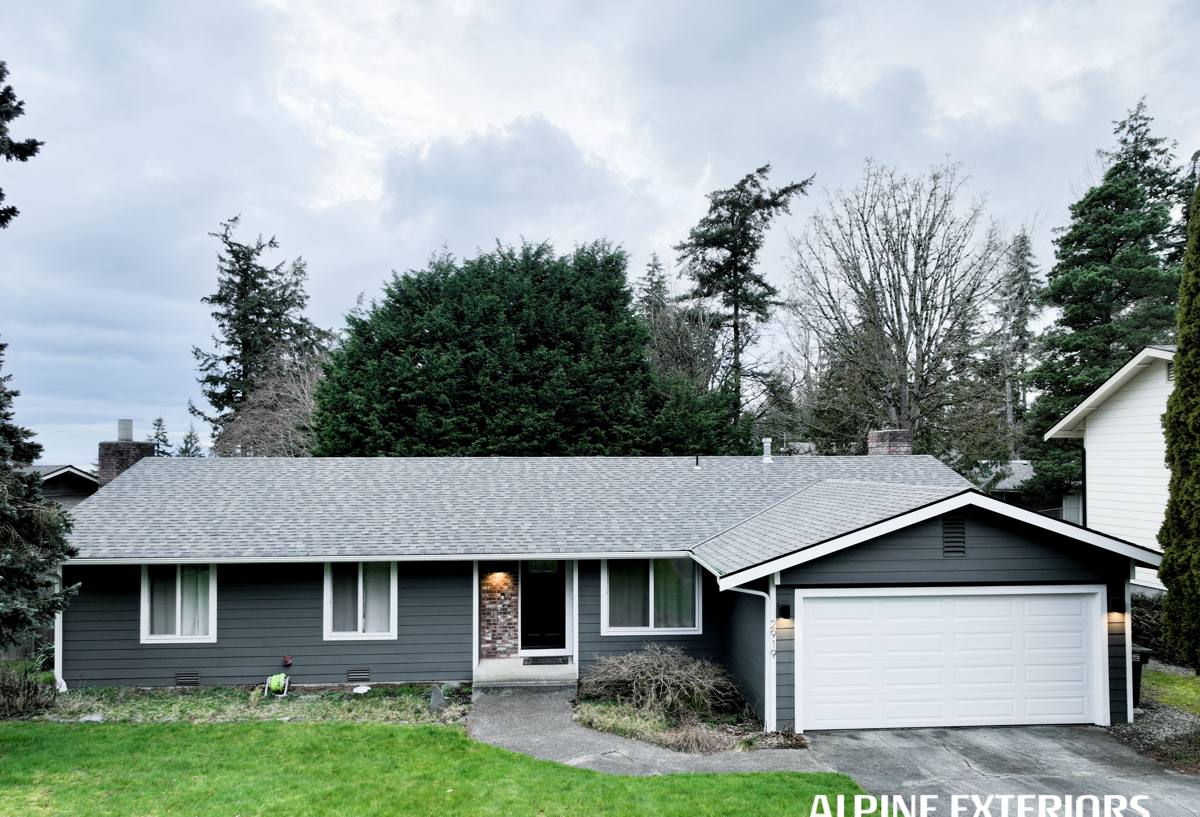
What Sumas Siding Actually Has to Stand Up To
Driving Rain and Sustained Dampness
Whatcom County's marine-influenced weather means long stretches of steady, wind-driven rain rather than short heavy downpours. That matters for siding because it's not the rain itself that causes damage — it's how long a wall assembly stays wet afterward. Siding that traps moisture behind it, or that swells and softens when saturated, is working against the climate instead of with it.
A Long Moss and Algae Season
Shaded north and east walls, tree cover, and cool damp air add up to a moss and algae season that runs far longer here than in drier parts of the state. Porous or textured siding surfaces give moss more to hold onto, and once it establishes on a wall, it holds moisture against the substrate underneath — accelerating whatever damage the rain alone would have caused.
Salt Air and Regional Corrosion Exposure
Out toward Birch Bay and the rest of the Whatcom County coastline, airborne salt accelerates the breakdown of paint films, metal fasteners, and certain siding finishes. Sumas is further inland, but we treat fastener selection and finish quality the same way across every job in the county — because a crew that only builds for the mildest conditions ends up cutting corners everywhere.
Temperature Swings and Freeze-Thaw Cycling
Being closer to the foothills, Sumas sees colder overnight temperatures and more frost days than the immediate coastline. Siding that absorbs water and then freezes is siding that cracks, delaminates, or pulls away from fasteners over a few winters. A product's resistance to moisture absorption isn't a marketing detail here — it's the difference between siding that lasts twenty-plus years and siding that needs attention by year seven or eight.
Why We Only Install James Hardie Siding
We get asked regularly why we don't offer vinyl, LP SmartSide, cedar, or other fiber cement brands like Allura or Cemplank. The honest answer is that we made a standard, not a sales pitch — we settled on James Hardie because it holds up to the specific conditions Whatcom County throws at a wall, and we'd rather turn down a job than install something we don't trust on a Sumas roofline.
Vinyl Siding
Vinyl is inexpensive and low-maintenance in the sense that it never needs painting, but it's a thin plastic product that expands, contracts, and can warp with temperature swings. In driving rain and wind, panel seams and J-channels are common points where moisture works its way behind the cladding — and once that happens, vinyl gives you no way to inspect or dry out what's underneath without pulling panels.
LP SmartSide and Other Engineered Wood
Engineered wood siding has improved over the years, but it's still a wood-based product with a factory resin coating protecting it from moisture. Any breach in that coating — a saw cut, a fastener hole, a scuff during installation — creates a path for water into a material that's designed to resist rot only as long as the coating stays intact. In a climate with as much sustained dampness as Whatcom County, that margin for error is thinner than we're willing to build on.
Cedar and Other Natural Wood
Cedar looks good and has real rot resistance built in, but it demands an ongoing maintenance schedule — refinishing, caulking, and moisture monitoring — that most homeowners underestimate when they choose it. Skip a cycle or two in a climate like this one and the siding starts absorbing water faster than it can shed it.
Other Fiber Cement Brands
Not all fiber cement is engineered the same way. We standardized on James Hardie specifically because of its HZ5 climate-engineered formulation for the Pacific Northwest, its factory-applied ColorPlus finish, and a warranty structure that's transferable and well-documented. That consistency lets us install to one exacting spec instead of adapting our process brand to brand.
What Correct Siding Installation Actually Involves
Fiber cement siding is only as good as the assembly it's installed into. Most of the siding failures we see on older homes weren't caused by a bad product — they were caused by shortcuts in the parts you can't see once the job is done.
- Water-resistive barrier: A continuous, properly lapped WRB behind the siding, with no gaps, tears, or reversed laps that let water track inward.
- Flashing at every penetration: Windows, doors, hose bibs, vents, and light fixtures all need integrated flashing that sheds water outward, not just caulk covering a gap.
- Correct fastening: Hardie-approved fasteners, driven at the manufacturer's specified depth and spacing — overdriven or underdriven nails are one of the most common causes of early siding problems.
- Proper clearances: Minimum gaps between siding and grade, roofing, decks, and patios so water has somewhere to go instead of wicking straight into the bottom edge of the board.
- Joint treatment: Butt joints and corners sealed and detailed to manufacturer spec, not just butted together and caulked over.
- Ventilation behind the cladding: A drainage plane that lets any moisture that does get in find its way back out instead of sitting against the sheathing.
None of this is visible once the siding is up and painted. It's also exactly where installation quality either earns its keep or quietly sets up the next owner for a wall repair in ten years.
Our Installation Process, Start to Finish
1. On-Site Assessment
We walk the exterior with you, check the current siding and sheathing condition, identify problem areas — shaded walls, drainage issues, existing moisture damage — and talk through what your home actually needs rather than a one-size-fits-all package.
2. Tear-Off and Substrate Inspection
Old siding comes off and we inspect the sheathing underneath before anything new goes up. Soft, delaminated, or water-damaged sheathing gets addressed at this stage — covering it over is exactly the kind of shortcut that causes problems down the line.
3. Weather Barrier and Flashing
We install or verify the WRB and flash every window, door, and penetration before the first piece of siding goes on. This is the step that determines whether your wall assembly actually manages water the way it's supposed to.
4. Siding Installation to Manufacturer Spec
James Hardie boards or panels go up with correct fastener spacing, joint treatment, and clearances — installed to the manufacturer's published specifications, which is also what keeps the product warranty intact.
5. Trim, Caulking, and Touch-Up
Corner boards, trim, and any factory-finish touch-up are completed with Hardie-compatible materials so the finish performs and weathers consistently across the whole house.
6. Final Walk-Through
We walk the finished job with you, point out anything worth knowing about your specific installation, and answer questions about care going forward.
James Hardie Product Lines for This Climate
James Hardie makes region-specific formulations, and for Whatcom County — including Sumas — that means the HZ5 product line, engineered for climates with significant moisture and freeze-thaw exposure.
| Product | Typical Use | Why It Fits Sumas |
|---|---|---|
| HardiePlank lap siding | Primary wall cladding | Traditional lap profile, strong moisture and impact resistance, wide color range |
| HardiePanel vertical siding | Accent walls, gables, modern facades | Clean vertical lines, pairs well with lap siding for design contrast |
| HardieTrim boards | Corners, window and door trim, fascia | Matches siding durability so trim doesn't fail before the field siding does |
| ColorPlus factory finish | Pre-finished color coat | Baked-on finish resists fading and chipping better than field-applied paint |
HZ5 vs. HZ10 Engineering
James Hardie engineers its boards differently depending on regional climate demands. HZ5 is formulated for areas with real moisture and moderate freeze-thaw exposure — a good match for Whatcom County, including Sumas. HZ10 is built for harsher freeze-thaw climates further inland or at higher elevation. We spec the version that matches what your specific wall exposure actually experiences.
What Siding Installation Costs Depend On
We don't publish flat pricing because every home is different, but the real cost drivers are consistent from job to job.
| Factor | Why It Matters |
|---|---|
| Home size and wall complexity | More corners, gables, and cutouts mean more labor and material waste |
| Current siding removal | Tear-off and disposal of old material adds time versus new construction |
| Sheathing repair needs | Water-damaged sheathing found during tear-off has to be replaced before siding goes up |
| Siding profile and finish | Lap widths, panel styles, and ColorPlus color choices vary in material cost |
| Trim and accent work | Additional trim boards, corner details, and accent panels add labor |
| Access and site conditions | Slopes, tight setbacks, or multi-story walls affect staging and labor time |
We give every homeowner an honest, itemized estimate after seeing the actual house — not a phone quote based on square footage alone.
Why Hiring a Crew That Already Works in Sumas Matters
Siding installation isn't just about the product — it's about a crew that understands how the local climate actually behaves against a wall over years, not just on install day. A contractor who regularly works Whatcom County knows which wall orientations need extra attention for moss and moisture, how to sequence a tear-off around the region's rain patterns, and how to detail flashing for the amount of driving rain this area sees compared to drier parts of the state. That local pattern recognition is hard to replace with a crew that mostly works elsewhere and treats every job the same regardless of climate.
It also matters for accountability. A local crew is easy to reach if a question comes up after the job is done, and stands behind both the installation workmanship and the manufacturer warranty on the materials.
Signs Your Current Siding Needs Attention
- Visible warping, buckling, or gaps between siding boards or panels
- Persistent moss or algae growth that returns quickly after cleaning
- Soft or spongy spots when you press on the siding, especially near the bottom edge
- Paint that's peeling, bubbling, or failing faster than a normal repaint cycle
- Visible rot or staining around window and door trim
- Rising energy bills without another clear explanation, which can point to a failing wall assembly
Any one of these on its own isn't necessarily an emergency, but a few together are usually a sign the current siding is past the point where maintenance alone will fix it.
Caring for Hardie Siding After Installation
Fiber cement is low-maintenance compared to wood or vinyl, but "low-maintenance" doesn't mean zero attention, especially in a climate that keeps moss and algae in play most of the year.
- Rinse siding gently once or twice a year to keep moss and algae from establishing, especially on shaded walls
- Keep gutters clear so overflow doesn't run down the siding face repeatedly
- Trim back vegetation that shades walls or holds moisture against the siding
- Check caulking at trim joints periodically and have gaps resealed before they let water in
- Address any impact damage promptly rather than letting it sit exposed
Done right, that's the entire maintenance list — no repainting cycle, no annual sealing, no ongoing rot watch.
Get a Free, No-Pressure Estimate
If your Sumas home's siding is showing its age, or you're planning ahead before it becomes a problem, we're happy to take a look and give you a straight answer about what it needs. There's no pressure and no obligation — just an honest assessment from a crew that installs this product, in this climate, every week. Use the form below to request your free estimate.