 Birch Bay Siding
 Sandy Point Sits Right at the Edge of What Siding Has to Survive
Sandy Point is one of the most exposed pockets of Birch Bay — close enough to the water that salt-laden air, wind-driven rain, and long stretches of shade and dampness are just part of owning a home there. That combination is hard on exterior materials in ways that inland Whatcom County homes never have to deal with. Salt air accelerates corrosion on fasteners and metal trim. Driving rain off the water finds every gap in flashing and caulking that a calmer site would never expose. And the tree cover and marine humidity that make this stretch of Birch Bay beautiful also mean moss, algae, and mildew get a long growing season on anything that stays damp.
None of that is a reason to avoid siding your home well — it's a reason to be specific about what goes on the wall and how it's installed. This page is about one product, in one place: James Hardie fiber cement siding, installed on homes in Sandy Point. We're not going to give you the general pitch you'd find on a national siding site. We're going to walk through what this climate actually does to a wall system, what a correct James Hardie install looks like in response, and why the details matter more here than almost anywhere else in the county.
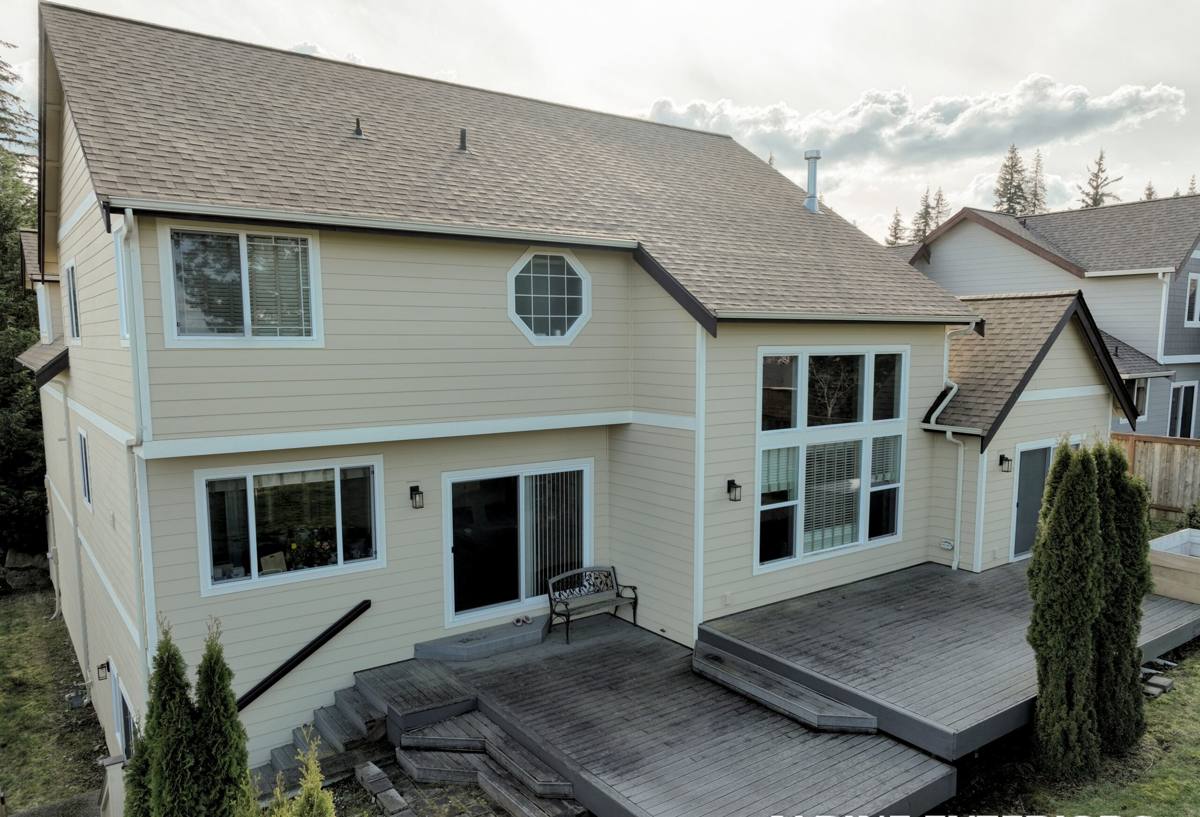
What Salt Air, Rain, and Moss Actually Do to a Wall
Salt Air
Airborne salt is corrosive to unprotected metal — fasteners, flashing, trim coil, even some paint finishes over time. On a standard inland home this is a minor, slow-motion concern. On a waterfront property like Sandy Point it's a design consideration from day one: fastener material, flashing material, and finish quality all need to be chosen with that exposure in mind, not upgraded later after rust stains start bleeding down the face of the siding.
Driving Rain
Wind off the water doesn't just add rain volume — it changes its direction. Rain that would run harmlessly down a sheltered wall gets pushed sideways and upward into laps, joints, and penetrations. That means the water-resistive barrier behind the siding, the flashing at every window and door, and the way each course of siding overlaps the one below it all have to be done correctly, not just "close enough." A wall that would perform fine in a low-wind inland location can leak at Sandy Point if those details are skipped.
Moss and Prolonged Dampness
Shaded north and west walls near the water can stay damp for days after a storm system passes through. That's exactly the environment moss, algae, and mildew need to take hold. On a material that absorbs moisture or has a coating that traps it against the substrate, that damp cycle degrades the wall over years. On a properly finished fiber cement product, it's mostly a surface-level cosmetic issue that periodic cleaning handles — which is a meaningful difference in a place where the moss season runs long.
Why James Hardie Fits This Exposure
James Hardie siding is fiber cement — a mix of cement, sand, and cellulose fiber pressed and cured into a dense, stable board. It doesn't absorb water the way wood-based products can, it doesn't rot, and it's non-combustible. For a marine-exposed neighborhood like Sandy Point, the properties that matter most are:
- Dimensional stability in wet-dry, humid-then-dry cycling common near open water
- A factory-applied ColorPlus finish that's baked on and warranted against fading and peeling, rather than a field-applied coat that has to fight salt air and UV from day one
- Engineered climate variants (Hardie's HZ product line) formulated for moisture-prone regions like the Pacific Northwest
- No wood substrate to swell, cup, or invite pests along a damp, shaded exterior wall
That's the product side. It only delivers on that promise if the installation respects the same conditions — which is where a lot of siding jobs, on any brand, fall short.
Choosing the Right Hardie Product Line for a Waterfront Lot
Not every Hardie product is interchangeable for a site like Sandy Point. The table below is a general guide to how the common lines compare for this kind of exposure — your actual choice depends on your home's design, existing trim, and your preference on look.
| Product | Typical Use | Notes for Sandy Point Exposure |
|---|---|---|
| HardiePlank Lap Siding | Primary field siding, most homes | Most common choice; pairs well with proper flashing detail at each course for wind-driven rain |
| HardiePanel Vertical Siding | Accent walls, gables, modern facades | Fewer horizontal laps means fewer water-entry points, but seam and joint flashing still critical |
| HardieShingle | Accent areas, Cape Cod / cottage styling | More detail work at each shingle course — labor-intensive to flash correctly near the water |
| HardieTrim | Corners, window and door trim, fascia | Should be paired with the siding, not mixed with a different trim material at corners |
For most Sandy Point homes we recommend an HZ5 (or regionally appropriate climate) product formulation, matched to Hardie's Pacific Northwest engineering guidance, rather than a generic national spec.
What a Correct Installation Actually Involves Here
The siding board itself is only part of the system. On an exposed, wind-driven site, the installation details below are the difference between siding that performs for decades and siding that looks fine for a season or two before problems show up behind it.
Weather-Resistive Barrier and Flashing
A continuous, correctly lapped weather-resistive barrier goes on before any siding. Every window, door, and penetration gets flashed so water is directed out and down, never trapped behind the cladding. On a driving-rain site, this layer is doing more real work than the siding itself.
Fastener Selection
Corrosion-resistant fasteners, installed per Hardie's fastening schedule, matter more here than on a sheltered inland wall. The wrong fastener in salt air shows up years later as rust streaks and a loosened board.
Clearances and Gaps
Hardie specifies minimum clearances from grade, roof lines, decks, and other siding terminations, plus expansion gaps at butt joints. Skipping these is one of the most common shortcuts on rushed jobs, and it's exactly where water intrusion starts on an exposed lot.
Caulking and Sealant
Not every joint should be caulked — some are designed to shed water on their own — but the joints that do require sealant need a product rated for the movement and exposure involved, applied at the right joints only.
Field-Cut Edges
Any factory edge that gets cut on site needs to be treated per Hardie's instructions before it's closed up. An unsealed cut edge is a moisture entry point that undermines the rest of a correctly built system.
Our Process for a Sandy Point Project
The steps below are the same for every home, but on a waterfront lot we spend more time up front on exposure and drainage than on a sheltered inland property.
- On-site assessment — we walk the home, note wind exposure by elevation, existing moisture or moss patterns, and the condition of the current wall assembly.
- Product and color selection — matched to the exposure level of each wall, not a single spec applied uniformly.
- Removal and inspection — old siding comes off and we check the sheathing underneath for hidden moisture damage before anything new goes on.
- Weather barrier and flashing — installed and inspected before a single piece of siding is hung.
- Siding installation — to Hardie's fastening, clearance, and joint specifications, with attention to the wind-loaded elevations.
- Trim, caulking, and final detail — the finishing work that determines how the wall sheds water for the next several decades.
- Walkthrough — we review the finished work with you before calling the job done.
Cost Factors on a Waterfront Home
Pricing for any siding job depends on the specifics of your home, but a few factors tend to matter more on an exposed Sandy Point property than elsewhere in Birch Bay:
| Factor | Why It Affects Cost Here |
|---|---|
| Wall exposure and access | Waterfront lots often have steeper grades or limited staging area near the shore side |
| Extent of hidden moisture damage | Long-term dampness on shaded or wind-exposed walls sometimes means sheathing repair before siding goes on |
| Product line and detailing | Vertical panel or shingle accents require more flashing and labor than straight lap siding |
| Trim and corner work | Corrosion-resistant fastening and full trim replacement add labor versus a partial re-side |
Maintenance in a Long Moss Season
Properly installed James Hardie siding is low-maintenance, not zero-maintenance. In Sandy Point's marine climate, a simple annual routine keeps it looking right and catches small issues before they become expensive ones:
- Rinse shaded and north-facing walls periodically to keep moss and algae from establishing
- Avoid pressure-washing directly into joints and laps — use a gentle rinse instead
- Walk the exterior after major windstorms and check trim, flashing, and caulked joints for movement or gaps
- Keep vegetation trimmed back from walls so airflow can dry the siding between rain events
- Watch for rust staining near fasteners or trim as an early sign something needs attention
Why a Crew That Already Works Sandy Point Matters
Whatcom County building requirements, wind exposure categories, and typical construction details vary by location, and a lot of that knowledge is site-specific rather than something you can look up generically. A crew that's already worked homes in Sandy Point knows which elevations take the worst weather, where moss tends to build up fastest, and what detailing has actually held up on similar homes nearby versus what's caused callbacks. That's the kind of judgment that shows up in the small decisions on a job — where to add extra flashing, which walls need closer fastener spacing, how far to hold clearances at grade — long before a homeowner would ever notice the difference on the surface.
Ready for a No-Pressure Look at Your Home
If your Sandy Point home is due for new siding, or you want a second opinion on how the current wall is holding up against the salt air and rain, we're happy to take a look. Use the form below to request a free estimate — no pressure, just a straight assessment of what your home needs.