 Birch Bay Siding
 Why Bellingham Roofs Take a Beating
Bellingham sits close enough to the Salish Sea that salt-laden air moves across the city, and over the years that air works on flashing, fasteners, and any exposed metal on a roof. Add Whatcom County's long stretch of driving rain off the water, plus the deep shade thrown by mature evergreens in so many Bellingham yards, and you get roofs that rarely dry out fully for months at a stretch. That mix of salt air, sustained rain, and shade is exactly what drives moss growth, and moss is the single biggest reason we get called out to repair roofs here that homeowners in drier parts of the country never have to think about.
None of this means every Bellingham roof is in trouble. It means small problems — a lifted shingle tab, a hairline gap in flashing, a patch of moss holding moisture against the deck — turn into leaks faster here than they would somewhere dry. Repair work in this climate is as much about catching things early as it is about fixing what's already failed.
Common Repair Needs We See Around Bellingham
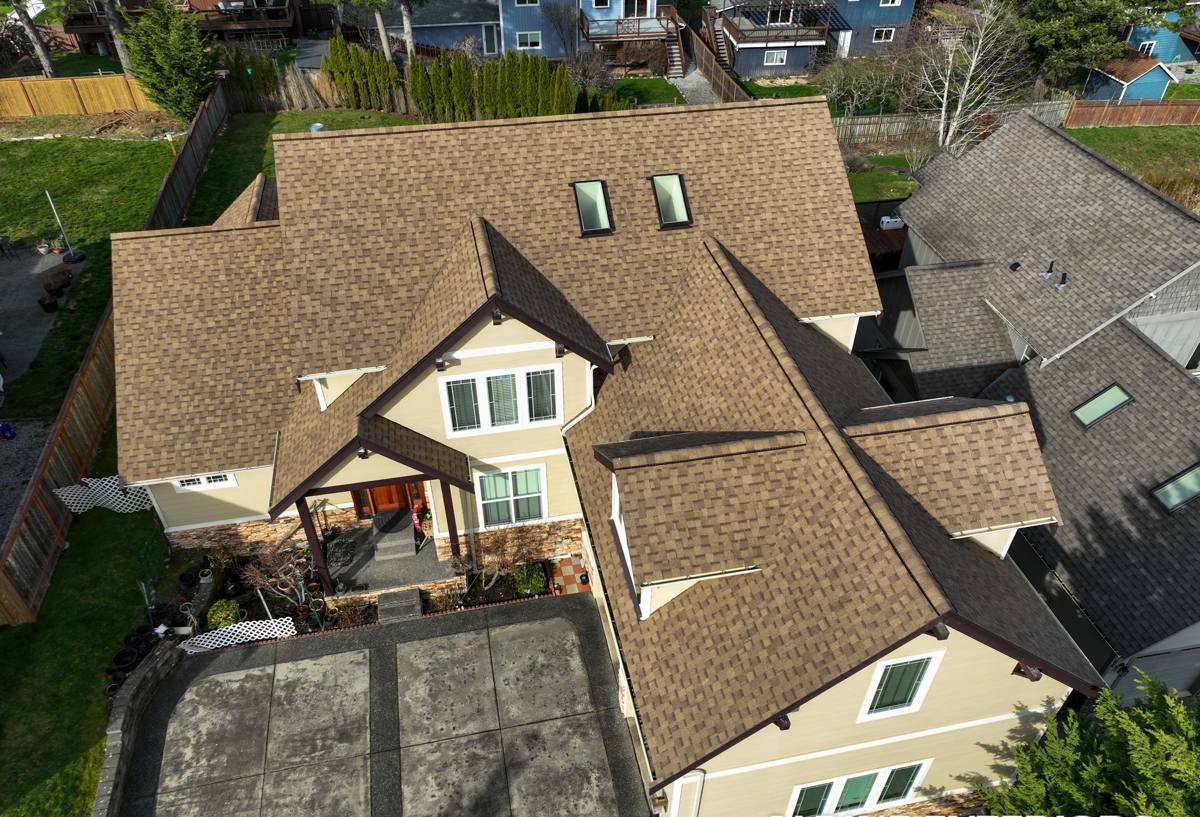
Most of the repair calls we take in and around Bellingham fall into a handful of categories. Moss colonies lifting shingle edges and holding water against the roof deck are the most common. Flashing failures around chimneys, skylights, and roof-to-wall transitions are close behind — these are small metal details, but they're where the vast majority of leaks actually start, not out in the open field of the roof. Valley leaks show up where two roof planes meet and funnel heavy rainfall into a single channel; if that channel is clogged with needles and moss debris, water backs up under the shingles instead of running off. We also see gutter overflow damage where clogged gutters send water behind fascia boards and into the roof edge, and the occasional wind-related nail pop or lifted ridge cap from a winter storm off the water.
What ties these together is moisture management. A roof in this climate isn't just shedding rain in a storm — it's dealing with near-constant dampness for a good part of the year, and every repair has to account for that, not just patch the visible symptom.
Signs You Need a Roof Repair, Not Just a Look
Some roof problems are obvious from the ground. Others only show up as a stain on a ceiling months after the actual damage started. Here's what should prompt a call:
- Dark streaks or thick moss growth concentrated on north-facing or shaded slopes
- Shingle tabs that look lifted, curled, or are missing granules in patches
- Rust staining or visible gaps around chimney, vent, or skylight flashing
- Sagging or discoloration along roof valleys after a heavy rain event
- Water stains on interior ceilings or upper walls, even faint ones
- Daylight visible through the roof deck from inside the attic
- Granules collecting in gutters or at downspout outlets
- A musty smell in the attic, which often means trapped moisture before you ever see a stain
Any one of these on its own might be minor. A few together, especially on an older roof, usually means it's worth a proper look before the next rainy stretch.
What a Proper Roof Repair Involves
Diagnosis Before Anything Else
The most common mistake in roof repair isn't bad workmanship — it's fixing the spot where water showed up inside the house instead of where it actually got in. Water travels along the underside of decking and framing before it drips somewhere visible, so a ceiling stain in one room can trace back to a flashing gap several feet away. A correct repair starts with tracing the actual entry point, usually from the attic side as well as the roof surface, before any material gets pulled or replaced.
Flashing and Valley Work
Because flashing failures are the leading cause of leaks in this region, repair work often centers on removing and correctly reinstalling flashing at chimneys, skylights, sidewalls, and valleys — not just caulking over a gap, which is a short-term fix that tends to fail again within a season or two. Valleys need enough clear channel width to handle heavy runoff without backing water up under adjacent shingles.
Moss and Debris Removal
Where moss is part of the problem, it has to come off without damaging the shingle mat underneath — scraping too aggressively strips granules and shortens the roof's remaining life. After removal, we treat the area to slow regrowth and address the underlying cause, usually shade and trapped debris, rather than just knocking moss off and leaving the conditions that grew it in place.
Matching Materials
A patch repair only holds up if the new material integrates with what's already there — same shingle profile, compatible underlayment, flashing metal that won't corrode against what's already installed. On an older roof this sometimes means sourcing a close match rather than an exact one, and being upfront with the homeowner about that before the work starts.
Repair or Replace? Weighing the Factors
Not every roof problem in Bellingham calls for a full replacement, and not every leak is fixable with a simple patch. The honest answer usually comes down to a few factors working together rather than any single one.
| Factor | Leans Toward Repair | Leans Toward Replacement |
|---|---|---|
| Roof age | Under 15-20 years, depending on material | At or past the material's typical service life |
| Damage extent | Localized to one area or detail | Spread across multiple slopes or repeat leak points |
| Decking condition | Solid, no soft spots underneath | Soft, delaminated, or visibly rotted sheathing |
| Repair history | First or second repair in this area | Same spot patched multiple times already |
| Moss/moisture pattern | Surface growth, deck still dry underneath | Chronic dampness affecting large sections |
We'll walk through where your roof lands on these factors honestly. Plenty of Bellingham roofs with real damage are still good repair candidates for years to come; the goal is making sure a repair is actually the right call, not just the cheaper one in the moment.
Roofing Materials We Work With in This Climate
Asphalt Composition Shingle
Still the most common roofing material on Bellingham homes, and for good reason — it's cost-effective to repair in sections, widely available in matching profiles, and performs well as long as flashing and ventilation details are done correctly. Repairs are usually the most straightforward on this material as long as the shingle line hasn't been discontinued.
Metal Roofing
Metal handles heavy, sustained rain well and sheds moss more readily than shingle because there's less texture for organic material to grip. Repairs on metal roofing are more specialized — seam and fastener work requires matching the panel profile and coating exactly, since mismatched metals can corrode against each other over time. We treat metal repair as its own trade skill, not an extension of shingle work.
Cedar Shake
Cedar has a genuine appeal and a long history in the Pacific Northwest, but it's also the material most affected by this region's damp, shaded conditions — it holds moisture longer than composition shingle or metal, which means more frequent moss and rot issues and a repair schedule that's more demanding to keep up with. Our standard is to be direct about that maintenance burden with homeowners who have existing cedar roofs, so repair decisions are made with the full picture rather than a surprise a few years down the line.
Our Process From Call to Cleanup
- Free on-site inspection, including attic access where possible to trace the actual leak path
- A written explanation of what's causing the problem and what the repair will involve, in plain terms
- A straightforward estimate before any work begins — no surprise add-ons mid-job
- Repair work using materials matched to what's already on your roof wherever possible
- Site cleanup, including removal of old material and moss debris, not just the repair itself
- A final walkthrough so you know exactly what was done and what to watch for going forward
Why Local Experience in Bellingham Matters
A roofer who works mostly in drier inland climates can still do competent work, but they're often solving for conditions that don't apply here. Knowing how fast moss reestablishes on a shaded Bellingham slope, how much valley capacity a roof needs for the rain this area actually gets, and which flashing details tend to fail first in salt-influenced air isn't something you pick up from a general roofing background — it comes from working on roofs in Whatcom County season after season. That local pattern recognition is often the difference between a repair that holds and one that reopens with the next big storm off the water.
If you're seeing signs of a leak, moss buildup, or storm damage on your roof, we're happy to take a look and give you a straightforward, no-pressure estimate — just fill out the form below to get started.