 Birch Bay Siding
 Point Whitehorn's Climate Is Harder on Siding Than People Expect
Point Whitehorn sits right up against the Strait of Georgia, and that exposure changes what a home's exterior has to deal with day in and day out. Homes here take a steady diet of salt-laden air, wind-driven rain coming off the water, and long stretches of gray, damp weather that can run from fall through spring. Add in the shade from mature Douglas fir and cedar cover common in this part of Whatcom County, and you get a moss and algae season that can last most of the year on north-facing walls and anything tucked under tree canopy.
None of that is dramatic on its own. It's the combination, repeated year after year, that wears out the wrong siding material. Salt air accelerates corrosion of fasteners and trim. Driving rain finds every gap in flashing and caulk. Moss and algae hold moisture against the wall surface long after a storm has passed, which is exactly the condition that rots wood-based products and delaminates poorly made composites. A siding system for Point Whitehorn has to handle sustained moisture exposure, not just an occasional rainy day.
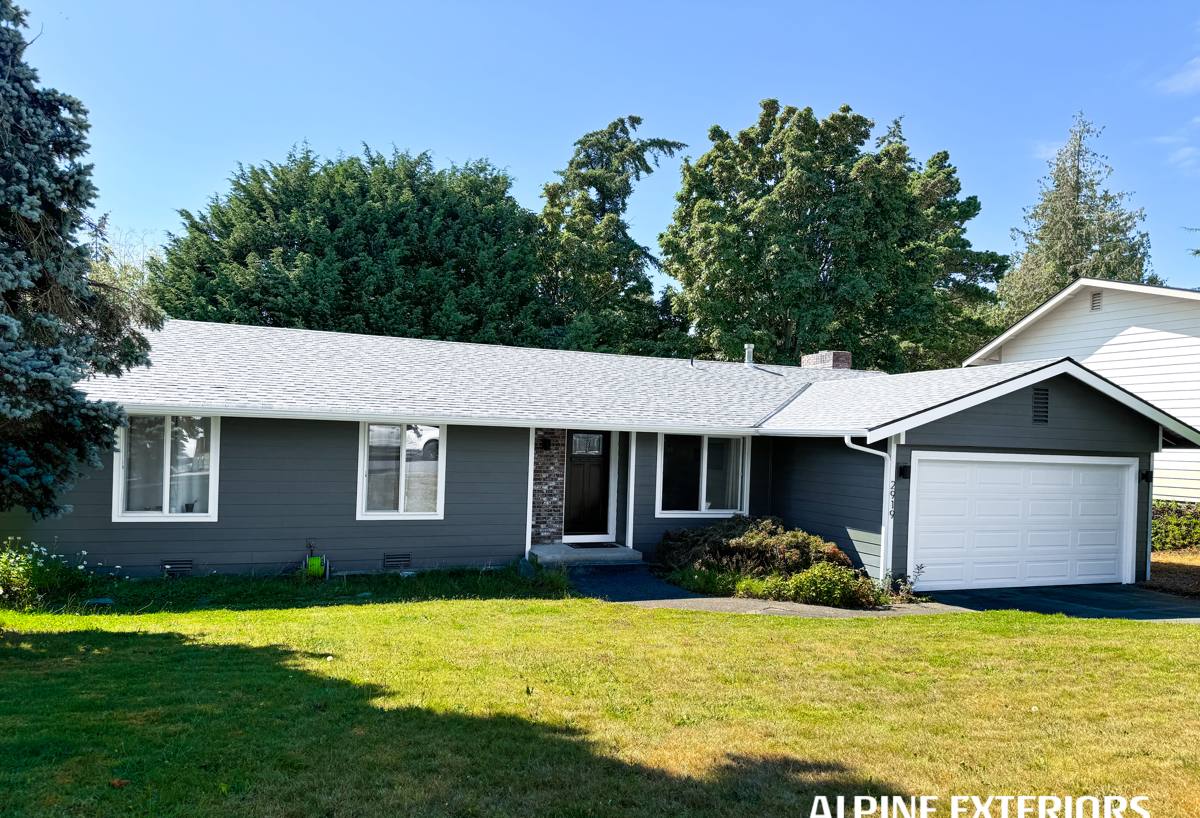
Why We Only Install James Hardie Fiber Cement Here
We install James Hardie fiber cement siding exclusively — not vinyl, not LP SmartSide, not cedar, not other fiber cement brands. That's a deliberate standard, not a sales preference, and it matters more in a place like Point Whitehorn than it would somewhere drier and more sheltered.
Fiber cement is cement, sand, and cellulose fiber pressed and cured into a dense, stable board. It doesn't absorb water the way wood or wood-composite products do, so it doesn't swell, cup, or rot when it stays damp for weeks at a time. It's non-combustible, which matters given the wildfire risk that shows up periodically across Washington's dry seasons. And James Hardie's ColorPlus factory finish is baked on and warrantied against fading and peeling, which counts for a lot on a coastal home where a painted wood surface would need recoating every few years just to keep up with sun and salt exposure.
We get asked why we don't offer vinyl or engineered wood siding as a lower-cost option. The honest answer is that we've seen how those products perform in this specific climate over time — vinyl can warp and crack in temperature swings and doesn't hold up structurally the way fiber cement does, and wood-based composites are more sensitive to the sustained moisture and installation precision this coastline demands. We'd rather install one product correctly and stand behind it than offer a menu of materials we don't fully trust here.
What a Correct Fiber Cement Installation Involves
Fiber cement siding is only as good as the assembly behind it. The board itself resists moisture, but the wall has to be built to manage the water that inevitably gets past the surface, especially in a location that sees this much wind-driven rain.
The moisture-management layer
Correct installation starts with a weather-resistive barrier installed as a drainage plane, not just a wrapped surface. Water needs a path to get out from behind the siding, which means a drainage gap or rainscreen approach is worth serious consideration on exposed elevations, particularly the sides of the home facing the water and prevailing wind.
Flashing and penetrations
Every window, door, vent, and utility penetration is a place water can work its way in. Flashing has to be layered correctly — head flashing over openings, proper kick-out flashing where rooflines meet walls, and sealant used as a backup, not a substitute for good flashing detail. This is where a lot of siding failures actually originate, regardless of what material is on the wall.
Fastening and clearances
James Hardie specifies fastener type, spacing, and placement for a reason, and in a salt-air environment, corrosion-resistant fasteners aren't optional. We also hold to manufacturer clearances at grade, roof lines, and decks — gaps that keep the siding from sitting in standing water or trapped moisture, which is a common cause of premature damage even on a good product.
Caulking and joints
Joints are sealed with a sealant rated for the exposure, and butt joints are treated so water doesn't wick into the cut ends of the board. Cut edges get sealed with touch-up paint or the appropriate product, since an unsealed cut edge is a weak point no matter how good the factory finish is.
Our Process for a Point Whitehorn Job
Every home is a little different, but the sequence we follow is consistent because it's built around getting the moisture management right before the finish siding ever goes up.
- Walk the home and assess current siding, trim, and any signs of moisture damage or rot in the sheathing
- Check roofline, deck, and grade clearances against manufacturer specs
- Remove old siding down to the sheathing and repair or replace any compromised material
- Install or verify a proper weather-resistive barrier with attention to drainage
- Detail flashing at every window, door, and penetration before siding installation begins
- Install James Hardie panels or lap siding per manufacturer fastening and clearance specs
- Seal joints, trim, and cut edges
- Final walk-through so you can see the completed work and ask questions before we consider the job done
James Hardie Compared to Other Common Siding Materials
| Material | Moisture Behavior | Coastal/Salt Air Durability | Finish Longevity |
|---|---|---|---|
| James Hardie Fiber Cement | Does not absorb, swell, or rot | Strong — cement-based, resists corrosion effects on the board itself | Factory ColorPlus finish, warrantied against fading/peeling |
| Vinyl | Doesn't rot but can warp/crack with temperature swings | Moderate — can become brittle over time in coastal wind exposure | Color molded in, but fades and chalks with UV/salt exposure |
| Engineered Wood (e.g., LP SmartSide) | Treated but wood-based; more sensitive to sustained moisture | Requires precise installation and maintenance to avoid edge swelling | Factory-primed or finished, but field-applied paint needs upkeep |
| Cedar / Primed Spruce | Absorbs water; prone to rot without diligent maintenance | Weak in sustained damp/shade conditions without regular care | Needs repainting or restaining on a recurring cycle |
This isn't a claim that other materials fail outright — plenty of homes wear vinyl or wood siding for years. It's that in a location with this much salt air, driving rain, and shaded moss season, fiber cement's moisture stability and low-maintenance finish hold up with less risk and less upkeep over the life of the siding.
What Drives Cost on a Point Whitehorn Project
| Factor | Why It Matters Here |
|---|---|
| Extent of sheathing repair | Coastal moisture exposure sometimes means hidden damage behind old siding, especially on north or west walls |
| Drainage plane / rainscreen detail | Added moisture management on the most exposed elevations increases labor but reduces long-term risk |
| Trim and flashing complexity | Homes with more window/door openings and roofline intersections need more detail work |
| Siding profile chosen | Lap siding, panel systems, and shingle-style products vary in material and labor cost |
| Access and site conditions | Tree cover, slope, and proximity to bluffs or shoreline can affect staging and equipment access |
We won't quote a number without seeing the home — anyone who does hasn't actually assessed the sheathing condition or the site. What we can tell you honestly is that the cost of doing the moisture-management work correctly the first time is almost always less than the cost of repairing rot damage a few years down the road.
Living With Moss Season: What Homeowners Can Do
Even the right siding material benefits from some basic upkeep in a climate like this. None of it is intensive, but it's worth knowing.
- Trim back tree branches and brush that hold shade and moisture against exterior walls
- Rinse siding periodically with a garden hose to clear salt residue and organic buildup, especially on north-facing and shaded walls
- Avoid pressure washing directly into joints, seams, or under laps — it can force water where it shouldn't go
- Check caulking at trim, windows, and joints annually and have any cracked or missing sealant addressed
- Keep gutters clear so overflow doesn't run down the siding face repeatedly in the same spot
James Hardie siding doesn't rot from moss or algae the way wood can, but staining and buildup still look better cleaned off, and clean siding is easier to inspect for any developing issue.
Why It Matters That We Already Work in Point Whitehorn
A crew that regularly works this stretch of Whatcom County coastline already knows which elevations take the worst of the weather, how local permitting and inspection tends to go, and what condition to expect when old siding comes off a home that's been sitting through decades of salt air and rain. That's not something you can fully substitute with a generic install crew working from a spec sheet. It shows up in the flashing details, the drainage decisions, and the fastening choices that don't cut corners just because they're not visible once the siding is up.
We stand behind the installation the same way James Hardie stands behind the product — with a system that's built for the conditions it actually has to survive, not just the conditions on a mild day.
If you're weighing a siding project for a home in Point Whitehorn, we're happy to take a look and walk you through what your specific home needs. Reach out for a free, no-pressure estimate using the form below.