 Birch Bay Siding
 Why Bellingham Roofs Wear Out Faster Than the Brochure Says
Bellingham sits close enough to the Salish Sea that salt-laden air reaches roofs across the city, not just the waterfront neighborhoods. Add Whatcom County's long wet season, driving rain off Bellingham Bay, and a moss-growing climate that runs roughly nine months a year, and you get a roofing environment that's genuinely tougher than what most manufacturers test for. A roof system built for a dry inland climate — thin underlayment, minimal ventilation, standard fasteners — will show its age here years ahead of schedule.
That's not a sales pitch, it's just what we see on tear-offs. Nails corrode faster in salt air. Moss holds moisture against shingles long after a storm has passed, breaking down the granule surface from underneath. Poor attic ventilation traps humidity that condensates on the roof deck from the inside, rotting sheathing that looks fine from the outside. A new roof done right for Bellingham accounts for all three of these before the first shingle goes down.
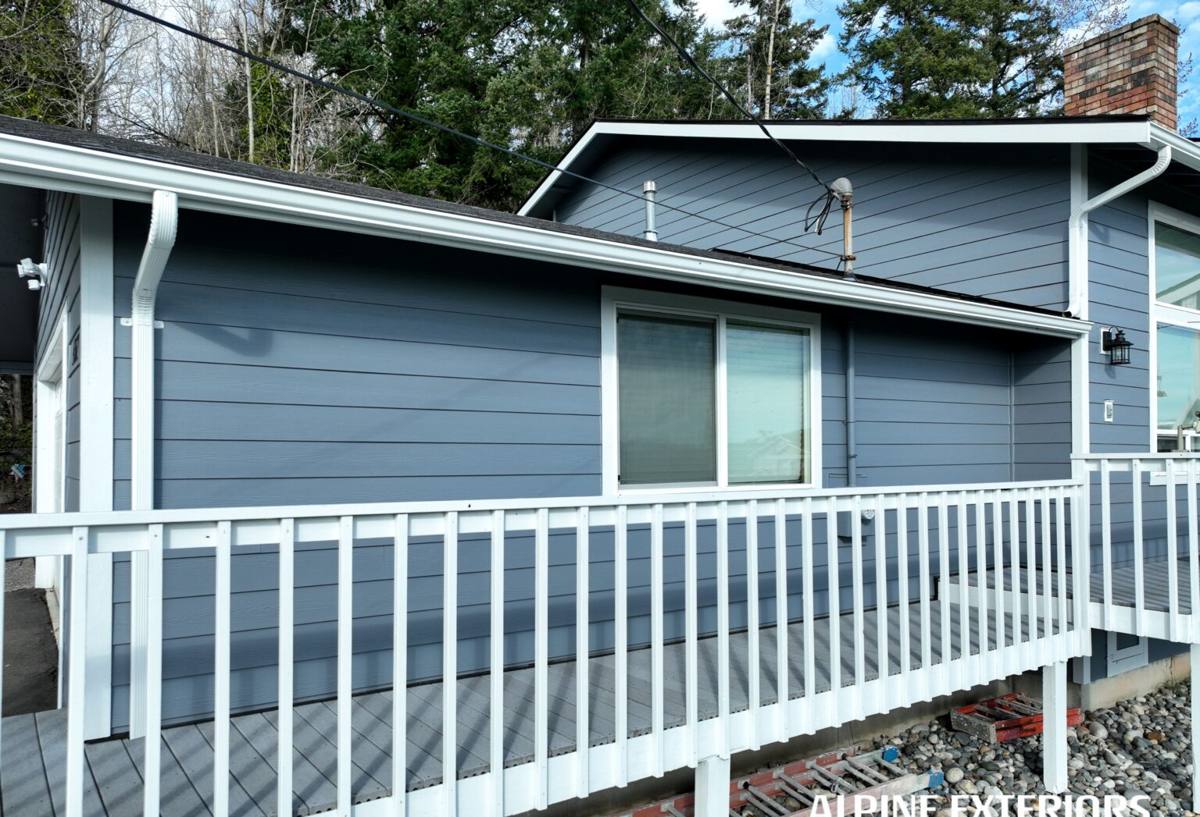
Signs a Bellingham Home Needs Replacement, Not Another Repair
Most homeowners call us after a leak, but by the time water is visible inside, the roof has usually been failing for a while. Here's what actually tells us replacement is the honest answer:
- Granules collecting in gutters and downspouts in noticeable amounts, not just a light dusting
- Shingles that are cupping, curling at the edges, or cracking when lightly flexed
- Moss or algae streaking that comes back within a season of cleaning
- Soft or spongy spots on the roof deck, felt when walking the roof
- Daylight visible through the attic sheathing, or damp insulation below the roof line
- A roof original to a home built more than 20-25 years ago, especially standard three-tab asphalt
- Multiple past repairs in different areas rather than one isolated problem spot
If a roof is showing one or two of these and is otherwise sound, a targeted repair can still make sense. When several show up together, patching becomes a short-term fix on a system that's already past its working life.
Roofing Materials That Actually Hold Up Here
There's no single "best" roofing material — the right choice depends on the home's roof pitch, budget, and how much long-term maintenance the owner wants to take on. Here's how the common options compare for a Whatcom County climate specifically:
| Material | Salt Air / Moisture Resistance | Moss Resistance | Typical Lifespan Here | Maintenance |
|---|---|---|---|---|
| Architectural asphalt shingle | Good with corrosion-resistant fasteners | Fair — benefits from zinc/copper strips | 25-30 years | Periodic moss treatment, gutter clearing |
| Standing seam metal | Excellent | Excellent — moss struggles to hold on smooth metal | 40-50+ years | Low |
| Synthetic composite (slate/shake look) | Very good | Good | 35-50 years | Low to moderate |
| Cedar shake | Fair — needs treatment and airflow behind it | Poor without active upkeep | 20-30 years with maintenance | High |
Cedar shake still has real appeal for its look, and we'll install it correctly for homeowners who want it — but we're honest that it demands the most ongoing attention in this climate, mainly because moss and moisture find their way into the wood grain itself. Standing seam metal and quality architectural asphalt are the two we recommend most often for straightforward, lower-maintenance performance around Bellingham.
Underlayment Matters as Much as the Shingle
What's under the visible roofing material is arguably more important than the material itself in a climate this wet. We use synthetic underlayment rather than older felt products, and we add self-adhered ice-and-water shield along eaves, valleys, and roof penetrations — the spots where wind-driven rain off the bay is most likely to work its way underneath the surface layer.
What a Correct New Roof Installation Actually Involves
A new roof is more than laying shingles over what's there. Done right, a full tear-off and replacement includes:
- Complete removal of the old roofing down to bare deck, with the deck inspected board by board
- Repair or replacement of any rotted or delaminated sheathing before new material goes down
- Corrosion-resistant fasteners rated for coastal/marine-influenced environments
- Synthetic underlayment plus ice-and-water shield at vulnerable areas
- New flashing at every roof penetration — chimneys, vents, skylights, wall intersections
- Balanced intake and exhaust ventilation sized to the attic space
- Proper valley treatment, since valleys concentrate more water than any other part of the roof
Skipping the sheathing inspection is the most common shortcut we see from rushed jobs — and it's the one that causes the most expensive problems down the line, because rotten decking under a brand-new roof just fails again from below.
Ventilation: The Step That Determines How Long the Roof Actually Lasts
Moss and shingle degradation get the attention, but ventilation is what quietly determines whether a roof hits its rated lifespan. In a marine climate like Bellingham's, warm moist air from inside the home rises into the attic and, without a clear path out, condenses on the underside of the roof deck. Over a few winters that moisture cycle rots sheathing and can void a shingle manufacturer's warranty outright, since most warranties require code-compliant ventilation to remain valid.
We calculate intake (usually soffit vents) and exhaust (ridge vent or equivalent) together as a system, sized to the attic's square footage, rather than just adding a vent or two and calling it done.
Our Installation Process for Bellingham Homes
- On-site inspection and estimate — we walk the roof and attic, check ventilation, and give a written scope, not a verbal guess
- Material selection — we walk through the tradeoffs above so the choice fits the budget and the home, not just what's easiest to install
- Permitting — pulled through the appropriate local jurisdiction before work begins
- Tear-off and deck inspection — old roofing removed, deck checked and repaired as needed
- Underlayment and flashing installation — the water-management layer that does the real work
- Roofing material installation — installed to manufacturer specification, which protects the warranty
- Ventilation balancing and final walkthrough — with the homeowner, before we consider the job complete
Permits, Warranty, and Insurance — What Bellingham Homeowners Should Know
Roof replacement in Whatcom County generally requires a building permit, and skipping that step can cause problems at resale or with insurance claims later. We handle permitting as part of the project rather than leaving it to the homeowner to sort out. On warranty, it's worth understanding there are two separate layers: the manufacturer's material warranty and the installer's workmanship warranty. A manufacturer warranty can be reduced or voided by improper ventilation or installation, which is exactly why correct installation matters more than which shingle brand ends up on the roof.
Cost Factors to Expect
| Factor | How It Affects Cost |
|---|---|
| Roof size and number of stories | More square footage and steeper access raise labor time |
| Roof pitch and complexity | Multiple valleys, dormers, or a steep pitch add labor and material waste |
| Existing deck condition | Rotted sheathing found during tear-off adds repair cost not visible in advance |
| Material choice | Asphalt is the most economical; metal and cedar cost more upfront |
| Ventilation upgrades | Adding proper intake/exhaust where none existed is an added but worthwhile cost |
We don't publish a flat price because two roofs of the same size can cost meaningfully different amounts once pitch, layer count, and deck condition are factored in. That's what the on-site estimate is for.
Why a Crew That Already Works Bellingham Is Worth Choosing
A crew that installs roofs across Whatcom County regularly already knows which fastener specs hold up near the water, which shingle lines have performed well locally, and how to size ventilation for this climate without guessing. That local track record matters more than it sounds — a contractor unfamiliar with marine-climate roofing can build a technically fine roof for a drier region and still hand a Bellingham homeowner a roof that underperforms here.
Before hiring anyone for a roof replacement, it's worth checking a few things:
- Current Washington contractor license and liability insurance, verifiable on request
- Manufacturer certification for the specific product line being installed, if warranty coverage matters to you
- A written estimate that specifies materials, underlayment, and ventilation plan — not just a total price
- Willingness to pull permits rather than asking the homeowner to do it
- Local references or completed work in the Bellingham/Whatcom County area
If you're weighing repair versus replacement, or just want an honest read on where your roof stands, we're glad to take a look. Reach out for a free, no-pressure estimate using the form below.