 Birch Bay Siding
 Building Decks for Marietta's Specific Conditions
Marietta sits close enough to Birch Bay and the water that homes here take a different kind of weathering than a deck built ten miles inland in Whatcom County. Salt-laden air moves off the bay, wind-driven rain hits siding and decking at an angle instead of falling straight down, and the shoulder seasons bring long stretches of damp, low-light weather where moss and algae get a real foothold. A deck built to a generic spec sheet will often look fine for a year or two here, then start showing problems — cupped boards, corroding fasteners, slick green film on the walking surface — well before it should. A deck built for this specific stretch of coastline holds up differently, and that starts with decisions made before the first board is ever cut.
This page is about custom deck work specifically for the Marietta area — what the local conditions actually demand, what a correctly built deck involves from the ground up, and what our process looks like when we build or replace one here.
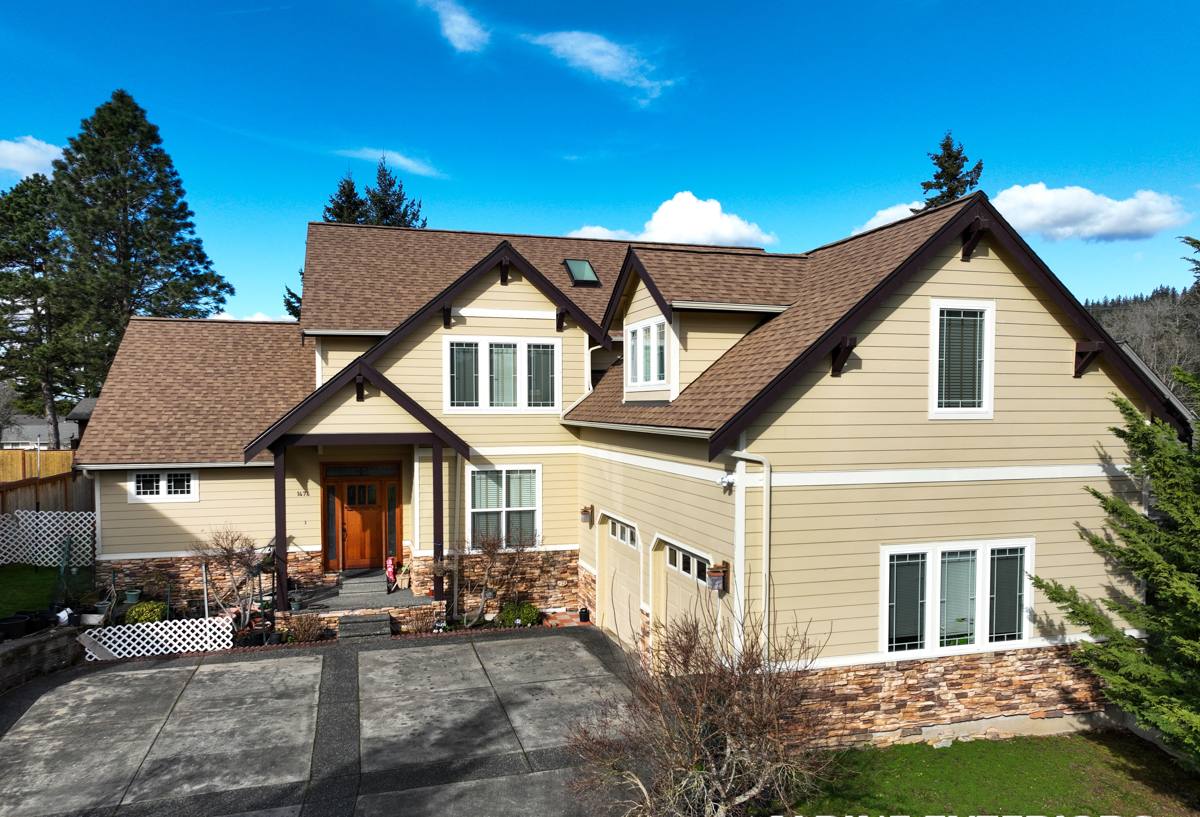
What Salt Air, Driving Rain, and Moss Season Actually Do
Each of these three factors attacks a deck in a different way, and understanding the mechanism matters because it changes what materials and details are worth paying for.
Salt Air
Airborne salt is corrosive to metal. Fasteners, joist hangers, post bases, and structural screws that aren't rated for coastal exposure can start rusting from the inside of the wood, often before any surface rust is visible from above. Once a fastener corrodes, it loses holding strength — and on a deck, that's a structural problem, not a cosmetic one.
Driving Rain
Wind off the water pushes rain sideways and up under things that a straight-down rain would never reach — ledger boards, stair stringers, the underside of rail posts, and gaps between decking boards. Water that gets trapped instead of shedding is what causes rot, not water that simply falls and drains.
Moss and Algae Season
Whatcom County's long stretch of overcast, damp weather (roughly fall through spring) is prime growing conditions for moss and algae on any horizontal wood or composite surface that doesn't get much direct sun or airflow. Beyond looking bad, a mossy deck surface is a genuine slip hazard, and moss holds moisture against the board longer than bare wood would otherwise sit wet.
Decking Material Options for This Climate
There's no single "correct" material for every deck — it depends on budget, how much sun exposure the deck gets, and how much maintenance the homeowner actually wants to do. Here's how the common options compare for a Marietta-area build.
| Material | Moisture/Moss Behavior | Maintenance | Typical Lifespan Here |
|---|---|---|---|
| Pressure-treated lumber | Sheds water well if sealed regularly; can hold moisture in shaded, low-airflow spots | Needs re-sealing/staining every 1-2 years in this climate | 15-20 years with upkeep |
| Cedar | Naturally rot-resistant but still needs sealing; can gray and hold moss without care | Regular cleaning and sealing recommended | 15-20 years with upkeep |
| Composite decking | Doesn't rot, but algae/moss can still grow on the surface film, especially in shade | Periodic cleaning, no sealing/staining | 25-30+ years (manufacturer-dependent) |
| PVC/capped polymer | Fully non-organic surface, least hospitable to moss, sheds water cleanly | Lowest maintenance of the group | 25-30+ years (manufacturer-dependent) |
We'll walk through these trade-offs honestly during an estimate rather than pushing whatever has the best margin. A shaded, tree-covered lot near Marietta might do better with composite or PVC simply because it won't need scrubbing every spring; a sunnier, more open lot might get many good years out of well-maintained cedar or treated lumber at a lower upfront cost.
Framing and Substructure: Where Deck Problems Actually Start
Most deck failures don't start at the decking surface — they start underneath, where nobody looks until there's a problem. A few things we treat as non-negotiable on every build:
- Joists and beams sized and spaced for the actual load, not just the minimum code allows
- Proper drainage slope built into the framing so water doesn't pool under the decking
- Ventilation gaps maintained between the ground and the framing to let air move and wood dry out
- Ledger board attachment flashed correctly where the deck meets the house — this is the single most common source of hidden rot on older decks
- Post bases set above grade and away from standing water, not buried in soil or mulch
A deck with beautiful decking boards on a poorly built frame is a deck that fails from the inside. We build the substructure to outlast the surface material, not the other way around.
Fasteners, Hardware, and Flashing — The Detail That Actually Matters Most Here
Given the salt air along this part of the coast, hardware choice is not a place to cut corners. We use fasteners, joist hangers, and structural connectors rated for coastal or high-corrosion environments — typically stainless steel or heavy-duty coated hardware, matched to whatever the decking and framing material calls for. Mixing incompatible metals (for example, the wrong fastener with certain treated lumber chemicals or with certain composite decking) can accelerate corrosion, so the hardware spec isn't a one-size-fits-all decision — it depends on the materials chosen.
Flashing at the ledger board, around posts, and at any point where the deck meets the house or penetrates through decking (stair stringers, post bases) is what actually keeps driving rain from working its way into wood it shouldn't reach. This is detail work that doesn't show up in a walkthrough and only becomes obvious years later when it's missing — which is exactly why it matters to get right the first time.
How We Approach a Marietta Deck Project
1. On-Site Assessment
We walk the property, look at sun exposure, wind exposure, drainage, and how close the build is to salt air influence, and talk through how the family actually plans to use the space.
2. Material and Design Discussion
Based on that assessment, we go over realistic material options and their trade-offs — cost, maintenance, and lifespan in this specific climate — so the decision is informed, not guesswork.
3. Written Estimate
A clear scope of work and pricing before anything is signed. No surprise change orders for things we could have identified up front.
4. Permitting
Deck projects in Whatcom County typically require a permit depending on size, height, and attachment to the structure. We handle that process as part of the job rather than leaving it to the homeowner to sort out.
5. Build
Framing first, with every structural and flashing detail addressed before decking goes down — not covered up and hoped for.
6. Final Walkthrough
We go over the finished deck together, including basic care and maintenance expectations specific to this climate, before calling the job done.
Maintenance: What Actually Keeps a Deck Looking and Performing Well Here
Even the best-built deck needs some seasonal attention in a climate like this. A short, honest maintenance routine goes a long way:
- Sweep debris (leaves, needles, dirt) off the deck regularly — trapped debris holds moisture and feeds moss growth
- Clean the surface at least once or twice a year with an appropriate deck cleaner to knock back algae and moss before it takes hold
- Check and re-seal wood decking on the manufacturer's recommended schedule — don't wait until it's visibly gray and dry
- Keep gutters and downspouts near the deck clear so runoff isn't dumping extra water onto or under the structure
- Inspect fasteners and hardware periodically for early signs of corrosion, especially near the water-facing side of the property
- Trim back overhanging vegetation that keeps sections of the deck shaded and damp longer than the rest
None of this is complicated, but skipping it is exactly how a well-built deck starts looking like a poorly built one within a few seasons.
Permits and Local Considerations in Whatcom County
Deck permitting requirements vary by jurisdiction and by the specifics of the project — height above grade, footprint, and whether it's attached to the house all factor in. Rather than guessing at requirements, we confirm what applies to your specific property and handle the permit process as part of the build, so there are no surprises at inspection.
Why a Crew That Already Works in Marietta Makes a Difference
A deck built by a crew that hasn't worked this specific stretch of coastline before is more likely to spec hardware and materials for a generic climate rather than for salt air and driving rain. We already know what fails first out here, what holds up, and what a Marietta homeowner is actually dealing with each winter when the moss comes back. That local experience shows up in the small decisions — flashing details, fastener choice, drainage slope — that don't get noticed until a deck is either still solid in ten years or isn't.
If you're planning a new deck or need to replace one that's showing its age, we're happy to take a look and talk through honest options for your property. Reach out for a free, no-pressure estimate using the form below.