 Birch Bay Siding
 Why Roofs in the Lynden Area Wear Out Faster Than the Warranty Suggests
Every asphalt shingle sold in the Pacific Northwest carries a warranty written for national average conditions. Lynden and the surrounding Birch Bay area do not have average conditions. Sitting close to the Salish Sea means homes here deal with a steady dose of salt-laden air, wind-driven rain that gets pushed sideways under poorly sealed shingle tabs, and a moss season that can run from fall through spring in a typical Whatcom County year. None of that shows up in a manufacturer's lab testing, and it's a big part of why a roof that looks fine on the surface can be failing underneath years before the shingles themselves wear out.
A correctly built roof accounts for these conditions from the start — not with a premium product alone, but with the right combination of materials, ventilation, and installation detail that a generic install often skips. That's the difference we focus on for asphalt shingle roofing in this area, and it's the reason a roof done right here should outlast one built the same way somewhere drier and calmer.
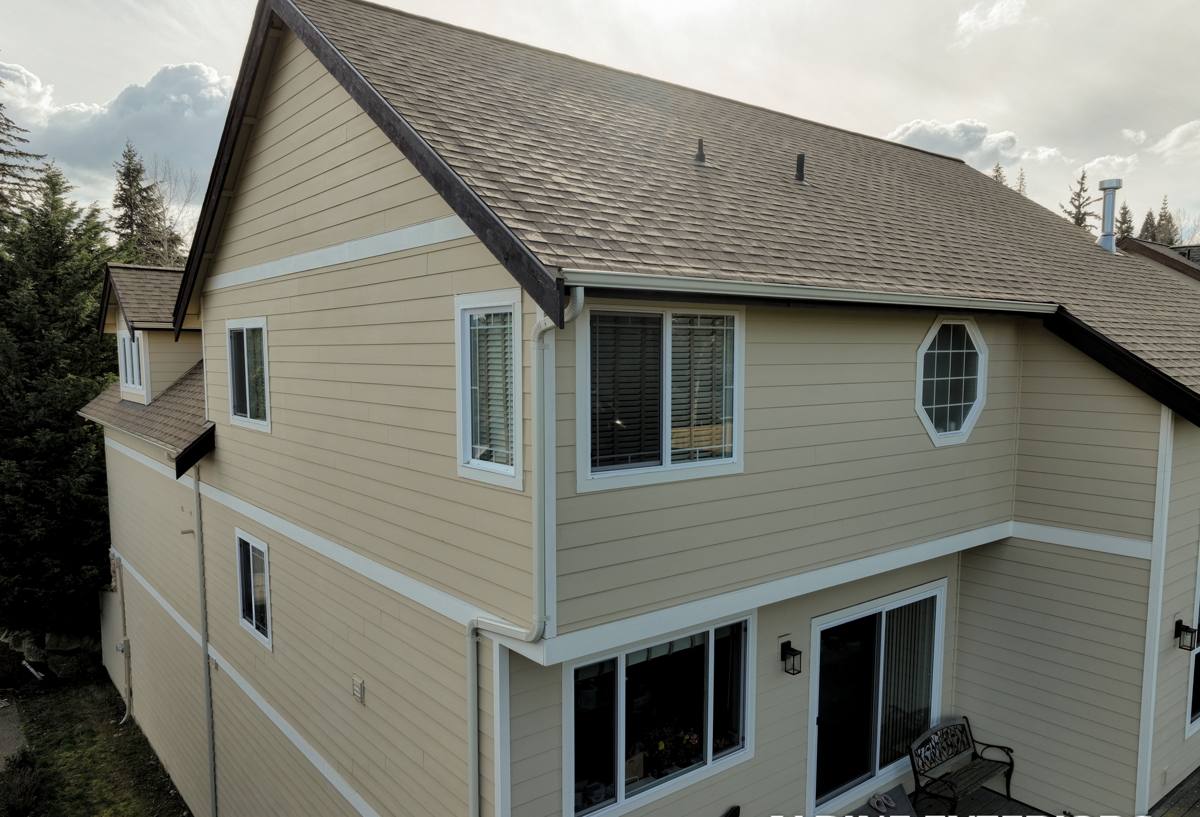
What "Correct" Asphalt Shingle Roofing Actually Involves
Asphalt shingles are a simple, proven product, but a roof is a system — the shingle is only one layer of it. In a climate with this much rain and salt exposure, every layer underneath the shingle matters as much as the shingle brand printed on the wrapper.
The Layers That Do the Real Work
- Deck inspection and repair: Any soft, delaminated, or water-stained sheathing gets replaced before anything new goes down. Shingles fastened to a compromised deck will never perform correctly, regardless of quality.
- Ice-and-water shield at vulnerable points: Eaves, valleys, and roof-to-wall transitions get a self-adhering waterproof membrane, not just felt. This is where wind-driven rain and ice dams (on the rare cold snap) cause the most hidden damage.
- Synthetic underlayment across the field: A quality synthetic underlayment sheds the water that inevitably works past shingle tabs during a sideways storm, and it holds up far longer than old-style felt in a damp climate.
- Metal flashing, not just cement or caulk: Chimneys, skylights, sidewalls, and dormers need properly formed and step-flashed metal. Sealant-only "flashing" is a common shortcut that fails first, often within a few wet seasons.
- Balanced attic ventilation: Intake at the soffits and exhaust at the ridge keep moist air moving out of the attic. Without it, condensation builds on the underside of the deck — a problem that looks like a roof leak but is really a ventilation failure.
Skip any one of these and the shingle warranty becomes close to meaningless, because most manufacturer warranties are voided by improper installation long before the shingle material itself gives out.
Signs a Lynden-Area Roof Needs a Look
Because moss and salt-driven wear happen gradually, most homeowners don't notice a problem until it shows up as a stain on a ceiling. Catching it earlier is cheaper and less disruptive. Walk your property periodically and watch for:
- Granules collecting in gutters or at downspout outlets — a sign shingles are losing their protective surface
- Dark streaking or green-black growth, especially on north-facing slopes that stay shaded and damp longer
- Shingle tabs that look lifted, curled, or cupped at the edges
- Visible moss clumps building up at butt joints or in valleys, where debris and moisture collect
- Rust staining or gaps around flashing at chimneys, vents, and skylights
- Any soft spot felt when walking the attic deck, or daylight visible through the roof boards from inside
- Interior ceiling stains, especially after a stretch of heavy wind and rain
Any one of these on its own isn't necessarily an emergency, but ignoring several at once usually means water has already found a way past the shingle layer.
How We Handle a Roofing Project in This Area
1. On-Site Assessment
We look at more than the shingles — deck condition, existing ventilation, flashing details, and how the roof has handled moss and moisture historically. A roof facing prevailing weather off the water often needs different attention than one tucked behind trees on the leeward side of a property.
2. Scope and Straight Answers
We tell you plainly whether you're looking at a repair, a partial re-roof, or a full tear-off, and why. We don't upsell a full replacement when a targeted repair will genuinely hold, and we don't recommend a patch when the deck or underlayment is already compromised.
3. Tear-Off and Deck Check
Old material comes off down to the deck so we can actually see what's underneath — this is the only reliable way to catch rot, delamination, or prior repair shortcuts before they're covered up again.
4. Waterproofing and Underlayment
Ice-and-water membrane goes in at eaves, valleys, and penetrations first, followed by synthetic underlayment across the full roof field.
5. Flashing and Ventilation Detail
New metal flashing is formed and installed at every wall, chimney, and penetration. Intake and exhaust ventilation are checked and corrected as part of the job, not treated as an optional add-on.
6. Shingle Installation
Shingles go down to manufacturer nailing pattern and exposure specs — the details that actually keep a warranty valid and keep tabs sealed down against wind.
7. Cleanup and Walkthrough
Site is cleared of debris and nails (magnetic sweep included), and we walk the finished roof with you so you know what was done and why.
Choosing a Shingle That Makes Sense for This Climate
Not every asphalt shingle line handles wind-driven rain, salt air, and moss exposure equally well. The table below breaks down the practical trade-offs between the common categories homeowners in this area choose between.
| Shingle Type | Wind & Rain Performance | Moss/Algae Resistance | Typical Lifespan Here |
|---|---|---|---|
| Standard 3-tab | Adequate when installed correctly, less margin for error | None built in unless specified | Shorter end of the range in this climate |
| Architectural (laminate) | Heavier, better wind rating, more forgiving on exposed slopes | Often available with algae-resistant granules | Mid-to-long range with proper ventilation |
| Algae-resistant (AR) granule lines | Same base performance as the shingle it's built on | Copper- or zinc-infused granules actively slow moss/algae growth | Comparable to standard, but stays cleaner longer |
| Impact-rated / high-wind rated | Best hold-down in sustained coastal wind | Varies by product line | Longest, if paired with correct underlayment |
For most Lynden-area homes, we lean toward a laminate architectural shingle with algae-resistant granules as the practical baseline — it isn't the cheapest option on the shelf, but it's the one that best matches what this climate actually does to a roof over time. We'll walk through the honest trade-offs for your specific roof rather than defaulting to one product for every job.
Moss, Algae, and Salt Air: What Ongoing Maintenance Actually Looks Like
A well-built roof still needs upkeep in Whatcom County's wet, shaded conditions. This isn't about scrubbing shingles aggressively — pressure washing actually strips protective granules and shortens shingle life. Instead, sound maintenance means:
- Keeping gutters and valleys clear so water and debris don't sit against shingle edges
- Trimming back overhanging branches to reduce shade, moisture retention, and debris buildup
- Removing moss growth gently — soft brushing or a low-pressure treatment rather than a power washer
- Checking flashing and sealant points annually, since these fail well before the shingle field typically does
- Watching attic ventilation, especially after any insulation or attic work that could block soffit vents
Salt air adds a second layer to this: it accelerates corrosion on exposed metal flashing, fasteners, and vent components faster than it does inland. Using corrosion-resistant fasteners and properly coated flashing at install time is a small upfront detail that pays off for years afterward.
Cost Factors Worth Understanding Before You Get Quotes
Every roof is priced individually based on size, pitch, and condition, so we won't put a number here that doesn't apply to your specific house. What's more useful is understanding what actually drives the cost up or down, so quotes make sense when you compare them.
| Factor | Why It Moves the Price |
|---|---|
| Roof pitch and access | Steeper or harder-to-access roofs require more safety setup and slow the work down |
| Number of layers to remove | Tearing off multiple old layers costs more in labor and disposal than a single-layer tear-off |
| Deck condition | Rotten or delaminated sheathing found during tear-off means replacement boards, priced as they're found |
| Roof complexity | Valleys, dormers, skylights, and multiple penetrations all add flashing labor and material |
| Shingle class chosen | Standard, architectural, algae-resistant, and impact-rated lines each carry different material costs |
| Ventilation upgrades needed | Adding or correcting intake/exhaust ventilation is a smaller cost during a re-roof than after |
Be cautious of any quote that's dramatically lower than the others without a clear explanation — it's usually missing one of these line items, not offering a genuine deal.
Why Hiring a Crew That Already Works This Area Matters
A roofing crew that regularly works Lynden and the greater Birch Bay area already knows what this climate does to a roof over a five- or ten-year span, not just what a spec sheet claims. That familiarity shows up in practical ways: knowing which slopes on a given lot orientation collect the most moss, which flashing details tend to fail first under sustained coastal wind, and how local permitting and inspection expectations work in Whatcom County. It also means we're a known, reachable crew if a warranty question or a storm-related issue comes up down the road — not a name from an out-of-town lead-generation site that's difficult to track down after the invoice is paid.
We're also straightforward about scope. If a roof genuinely just needs a repair, we say so. If it needs a full replacement because the deck or underlayment has already failed, we explain exactly why — with what we found during the inspection, not a sales pitch.
Warranty and Manufacturer Standards
Shingle manufacturers publish specific installation requirements — nailing patterns, exposure, underlayment compatibility, and ventilation minimums — as conditions of their material warranties. We install to those published standards as a baseline, not a suggestion, because an improperly installed roof can leave a homeowner with a shingle warranty that looks solid on paper but doesn't actually hold up when a claim is filed. Workmanship coverage on our end is separate from the manufacturer's material warranty, and we'll explain clearly what each one covers before work starts, not after.
If your roof is showing early wear, due for replacement, or you just want an honest read on where it stands, we're glad to take a look. Fill out the form below for a free, no-pressure estimate — we'll tell you what we actually find, not just what's easiest to sell.