 Birch Bay Siding
 Siding That Has to Work in Lynden's Climate, Not Just Look Good on Day One
Lynden sits inland from Birch Bay in the Nooksack River valley, and while it doesn't take the same direct salt spray as the coast, it shares the same underlying problem: Whatcom County stays wet for most of the year. Low clouds sit over the valley floor, driving rain comes through sideways during winter storms, and the combination of farmland humidity and shaded north walls means moss and algae get a long head start every season. Siding here isn't decorative. It's the one layer standing between that moisture cycle and the framing underneath it.
We install James Hardie fiber cement siding exclusively, and Lynden is one of the areas where that decision matters most. Homes on treed or low-lying lots, older farmhouses with minimal roof overhang, and newer builds with modern flat-panel details all face the same slow, repeated wetting-and-drying cycle. The products we won't install — vinyl, LP SmartSide, cedar, primed spruce — each have a specific weak point in exactly this kind of climate. We'll explain what that means below, honestly and without exaggeration, and why Hardie is what we put on homes instead.
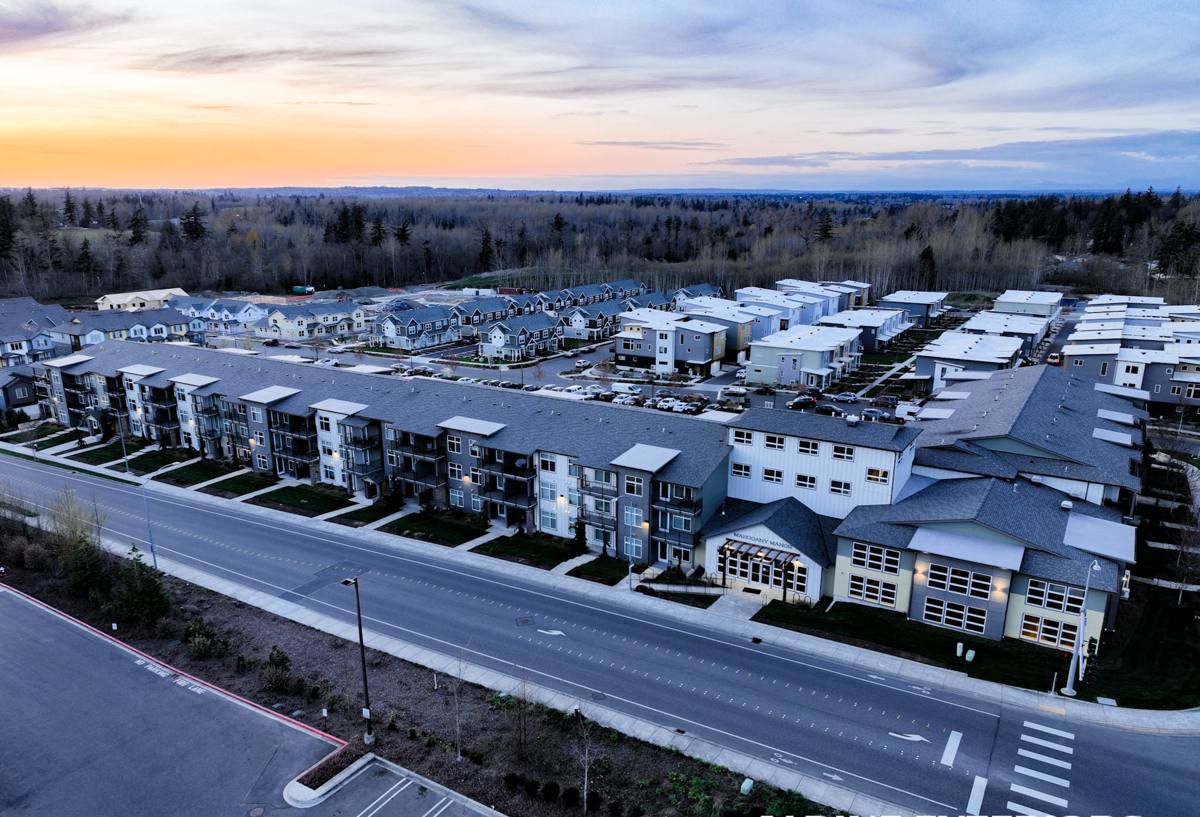
What Lynden's Climate Actually Does to Siding
Three things drive siding failure in this part of Whatcom County, and they compound each other:
- Driving rain: Winter storms push rain horizontally into wall assemblies, not just straight down onto roofs. Any gap, unsealed seam, or poor flashing detail becomes an entry point.
- Extended dampness: Valley fog and overcast stretches mean siding often doesn't fully dry out between rain events, especially on shaded elevations and under eaves.
- Moss and algae season: That prolonged dampness feeds moss growth on roofs and siding for a large part of the year, and moss holds moisture directly against whatever surface it's growing on.
Wood-based products absorb that moisture over time — swelling, delaminating at cut edges, or rotting if a coating fails. Vinyl doesn't absorb water, but it also doesn't manage it; it flexes and gaps with temperature swings, and gives moss and algae a smooth surface to colonize behind seams and laps. James Hardie fiber cement is engineered specifically to resist this pattern: it doesn't swell, it doesn't support rot, and its factory-applied ColorPlus finish holds up to repeated wetting far better than field-applied paint on wood substrates.
Why We Standardized on James Hardie
This isn't a brand preference — it's a materials decision built around exactly the conditions Lynden homes face.
| Factor | James Hardie Fiber Cement | Vinyl / LP / Wood Alternatives |
|---|---|---|
| Moisture response | Non-combustible cement composite; doesn't swell or rot | Wood swells and can rot at cut edges; vinyl doesn't absorb but traps moisture behind panels |
| Moss/algae resistance | Dense factory finish resists staining and biological growth better than field-painted surfaces | Rougher or seamed surfaces give moss and algae more to grip |
| Finish durability | Factory-baked ColorPlus finish, warrantied against fading and peeling | Field-applied paint needs recoating; vinyl color is baked into thin material that can fade and become brittle |
| Fire resistance | Non-combustible | Vinyl softens/melts under heat; wood is combustible |
| Long-term cost | Higher upfront, lower repaint/replacement frequency | Lower upfront, more frequent maintenance or replacement in this climate |
None of this means the alternatives are junk products — they're simply built around different priorities and different climates. In a valley that stays wet for months at a stretch, we've made the call that fiber cement is the only material we're willing to stand behind long-term.
Choosing the Right Hardie Product Line for This Area
James Hardie engineers its siding by climate zone, and that matters more in the Pacific Northwest than in drier parts of the country. For Whatcom County, including Lynden, the HZ10 moisture-optimized formulation is the appropriate baseline — it's built for regions with sustained rain and humidity rather than freeze-dominated or arid climates. Within that, homeowners generally choose between:
- HardiePlank lap siding — the most common choice for traditional and farmhouse-style homes throughout Lynden, available in several exposure widths and textures.
- HardiePanel vertical siding — often used for gable accents, shop-style outbuildings, or modern designs with clean vertical lines.
- HardieShingle — for homes wanting a shingle look on accent areas without the moisture vulnerability of actual cedar shingles.
- HardieTrim — used around windows, corners, and fascia so the trim ages at the same rate as the field siding instead of becoming the weak point.
The right combination depends on the home's style, roofline, and how exposed each elevation is to driving rain — a north-facing wall under trees needs the same product but benefits from extra attention to flashing and clearance, which we cover below.
What a Correct Installation Actually Involves
Fiber cement siding fails prematurely almost exclusively because of installation mistakes, not the material itself. This is the part that separates a job that lasts thirty-plus years from one that causes problems in five.
Water management details
Every horizontal joint, window head, and door opening needs proper flashing and weather-resistive barrier integration — the siding is one layer of a system, not a standalone shield. Rainscreen gapping (a small air gap behind the siding) is increasingly important in wet valley climates like Lynden's, because it lets any moisture that does get past the surface dry out instead of sitting against the sheathing.
Clearances and fastening
Hardie's own installation specifications call for minimum clearances from roof lines, decks, and grade — details that are easy to skip and impossible to see once the job is finished. Fasteners need to be the correct type and driven to the correct depth; overdriven nails crack the board's factory seal and create a moisture entry point that isn't visible until the damage is already done.
Caulking and paint at cut edges
Every field cut exposes raw fiber cement that has to be sealed before it's closed up. Skipping this step is invisible at installation and shows up as staining or edge deterioration a few years later — exactly the kind of slow failure that's hard to trace back to the install once it happens.
Quick homeowner checklist: signs of a correct Hardie install
- Consistent gap maintained above rooflines, decks, and at ground contact
- No visible nail heads blown through or overdriven into the face of the board
- Caulked and painted field-cut edges, especially around windows and corners
- Flashing visible (or documented) at every window head and horizontal transition
- Uniform reveal lines and tight, straight butt joints
Our Process for Lynden Projects
We walk every project the same way, whether it's a full re-side or a targeted repair:
- On-site assessment: We look at existing siding condition, moisture staining, moss buildup, and any rot at trim, corners, or the base of walls before quoting anything.
- Tear-off and sheathing check: Once old siding comes off, we inspect the sheathing and framing underneath — this is where hidden moisture damage from a prior installation often turns up.
- Weather barrier and flashing: We install or verify the weather-resistive barrier and flash every penetration and transition before a single piece of Hardie goes up.
- Installation to manufacturer spec: Fastening, clearances, gapping, and cut-edge treatment are done to James Hardie's published installation guidelines, not shortcuts.
- Final walk-through: We review the finished job with the homeowner and point out the details that matter for long-term maintenance.
Ongoing Maintenance in a Wet Climate
James Hardie siding is low-maintenance, not zero-maintenance — especially in a climate that grows moss the way Whatcom County does.
| Task | Frequency | Why it matters here |
|---|---|---|
| Soft wash to remove moss/algae | Every 1-2 years, more on shaded walls | Prevents moisture retention against the surface during the wet season |
| Inspect caulking at trim and penetrations | Annually | Caulk is the first line of defense against driving rain |
| Clear debris from base of walls and gutters | Seasonally | Keeps water from pooling against the bottom course |
| Visual check after major storms | As needed | Catches wind-driven damage or displaced flashing early |
Why It Matters to Hire a Crew That Already Works This Area
Lynden's building stock ranges from older farmhouses to newer developments, and the moisture challenges differ by lot — a shaded, low-lying property behaves differently than an open, exposed one even a few miles away. A crew that already works throughout Whatcom County has seen how local siding actually fails over time, not just how it looks in a showroom, and installs accordingly: extra attention to north-facing walls, correct clearances around decks and grade, and flashing details sized for real Pacific Northwest rain rather than a generic national spec sheet.
We only install one product because we only want to be accountable for one system, installed one correct way, in a climate we know well. If you're weighing a re-side or repair in Lynden, we're happy to take a look at your home and walk you through exactly what it needs — no pressure, no upsell to a product we don't stand behind. Reach out for a free estimate using the form below.