 Birch Bay Siding
 Why Cottonwood Beach Roofs Wear Differently Than Roofs Inland
Cottonwood Beach sits right up against the water, and that changes what a roof has to deal with year after year. Salt-laden air moves off the Strait of Georgia and settles on everything — fasteners, flashing, shingle granules — accelerating corrosion and breakdown in ways that roofs a few miles inland in Whatcom County never experience. Add in driving, wind-blown rain that gets pushed sideways under poorly sealed edges, and a moss season that can run eight months or more in a wet Pacific Northwest year, and you've got a roofing environment that's genuinely tougher than most manufacturers' warranty testing accounts for.
We're not describing this to scare anyone into a premature replacement. Most roofs in this area do fine for their expected lifespan when they were installed correctly to begin with. The problem shows up when a roof was built to a generic spec instead of a coastal one — standard fasteners instead of corrosion-resistant ones, minimal underlayment, or ventilation that doesn't account for how much moisture this air actually carries. That's the gap we focus on closing when we replace a roof in Cottonwood Beach.
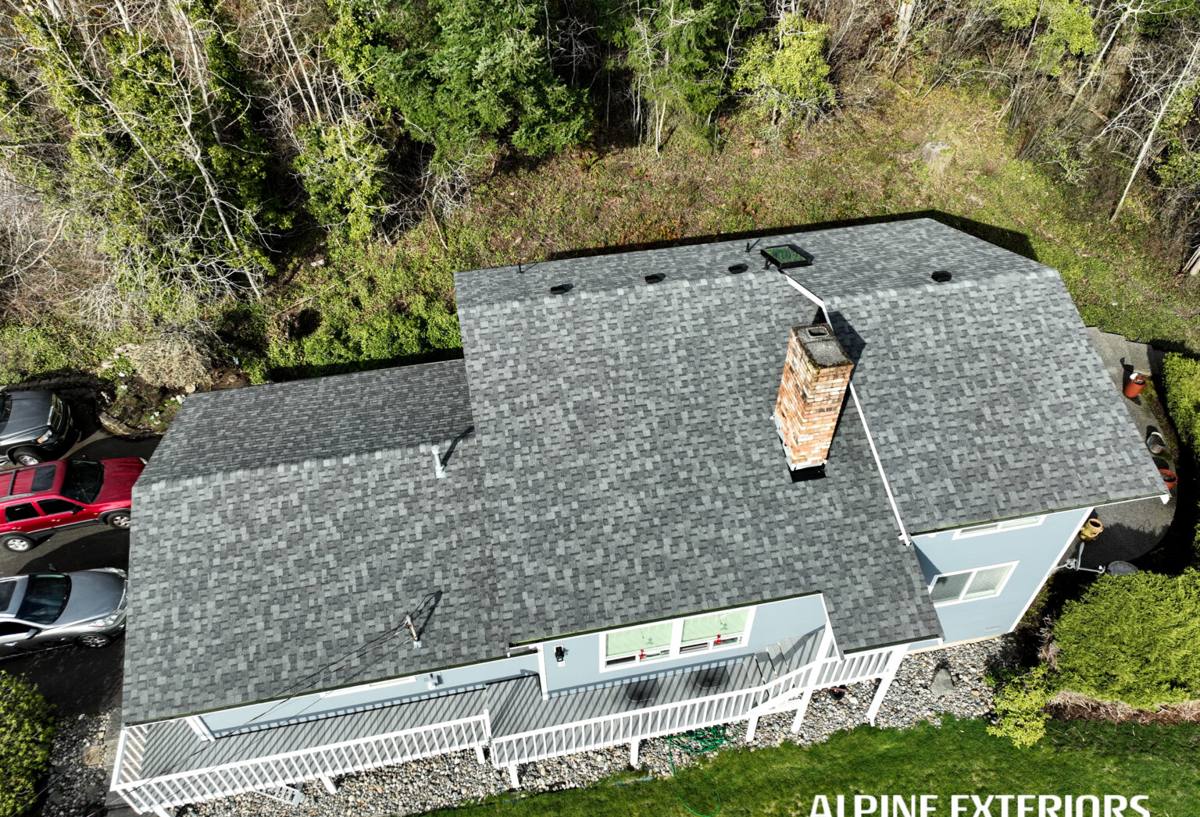
Signs Your Roof Needs Full Replacement, Not Another Repair
A lot of homeowners call us after a leak, assuming it's a small fix. Sometimes it is. But on homes this close to the water, a leak is often the visible symptom of a roof that's been losing ground for years. Here's how we tell the difference during an inspection.
Age and Material Condition
Standard asphalt composition shingles are typically rated for 20-30 years, but in a heavy salt-air, high-moss environment, that lifespan gets compressed. If your roof is past the 18-20 year mark and showing granule loss, curling edges, or brittle shingles, patch repairs stop making financial sense — you're paying to delay the inevitable rather than solve it.
Moss and Algae Damage Beneath the Surface
Moss doesn't just look bad. Its root structure lifts shingle edges and holds moisture directly against the roofing material, which is exactly the condition that rots decking and breaks down asphalt from underneath. By the time moss is visible from the ground, it's often been doing damage for a season or two already.
Flashing and Fastener Corrosion
Salt air attacks exposed metal — flashing around chimneys and vents, nail heads, gutter edges — faster than it attacks the shingle field itself. Rust streaks, pitted metal, or fasteners that have backed out are strong signs the roof's hardware is failing even if the shingles look okay from a distance.
What a Correct Roof Replacement Actually Includes Here
A roof replacement done right for this stretch of coastline isn't just "new shingles on old plywood." It's a full system rebuild, and every layer matters more here than it would on a roof twenty miles from the water.
- Complete tear-off to bare decking, never an overlay — overlays trap moisture and hide rot
- Decking inspection and replacement of any soft, delaminated, or water-stained sheathing
- Ice-and-water shield or high-quality synthetic underlayment at eaves, valleys, and all penetrations
- Corrosion-resistant fasteners and flashing rated for coastal exposure, not standard-grade hardware
- Proper intake and exhaust ventilation sized for the roof's actual square footage
- Sealed, correctly lapped flashing at every chimney, skylight, and pipe boot
- Moss-resistant shingle selection or zinc/copper strip installation where appropriate
Skip any one of these and the roof will likely underperform its rated lifespan in this climate — sometimes by a decade or more. This is where a lot of the "we had our roof replaced five years ago and it's already leaking" stories come from.
Choosing Materials for Salt Air and Moss Exposure
There's no single "best" roofing material for every home — budget, roof pitch, and the look you want all factor in. But some materials genuinely hold up better under Whatcom County's coastal conditions than others, and we'll walk through the honest trade-offs during your estimate rather than push whatever's easiest to install.
| Material | Moss Resistance | Salt Air Durability | Maintenance Needs |
|---|---|---|---|
| Standard asphalt composition | Moderate — benefits from zinc strips | Good with corrosion-resistant fasteners | Periodic moss treatment recommended |
| Algae/moss-resistant shingles | Strong — copper granules inhibit growth | Good | Lower, but not maintenance-free |
| Standing seam metal | Very strong — sheds moisture, little to grip | Excellent with marine-grade coatings | Low, occasional fastener check |
| Cedar shake | Weak without diligent upkeep | Moderate — needs regular treatment | High — requires consistent moss/moisture management |
We're upfront that cedar shake, while attractive, asks a lot of a homeowner in this specific environment — the maintenance schedule needed to keep it performing near the water is a real commitment, not a one-time treatment. That's a trade-off worth knowing before you commit, not after.
Ventilation and Moisture Control Most Estimates Skip
This is the piece that gets shortchanged most often, because it's invisible once the roof is finished. A roof deck that can't breathe traps humid air underneath the shingles — humidity that's already elevated from the marine environment — and that trapped moisture condensates, saturates the decking, and shortens the life of everything above it, warranty or not.
Correct ventilation means balanced intake at the soffits and exhaust at the ridge, sized to the attic's actual volume. We check this on every Cottonwood Beach replacement rather than assuming the existing setup was adequate, because a lot of older homes in the area were built before coastal ventilation standards caught up with what this climate actually demands.
Our Replacement Process, Start to Finish
- On-site inspection. We walk the roof and attic, check decking condition, ventilation, and flashing, and take photos of anything you should see before we quote.
- Written estimate. A clear scope of work and price — what's included, what materials, and what happens if we find hidden damage once tear-off starts.
- Scheduling around weather. We plan tear-off days to minimize how long your decking sits exposed to Birch Bay's rain patterns.
- Tear-off and deck inspection. Old roofing comes off completely; any compromised decking gets flagged and replaced before anything new goes down.
- Underlayment, flashing, and ventilation installed. The system layers most homeowners never see, done to a coastal spec.
- Final roofing material installation. Shingles, metal, or shakes installed to manufacturer spec plus our own coastal adjustments.
- Cleanup and walkthrough. Site cleared of debris and fasteners, and we walk the finished roof with you.
Why a Crew That Already Works Cottonwood Beach Matters
Roofing crews that mostly work inland don't always adjust their approach for what a property this close to the water actually needs — they'll often use the same fastener grade, the same underlayment package, and the same ventilation assumptions they'd use anywhere else in Whatcom County. That's not negligence, it's just a different baseline. A crew that regularly works Cottonwood Beach and the rest of Birch Bay has already seen which shortcuts fail first in this environment, and builds around them by default rather than as an upsell.
There's also a practical side to local familiarity: knowing the wind exposure on different parts of the neighborhood, understanding how moss tends to establish on north-facing slopes near tree cover, and being available quickly if a storm causes damage between scheduled work. That kind of responsiveness is harder to get from a crew based well outside the area.
Maintaining Your New Roof Through Moss Season
A well-installed roof still benefits from basic upkeep in this climate. A few habits go a long way toward hitting — or beating — the material's expected lifespan.
- Keep gutters and valleys clear of debris that holds moisture against the roof
- Trim back overhanging branches that shade the roof and slow drying after rain
- Have moss growth treated early rather than letting it establish and spread
- Schedule a visual inspection after major windstorms to catch lifted flashing or shingles early
- Watch for granule buildup in gutters, which signals accelerating shingle wear
None of this replaces a correctly installed roof, but it does protect the investment once it's in place.
Get a Straight Answer on What Your Roof Needs
Every roof on this stretch of coastline is dealing with the same salt air, driving rain, and moss pressure, but the right fix still depends on the specific condition of your roof — age, decking, ventilation, and how the last install held up. We're happy to take a look, tell you honestly whether you're looking at replacement or a legitimate repair, and walk you through material options without pushing you toward the most expensive one. Reach out for a free, no-pressure estimate using the form below.