 Birch Bay Siding
 What "New-Construction" Windows Actually Means
In the window trade, "new construction" isn't just a window style — it describes an installation method. New-construction windows have a nailing fin (a flange around the perimeter of the frame) that gets fastened directly to the wall sheathing and integrated into the weather-resistive barrier (WRB) before siding or trim goes on. This is different from a "replacement" or "pocket" window, which gets inserted into an existing opening with the old frame left in place. If you're building new in Bellingham or doing a full addition, new-construction windows are almost always the right call — they give us access to the rough opening, the sheathing, and the WRB all at once, which means we can build a water-management system around the window instead of working around what's already there.
That distinction matters more here than in a lot of places. Bellingham sits in a marine climate zone in Whatcom County, with wind-driven rain off the water, salt-laden air, and long stretches of damp, low-sun conditions that keep surfaces wet for days at a time. A new-construction window done right handles all of that quietly for decades. Done wrong, it becomes the single most common source of water intrusion in a new home.
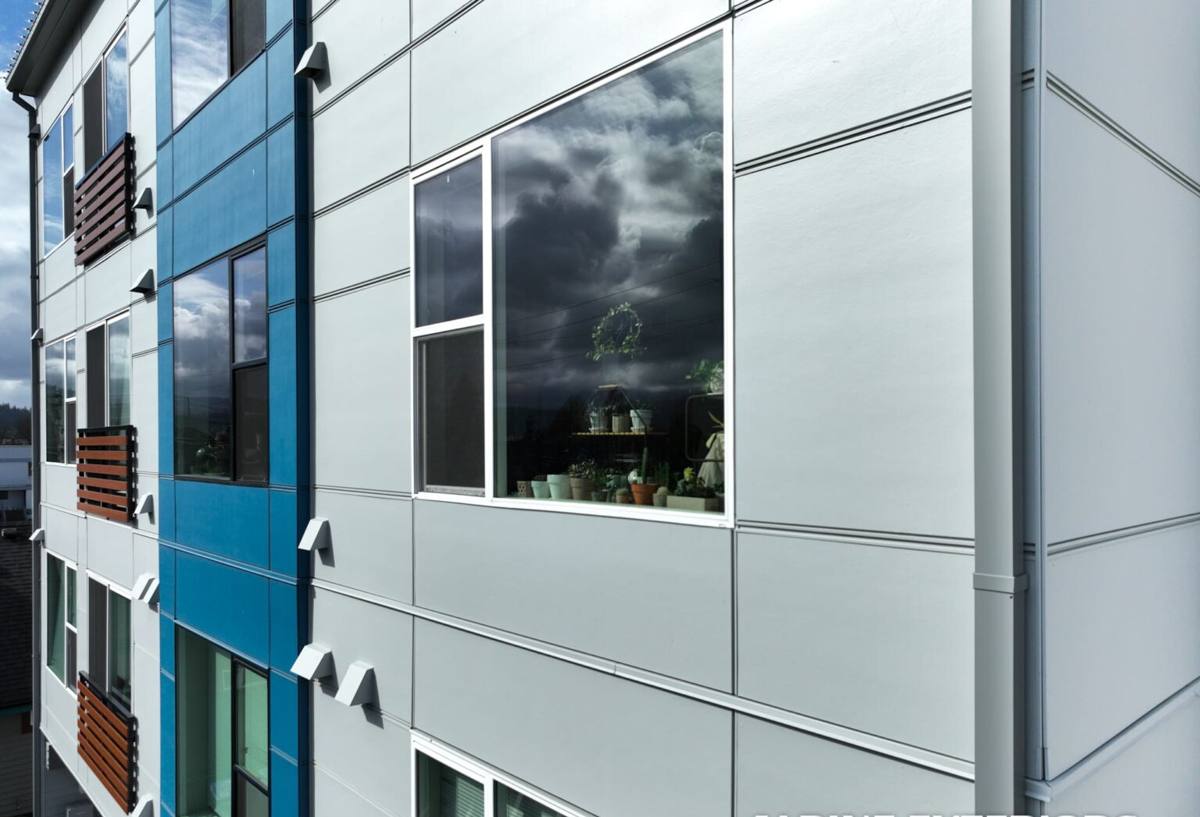
Why Bellingham's Climate Drives the Details
Three things about this area shape how we approach every new-construction window install:
Driving Rain
Storms coming off the water push rain sideways, not just down. That means a window flashing detail that would be fine in a drier inland climate isn't good enough here — every lap, every seam, and every fastener penetration has to shed water downward and outward, with no reliance on caulk alone to keep it dry.
Salt Air
Coastal and near-coastal air in this part of Whatcom County carries salt that accelerates corrosion on fasteners, hardware, and unprotected metal flashing. We pay attention to fastener and flashing material selection for that reason, not just for the window frame itself.
Moss and Prolonged Dampness
The long moss season here isn't just a roof and siding issue — it's a sign of how long surfaces stay wet in this climate. Any gap in flashing or sealant that would dry out quickly in a drier region can stay damp for weeks, which is exactly the condition that rots sheathing and framing behind a window that wasn't sealed correctly.
What a Correct Installation Involves
A new-construction window installation is really a sequence of layers, each one lapped over the next so water is always directed outward and down, never trapped behind the wall assembly. On a typical Bellingham project, that sequence looks like this:
- Rough opening prep — checking the opening is square, plumb, and sized correctly before the window ever gets set.
- Sill pan flashing — a sloped, sealed pan at the bottom of the opening that catches any water that gets past the window and directs it back outside, rather than into the wall cavity.
- Jamb and head flashing — integrated with the WRB in the correct shingle-lap order so water always runs over, not under, each layer.
- Window set and fastening — nailing fin secured per the manufacturer's fastening schedule, with the frame checked for level, plumb, and square before final fastening.
- WRB integration — house wrap or building paper lapped over the flanges and taped or sealed so the window becomes part of a continuous drainage plane, not a break in it.
- Interior and exterior sealant — compatible, non-conflicting sealants at the right joints only — sealing every seam solid without a way for incidental moisture to drain out can trap water rather than shed it.
Every one of those steps matters on its own, but it's the order and the overlap that actually keeps water out. Skipping the sill pan, or sealing the bottom of the window instead of leaving it able to drain, is one of the most common errors we see behind siding on homes that develop rot years later.
What Happens When It's Done Wrong
Water problems from a poorly installed window rarely show up right away. In this climate, they show up two, five, even ten years later — as soft trim, stained drywall below a window, or rot in the sheathing that isn't visible until siding comes off for another project. By the time it's visible, the repair usually involves more than the window itself: replacing damaged sheathing, framing, and insulation, not just resealing a joint. Getting the flashing sequence right the first time is dramatically cheaper than fixing what a bad install causes later.
Material and Product Considerations
Frame material affects how a window holds up to Whatcom County's damp, salty air over the long run. We don't push one brand over another — the right choice depends on budget, the home's design, and how exposed the elevation is to weather. Here's how the common options generally compare for a coastal Washington build:
| Frame Material | Moisture Behavior | Maintenance | General Cost Position |
|---|---|---|---|
| Vinyl | Won't rot or corrode; performs well in damp climates | Low — occasional cleaning | Most economical |
| Fiberglass | Very stable in moisture and temperature swings; strong long-term option | Low | Mid to upper range |
| Wood / Wood-Clad | Attractive interior look, but exterior wood or clad joints need consistent upkeep in wet, salt-air conditions | Higher — finish and joint maintenance | Higher |
| Aluminum | Durable but prone to condensation and slower to insulate against cold unless thermally broken | Moderate — watch fastener corrosion near salt air | Mid range |
Whatever frame material a homeowner or builder chooses, we treat the flashing and drainage details as non-negotiable — the window itself is only as good as the water management built around it.
Our Process for New-Construction Projects in Bellingham
Most of our new-construction window work comes through builders and general contractors, though we also work directly with homeowners managing their own build or addition. Either way, the process is straightforward:
- Review the plans and window schedule so quantities, sizes, and rough openings are confirmed before framing is finalized
- Coordinate timing with the builder — windows go in after sheathing and WRB are up, before siding starts
- Install sill pans, flashing, and windows following manufacturer specs and best-practice sequencing for this climate
- Integrate flashing with the WRB so the drainage plane stays continuous behind the future siding
- Walk the job with the builder or homeowner before siding closes everything in, so any question can be answered while it's still visible
Because siding is our core trade, we think about window flashing the same way we think about siding water management — as one continuous system, not two separate trades that happen to meet at the same wall.
A Checklist Before You Hire Anyone for This Work
Whether you use us or another contractor, these are worth confirming before new-construction windows go in on a Bellingham project:
- Does the installer use sill pan flashing on every window, not just sealant at the sill?
- Can they explain their flashing lap sequence in plain terms — where each layer overlaps the next?
- Do they coordinate directly with the WRB installer or siding crew so the drainage plane isn't broken?
- Are they following the specific window manufacturer's fastening and flashing instructions (this affects warranty coverage)?
- Have they installed windows on other homes in this same coastal, high-rainfall climate — not just inland or drier-region work?
Why Local Experience in This Climate Matters
A flashing detail that works fine in a drier part of the state can fail here within a few wet seasons. Crews who work regularly in Whatcom County's marine climate know to treat driving rain, salt air, and extended dampness as the baseline, not the exception — it changes fastener choices, sealant selection, and how much margin gets built into every lap and overlap. That's the difference between a window install that's technically installed and one that's actually built for where it sits.
Timing and Scheduling Around the Weather
New-construction window installs go faster and hold up better when they're scheduled around drier stretches rather than squeezed in during the wettest months. We work with builders to sequence window installs at the right point in the build — sheathing and WRB complete, siding not yet started — and we plan around Whatcom County's wetter, mossier months where possible so sealants and flashing tapes cure properly instead of being applied to damp or marginal surfaces.
If you're building new or adding on in the Bellingham area and want windows installed with the flashing and drainage detail this climate actually requires, we're happy to walk the plans with you and provide a free, no-pressure estimate — just fill out the form below.