 Birch Bay Siding
 James Hardie Siding for Bellingham Homes
Bellingham sits close enough to Birch Bay and the Salish Sea that homes here deal with the same coastal punishment: salt-laden wind off the water, long stretches of driving rain, and a moss season that can run from October through May. Siding that isn't built for this combination fails early — not always dramatically, but in ways that add up: swelling seams, peeling paint, soft spots behind trim, and a north wall that never quite dries out. We install James Hardie fiber cement siding specifically because it's engineered to hold up against exactly this kind of weather, and we do the work with a crew that's already out in Whatcom County neighborhoods on a regular basis, not just passing through for one job.
This page focuses on one service in one area: James Hardie siding installation and replacement for homes in and around Bellingham. If you're comparing products or deciding whether it's time to replace, this is meant to give you a straight answer grounded in what actually happens to siding here.
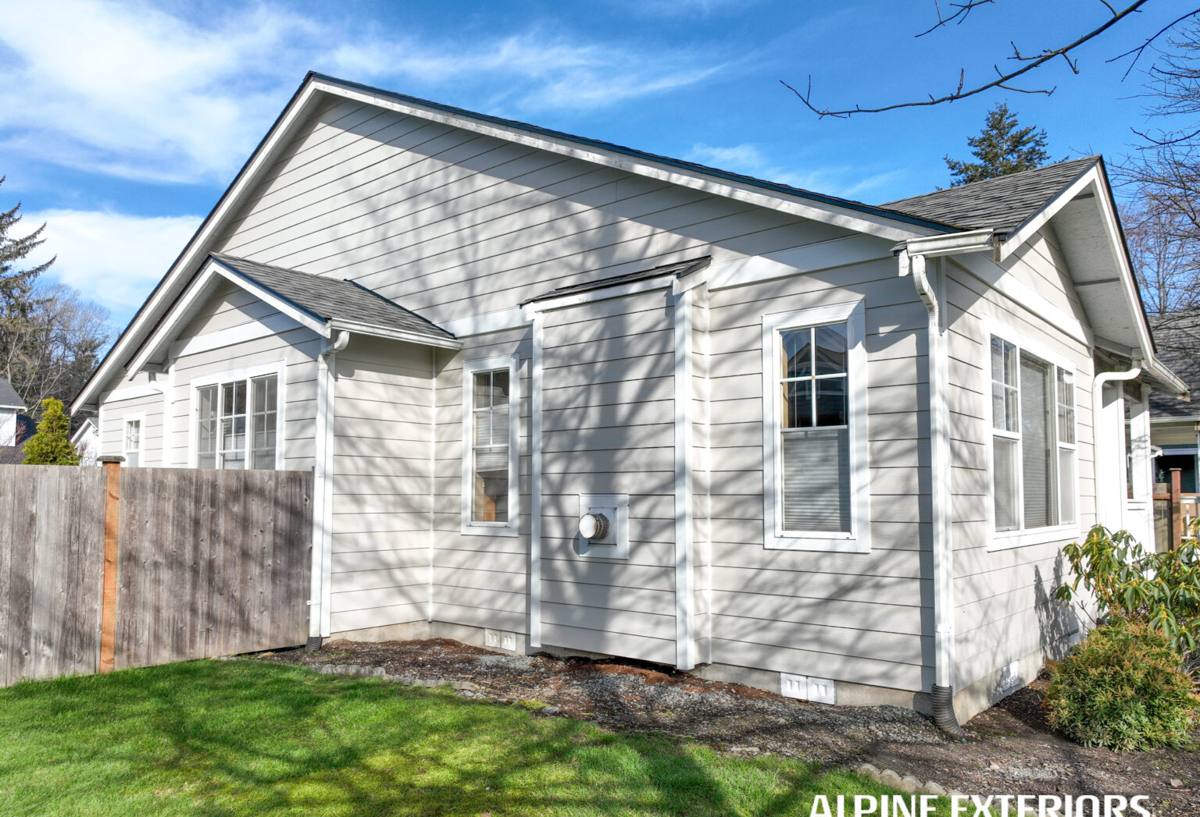
What Bellingham's Climate Actually Does to Siding
Salt Air and Moisture
Proximity to the water means airborne salt settles on exterior surfaces year-round, and it doesn't just sit there — it draws moisture. Combined with our marine layer and frequent fog, siding on the exposed sides of a Bellingham home spends more hours per year in a damp state than siding almost anywhere inland. Wood-based products absorb that moisture cycle after cycle; the material itself expands and contracts, which is what eventually cracks paint film and opens up seams for water to get behind the board.
Driving Rain
Wind-driven rain off the Sound doesn't fall straight down — it hits siding at an angle, working its way behind poorly lapped boards, under loose caulk, and into any gap around trim and penetrations. A siding system's water-management details (how boards overlap, how flashing is integrated, how joints are sealed) matter more here than in calmer inland climates because the water pressure against the wall is genuinely higher during a real Pacific storm.
Moss and Prolonged Dampness
Our moss season is long. Anywhere shaded, north-facing, or tucked under overhangs stays damp long enough for moss and algae to establish on siding surfaces, especially anything with a porous or textured factory finish. Moss holds moisture directly against the material, which accelerates whatever rot or paint failure was already starting underneath.
Why We Only Install James Hardie
We made a decision to install James Hardie fiber cement exclusively — not vinyl, not LP SmartSide, not Cemplank, Allura, primed spruce, or cedar. That's not a marketing position, it's a standard we hold because of what we've seen these products do (and not do) in exactly the climate Bellingham sits in.
- Vinyl expands and contracts significantly with temperature swings, and its seams and J-channels give wind-driven rain an easy path behind the panel. It also doesn't hold paint, so a color change later means full replacement.
- Wood-based composite products (LP SmartSide and similar) use engineered wood strand as their core. Wood strand can absorb moisture at cut edges and fastener points, and in a climate with this much sustained dampness, edge sealing has to be flawless and stay flawless for decades — a hard bar to clear.
- Other fiber cement brands (Cemplank, Allura) are a similar material category to Hardie but don't carry the same regional-specific product engineering or the same factory finish warranty structure we've come to rely on for coastal Washington installs.
- Primed spruce and cedar are honest, attractive materials, but they're wood — they need repainting on a real schedule, and in a marine climate that schedule compresses. Skipping a repaint cycle here has consequences faster than it would somewhere drier.
James Hardie fiber cement is non-combustible, dimensionally stable (it doesn't swell and shrink the way wood or wood-composite does), and available in the HZ5 product line engineered for climates like ours. Its ColorPlus factory finish is baked on under controlled conditions, which holds up to UV and moisture far better than field-applied paint, and it comes with a strong transferable warranty when installed to the manufacturer's specification. Standardizing on one product means our crew installs it constantly, knows its details cold, and doesn't have to relearn a different water-management system for every job.
What Correct Installation Looks Like Here
Fiber cement's reputation depends entirely on installation quality. A correctly installed Hardie job and a poorly installed one can look identical on day one and behave completely differently by year five. In a climate like Bellingham's, a few details matter more than others:
Water Management Behind the Siding
Every wall needs a proper weather-resistive barrier and correctly integrated flashing at windows, doors, and any penetration. Fiber cement is durable, but it's not a substitute for a wall assembly that manages bulk water — the siding is the outer layer of a system, not the whole system.
Clearances and Gaps
Hardie's own installation instructions specify minimum clearances from grade, roof lines, decks, and other flat surfaces, plus gaps at butt joints and around trim that get sealed with the right sealant — not caulked tight with no room to move. Skipping these clearances is one of the most common ways we see fiber cement installs fail early, and it's invisible until moisture starts finding its way in.
Fastening
Fasteners need to hit framing correctly and be set to the right depth — not overdriven, not underdriven — and using the fastener type Hardie specifies for the product line and climate zone, not whatever's on the truck.
Cut-Edge Sealing
Factory edges come primed, but every field cut exposes raw material that needs to be sealed before installation. In a climate with this much sustained moisture, an unsealed cut edge is a slow, quiet entry point for water.
Product Line and Cost Factors
Hardie offers several siding profiles and product lines, and the right choice depends on the home's exposure, style, and your budget. Below is a general comparison to frame the conversation — actual project pricing depends on square footage, trim complexity, tear-off scope, and site access, and we give an exact number after walking the property.
| Factor | What It Affects | Bellingham-Specific Note |
|---|---|---|
| Profile (lap, shingle, panel) | Look and installation labor | Lap siding is the most common match for existing Whatcom County home styles |
| Product line (HZ5, ColorPlus vs. primed) | Climate engineering and finish durability | HZ5 is engineered for wetter, more moderate climates like ours |
| Tear-off vs. new construction | Labor and disposal cost | Most Bellingham jobs are re-siding over old vinyl, wood, or aging composite |
| Trim and detail work | Water-management complexity | Homes with lots of window trim or roof intersections need more flashing detail |
| Site access | Labor time | Tight lots, slopes, or limited staging area add time |
Our Process
We walk every Bellingham property in person before quoting anything. That means looking at which walls take the worst weather exposure, checking existing moisture damage behind the current siding, and identifying any trim or flashing details that need attention before new siding goes up — because covering a moisture problem instead of fixing it just hides it for a while.
- On-site inspection and moisture check of the existing wall assembly
- Written estimate covering product line, profile, color, and full scope
- Removal of old siding and inspection/repair of sheathing and weather barrier
- Installation to Hardie's published specifications for clearances, fastening, and sealing
- Final walkthrough covering warranty registration and maintenance basics
Why Hiring a Bellingham-Familiar Crew Matters
A crew that regularly works Bellingham and the greater Whatcom County coastline already understands which walls on a typical home take the brunt of the weather, how moss tends to establish here, and what water-management details actually get tested by a real Pacific storm season — not a generic install checklist written for a drier climate. That familiarity shows up in the small decisions: where to add extra flashing, which clearances not to shortcut, and which walls deserve the most attention during inspection. It's the difference between a crew that's installed Hardie a handful of times and one that installs it as its only product, in this exact climate, on a regular basis.
Maintenance Once It's Installed
- Rinse siding annually to remove salt residue and organic buildup before it hosts moss
- Keep gutters clear so overflow doesn't run down and pool against siding at corners
- Trim back vegetation and tree cover that keeps shaded walls from drying out
- Recaulk joints and trim intersections if you notice separation or cracking
- Check for and address moss promptly on north-facing or shaded sections
- Have a professional inspect flashing and clearances every few years, especially after major storms
James Hardie siding installed correctly needs far less upkeep than wood or wood-composite alternatives, but "correctly installed" and "zero maintenance" aren't the same thing — a little seasonal attention goes a long way in this climate.
If you're weighing a siding replacement in Bellingham or anywhere nearby in Birch Bay and Whatcom County, we're happy to walk the property and give you a straight, no-pressure estimate — just fill out the form below.