 Birch Bay Siding
 Point Whitehorn's Coastal Climate Puts Roofs to the Test
Point Whitehorn sits close enough to the water that salt air is part of daily life, not an occasional nuisance. Combine that with the wind-driven rain that rolls off the Strait of Georgia and the long, damp moss season that Whatcom County is known for, and you've got a roofing environment that's noticeably harder on materials than what you'd deal with further inland. A roof that would hold up fine in a drier, more sheltered part of the state can start showing problems here years ahead of schedule.
Metal roofing, when it's specified and installed correctly for this exact environment, handles these conditions better than most other roofing options. But "metal roofing" isn't one product — it's a category, and the wrong choices within that category (the wrong fastener, the wrong coating, the wrong panel profile) will fail here just as fast as anything else. This page is about what actually matters for a metal roof going on a home in Point Whitehorn, not a generic rundown of metal roofing in general.
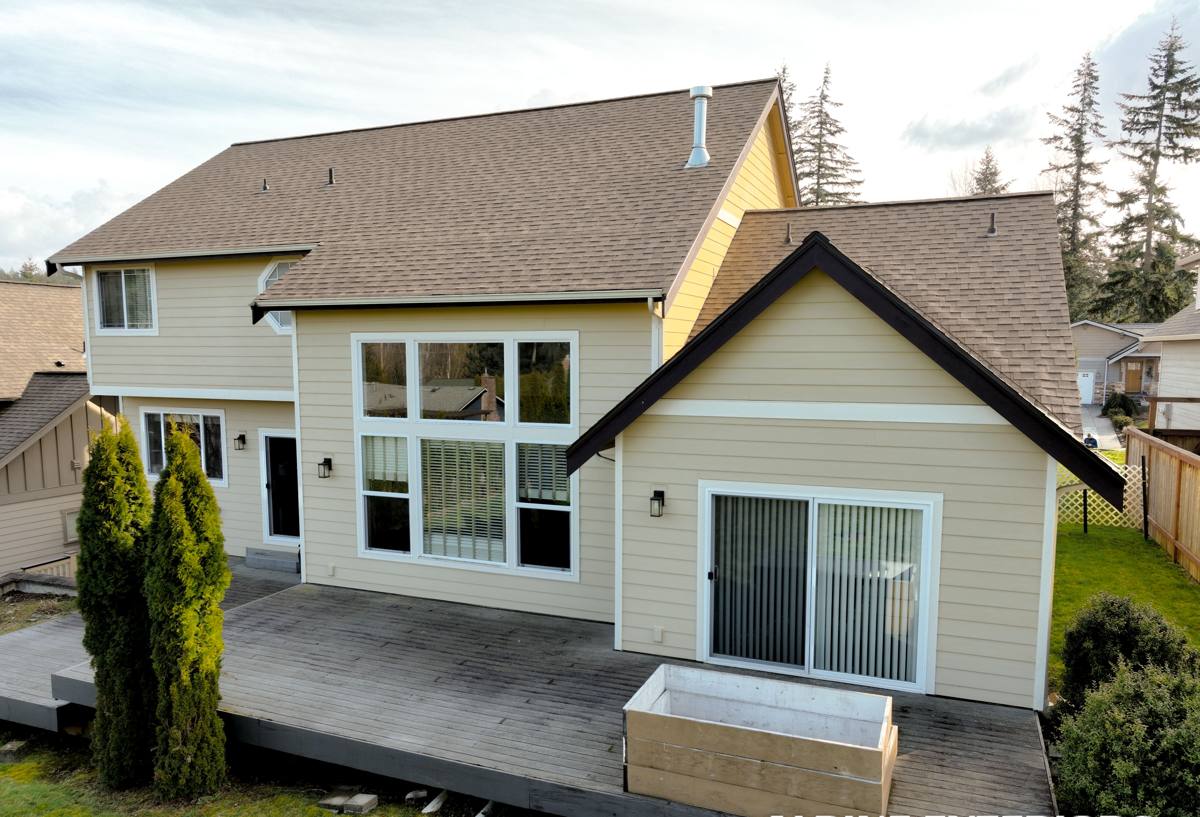
What Salt Air and Driving Rain Actually Do to a Roof
It helps to understand the specific failure modes before talking about solutions.
Salt Air and Corrosion
Airborne salt accelerates corrosion on any exposed metal — fasteners, flashing, panel edges, and cut ends where the protective coating has been compromised. On a roof close to the water, unprotected or under-spec'd steel components can start rusting at points of contact years before the field of the panel shows any wear. This is almost always a fastener and flashing problem before it's a panel problem.
Wind-Driven Rain
Normal rain falls mostly straight down and sheds off a roof the way it's designed to. Wind-driven rain comes in at an angle, sometimes nearly sideways during a coastal storm, and it finds every gap in a roofing system that wasn't detailed for it — lapped seams that are too shallow, flashing that relies on caulk instead of proper overlap, penetrations that weren't sealed with the wind direction in mind. A metal roof's biggest advantage in this kind of weather is that panel seams, when installed correctly, shed water far more reliably than shingles ever will.
Moss and Prolonged Moisture
Whatcom County's wet season runs long, and shaded or north-facing roof sections stay damp for weeks at a stretch. Moss doesn't damage metal panels the way it damages organic roofing materials, but it does trap moisture against fasteners, flashing, and roof-to-wall transitions, and it can hold debris that clogs drainage paths. A roof that isn't detailed to shed water and dry out quickly will fight moss and moisture problems indefinitely, regardless of the roofing material on top.
What a Correctly Installed Metal Roof Needs in This Environment
Fasteners and Flashing Rated for Coastal Exposure
This is the single biggest factor in how a metal roof performs near salt air, and it's also the easiest thing for a crew unfamiliar with the area to get wrong. Fasteners, flashing, and trim all need to be matched to the panel material and rated for coastal exposure — mixing incompatible metals invites galvanic corrosion, and standard-grade hardware simply doesn't hold up as long this close to the water. We spec fastener and flashing packages for coastal exposure as a standard practice on Point Whitehorn jobs, not as an upgrade.
Panel Seams and Overlap Built for Wind-Driven Rain
Panel seam type and overlap depth matter more here than in sheltered inland areas. A seam or lap that's technically watertight in calm rain can still let water in when it's being pushed sideways by wind. Correct panel selection and seam detailing for actual site exposure — not just "what's standard" — is part of doing this job right.
Underlayment and Ventilation
Metal panels are only one layer of the system. A quality synthetic underlayment underneath adds a second line of defense against wind-driven rain and ice-dam-style backup at eaves and valleys. Proper roof ventilation matters just as much — a roof deck that can't breathe stays damp longer after every rain event, which shortens the life of the underlayment, the fasteners, and eventually the panels themselves.
Choosing a Metal Roofing System for Point Whitehorn
Not every metal roofing product is a good fit for a coastal, high-moisture site. The table below reflects the trade-offs we walk homeowners through.
| System | Coastal/Salt-Air Suitability | Moss & Moisture Resistance | Typical Lifespan | Notes |
|---|---|---|---|---|
| Standing seam steel (quality coating) | Strong, when fastener/flashing package is matched | Excellent — sheds water fast, no organic growth on the panel itself | 40-plus years | Our default recommendation for most Point Whitehorn homes |
| Aluminum standing seam | Very strong — naturally corrosion-resistant | Excellent | 40-plus years | Good option where salt exposure is especially heavy; typically a higher upfront cost |
| Exposed-fastener metal panels | Fair — depends heavily on fastener quality and maintenance | Good | 20-30 years | Lower upfront cost, but fasteners need periodic inspection and eventual replacement |
| Standard-grade galvanized panels/hardware | Weak this close to the water | Fair | Shortened by coastal exposure | We don't recommend this for Point Whitehorn sites; corrosion risk outweighs the savings |
The right answer depends on the specific home — roof pitch, how exposed it is to the wind off the water, existing structure, and budget. That's a conversation we have on-site, not a one-size answer.
Why We Don't Recommend Standard-Grade Hardware Near the Water
We get asked from time to time why we won't cut costs with standard galvanized fasteners or basic flashing on a coastal job. It comes down to our own standard, not a knock on the product in general — standard-grade hardware is fine in a lot of settings, just not this one. Near salt air, the maintenance burden and premature failure risk on lower-grade components isn't worth the short-term savings, because replacing corroded fasteners on a finished roof is far more expensive than specifying the right hardware the first time. We'd rather walk a homeowner through the real cost difference upfront than have them deal with rust streaks and loosening panels five years in.
Our Process for a Point Whitehorn Metal Roof
- On-site assessment. We look at pitch, exposure to prevailing wind and salt air, existing roof condition, ventilation, and drainage — not just the roof, but how the house sits relative to the water and tree cover.
- System recommendation. Based on that assessment, we recommend a panel type, gauge, coating, and fastener/flashing package suited to the specific exposure level of that home, and explain the trade-offs in plain terms.
- Tear-off and deck check. We remove the old roofing and inspect the deck for moisture damage before anything new goes down — installing a new roof over a compromised deck just hides the problem.
- Underlayment and flashing. Quality synthetic underlayment and coastal-rated flashing go in at every valley, penetration, and wall transition — these details are where roofs actually fail, not usually in the field of the panel.
- Panel installation. Panels are installed with correct seam overlap and fastener spacing for the site's wind exposure.
- Final walkthrough. We review the finished roof with the homeowner, including what maintenance (if any) to expect going forward.
Signs Your Current Roof Is Falling Behind
A few things worth checking, especially on a roof that's due for attention:
- Rust streaks running down from fasteners, flashing, or panel seams
- Heavier moss buildup on north-facing or shaded roof sections than elsewhere
- Water stains on interior ceilings near valleys, chimneys, or wall transitions after wind-driven storms
- Loose, lifted, or visibly corroded fasteners
- Gaps or separation at flashing around vents, skylights, or roof-to-wall junctions
- Granule buildup or debris collecting in gutters after every rain, suggesting poor drainage off the roof
Any one of these on its own isn't necessarily an emergency, but they're worth a professional look before the next wet season.
Maintenance That Actually Matters After Installation
A correctly installed metal roof in this climate doesn't need much, but it's not zero-maintenance either. Keeping gutters and valleys clear of debris and moss growth prevents water from backing up under seams. A periodic visual check for loose fasteners or scuffed coating — especially after a bad windstorm — catches small issues before they become leaks. Beyond that, a well-detailed metal roof in Point Whitehorn should go long stretches without needing attention, which is a big part of why we recommend it here in the first place.
Why It Matters That We Already Work in Point Whitehorn
A roofing crew that hasn't worked this specific stretch of Whatcom County coastline doesn't necessarily know how much salt exposure a given lot actually sees, which sides of a roof take the worst of the wind-driven rain, or how aggressively moss builds up on shaded sections through the wet months. Those are details you learn from working the area repeatedly, not from a general roofing background. We bring that local knowledge into every recommendation — the panel type, the fastener package, the flashing details — instead of applying a generic spec and hoping it holds up.
If you're weighing a metal roof for a home in Point Whitehorn, or you're not sure whether your current roof is holding up the way it should against this coastal climate, we're happy to take a look and give you a straight, no-pressure estimate — just fill out the form below.